

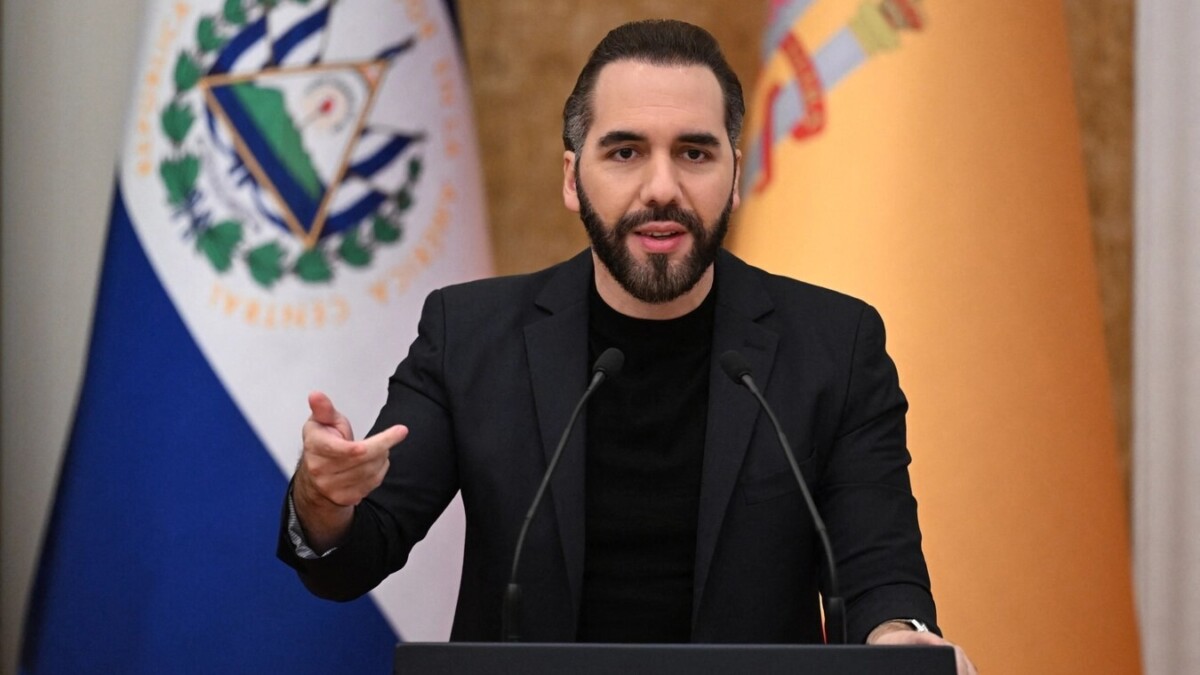
Two thousand five hundred Salvadoran soldiers deployed in Port-au-Prince, symbolic operations from the first days, and a president determined to export his tough method against gangs: El Salvador’s intervention in Haiti raises as much hope as concern.
The capture of Sylvio-Cator Stadium, in the heart of Port-au-Prince, is a signal. Controlled by gangs for two years, this emblematic site is now in the hands of Salvadoran soldiers, who have made it their operational base. In a few days, the 2,500 soldiers deployed by Nayib Bukele also retook the headquarters of the Haitian electricity company and a police station, while launching an operation against one of the country’s most influential gang leaders. The Salvadoran president himself commented on these advances on social media, promising Haitians that his intervention is “neither an operation against the Haitian people nor an invasion.”
Originally, the deployment had a more limited objective: to find four soldiers missing while operating as part of the Gang Suppression Force (FRG), under a UN mandate. These men have still not been located. But Bukele quickly expanded the scope of his mission, openly aiming to reproduce in Haiti the security strategy that drastically reduced violence in El Salvador, at the cost of tens of thousands of arrests and numerous accusations of human rights violations.
In the streets of Port-au-Prince, the popular reaction is, for now, largely favorable. “Fear has changed sides”: this phrase circulates on Haitian social media and in street conversations. A demonstration in support of the Salvadoran soldiers was scheduled for Tuesday, November 17. After the repeated failure of successive multinational forces, part of the population sees in this intervention an unprecedented chance to regain control of the capital.
However, many shadows remain. The Salvadoran soldiers do not operate under the UN mandate that governs the FRG: they therefore act without the rules of engagement and accountability mechanisms typical of a classic international force. Amnesty International has already called on both governments to “ensure that all operations by Salvadoran forces respect human rights” and to allow civilians to report any abuse “without fear of reprisals.”
The security situation on the ground is also particularly complex. Several forces now coexist in Haiti: the FRG under UN mandate, the Haitian police and army, Salvadoran soldiers, and mercenaries from the private company founded by Erik Prince, the creator of Blackwater. This fragmentation of armed actors is considered potentially counterproductive by observers.
Fundamentally, the transposition of Bukele’s method to Haiti faces considerable structural obstacles. Haitian gangs are better armed and more powerful than those in El Salvador. Above all, Haiti lacks the judicial system and prison infrastructure that allowed the Salvadoran president to massively incarcerate gang members in his country. The risk of stalemate is real.
Bukele nevertheless seems to have obtained Donald Trump’s approval to launch this operation, even if there are divergences within the U.S. administration. Secretary of State Marco Rubio has been very cautious on the subject, and the U.S. chargé d’affaires in Haiti reportedly sent a diplomatic note protesting the lack of coordination between Salvadoran soldiers and the FRG. Despite these reservations, an intervention of this scale cannot be conceived without at least tacit support from Washington. It corresponds in any case to a certain Trumpian vision of international relations: subcontracting the fight against organized crime, outside any UN framework, without excessive constraints related to human rights.
For Nayib Bukele, who describes himself as the “coolest dictator in the world,” the stakes go beyond Haiti: it is about establishing himself as a leading actor on the American continent, succeeding where the international community has so far failed. The visit of Haitian Prime Minister Alix Didier Fils-Aimé to El Salvador, scheduled for Monday to discuss the future of this deployment, was ultimately canceled, leaving several crucial questions about the duration and modalities of this intervention unresolved.



Respond to the article
Be the first to comment on this article.