

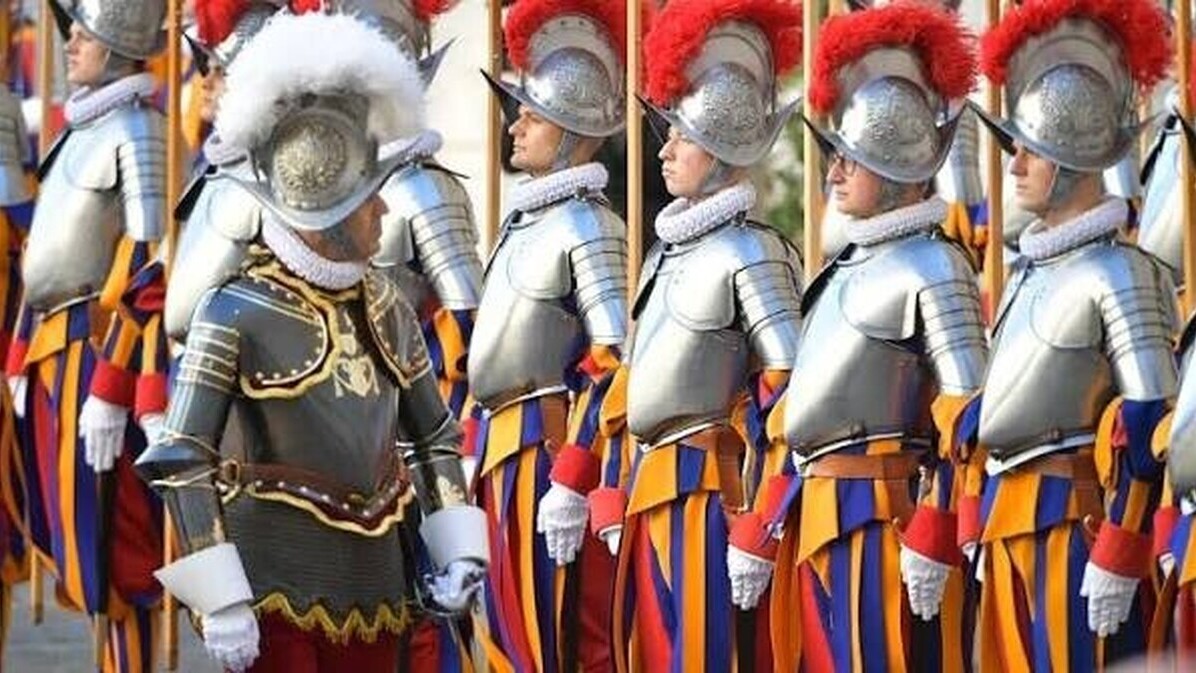
With their colorful uniforms, halberds, and military traditions, the Swiss Guards are among the most recognizable symbols of the Vatican. Yet behind their historic appearance lies a genuine security unit tasked with protecting the sovereign pontiff. For over 500 years, these Swiss soldiers have carried out a unique mission at the heart of the world’s smallest state.
It is impossible to visit the Vatican without noticing the soldiers dressed in blue, red, and yellow standing guard at the entrances of the Apostolic Palace. The Pontifical Swiss Guard is one of the oldest military institutions still active. Officially founded on January 22, 1506, it originated from Pope Julius II’s decision to call upon Swiss soldiers for his personal protection. At that time, Swiss mercenaries had a strong reputation in Europe for their discipline, courage, and military skills. Their presence in Rome was set against a backdrop of rivalries among European powers and conflicts surrounding the Papal States.
The history of this unit is notably marked by the Sack of Rome on May 6, 1527. During the assault led by Emperor Charles V’s imperial troops, 147 Swiss Guards died defending Pope Clement VII. Some surviving soldiers enabled the pontiff to reach Castel Sant’Angelo, where he found refuge. This episode has become one of the founding events in the corps’ memory. Even today, May 6 remains an important date for the Pontifical Swiss Guard, as new recruits traditionally take their oath on this occasion.
Particularly Strict Recruitment Conditions
Contrary to what their uniform might suggest, the Swiss Guards are not mere actors maintaining a tourist tradition. Their recruitment follows precise criteria. Candidates must be Swiss nationals, Catholic, male, and have completed basic military training in the Swiss army. They must also be in good physical condition, have an impeccable reputation, and meet the age and height requirements set by the corps. The minimum service commitment is generally 26 months, although some soldiers choose to extend their service.
Once recruited, the guards undergo training designed to prepare them for various security missions. This includes close protection exercises, intervention techniques, physical preparation, and learning Vatican-specific procedures. Knowledge of Italian also plays an important role in their integration. Recruits also learn about the functioning of pontifical institutions and the protocol requirements related to their mission. Their daily routine thus combines military discipline, professional training, and participation in official ceremonies.
A Historic Uniform Famous Worldwide
The Swiss Guards’ ceremonial uniform is probably one of the most photographed military outfits in the world. Its blue, red, and yellow stripes recall the colors associated with the Della Rovere and Medici families, who played important roles in the history of the papacy and the corps. A popular legend sometimes attributes its creation to Michelangelo, but this claim has no historical evidence. The current uniform was developed in the early 20th century, notably under the leadership of Commander Jules Repond, who drew inspiration from old depictions to give it its characteristic appearance.
During ceremonies, soldiers may wear a metal helmet adorned with a plume, a cuirass, and a halberd, a pole weapon once used by European infantry. These items contribute to the historical and ceremonial dimension of the Swiss Guard. However, the soldiers also have more discreet service uniforms adapted to daily necessities. The halberds are obviously not their only equipment: the guards are trained in the use of modern defense means. This dual identity, between Renaissance heritage and contemporary security demands, defines the uniqueness of this institution.
How Do the Swiss Guards Protect the Pope?
The main mission of the Pontifical Swiss Guard is to ensure the security of the pope, his person, and his residence. Its members control certain Vatican access points, monitor sensitive areas, and participate in protecting the sovereign pontiff during his travels. They may also intervene during official audiences and religious ceremonies. Their activity is coordinated with the Vatican City State Gendarmerie Corps, which is responsible for police duties, public security, and certain protection operations.
The pope’s security is a complex system involving several services. During foreign trips, the host country’s authorities also participate in protecting the sovereign pontiff, in collaboration with Vatican security officials. The Swiss Guards must therefore be able to adapt to very different environments, from solemn ceremonies to situations requiring heightened vigilance. Their work demands great discretion, especially due to their constant proximity to the head of the Catholic Church.
A Daily Life Between Military Discipline and Religious Traditions
The life of a Swiss Guard is not limited to the hours spent at the Vatican gates. The soldiers follow a schedule organized around guard duties, training, group activities, and personal life. Their commitment also has an important religious dimension, as the corps is directly linked to the protection of the sovereign pontiff. The guards participate in certain celebrations and live in an environment marked by Catholic traditions. This particularity distinguishes their mission from that of conventional armed forces, even though their operation relies on a hierarchical organization and strict military rules.
Over the centuries, the Pontifical Swiss Guard has endured the political and religious transformations of Europe without disappearing. It witnessed the end of the Papal States in the 19th century, the creation of the Vatican City State in 1929, and the successive evolutions of the papacy. Its continuation reflects the importance given to the continuity of the Holy See’s institutions and traditions. Today, these soldiers represent both an operational protection force and an element of European historical heritage. Behind their spectacular uniforms, they perpetuate a mission begun in 1506: to watch over the pope’s security.









Respond to the article
Be the first to comment on this article.