

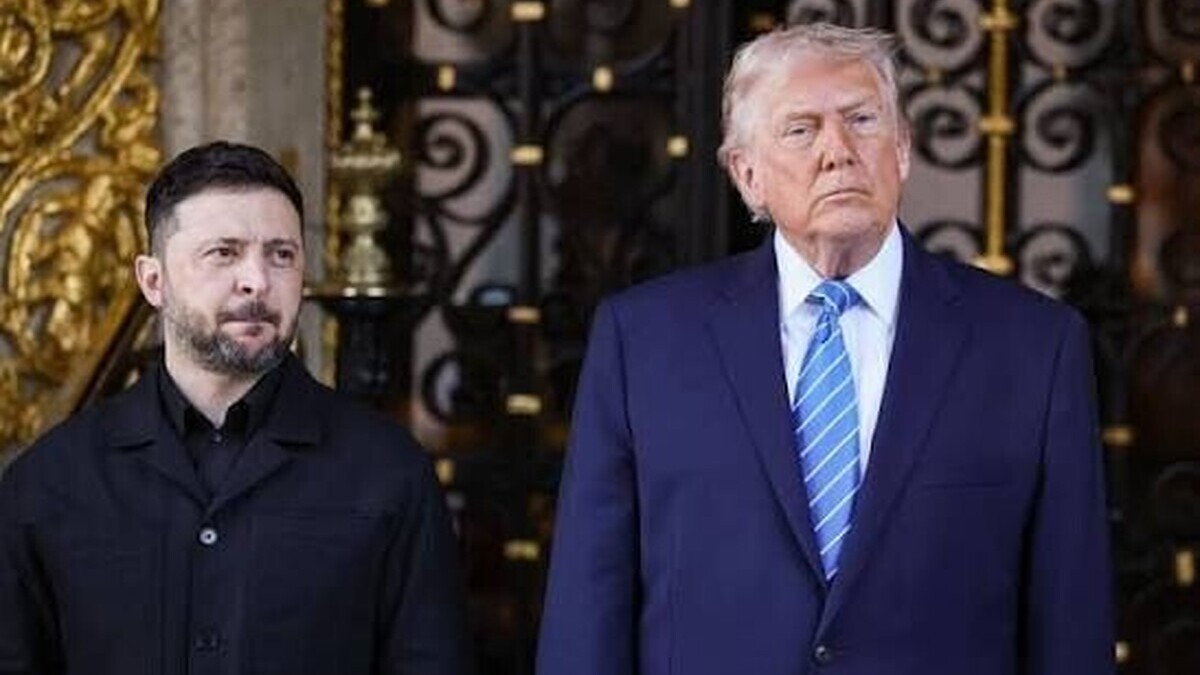
Volodymyr Zelensky revealed that American negotiators presented him with an unprecedented idea: Ukraine would join NATO on the condition that it withdraw from the Donbas territories still under Kyiv's control. Washington has neither confirmed nor denied this proposal.
This is a diplomatic avenue that no one had yet raised so openly. Ukrainian President Volodymyr Zelensky stated on Saturday that American envoys had asked him a question unprecedented in the negotiations: would Ukraine agree to withdraw from Donbas in exchange for NATO membership? "This is the first time this question has been raised," he clarified in remarks released by his office.
This revelation comes the day after an intense diplomatic sequence: Jared Kushner and Steve Witkoff, Donald Trump's two envoys, traveled to Dublin to meet with Zelensky, after holding talks in Moscow with Vladimir Putin . The talks also continued this week in Abu Dhabi, in a format bringing together all three parties.
Washington has not confirmed the Ukrainian president's remarks. A US official simply stated that "many ideas continue to be discussed" and that "any final agreement will have to be accepted by both sides." Kushner himself seemed to want to downplay the situation a few hours after Zelensky's statement, calling for "confidentiality" in a process he described as sensitive and deploring the disclosure of "maximalist" proposals.
Zelensky nevertheless specified the conditions under which he might submit such a proposal to his fellow citizens: it would require solid security guarantees, no restrictions imposed on the Ukrainian army, and funds for the country's reconstruction. If this were to happen, he would organize a referendum. He also reaffirmed his willingness to step down as president if NATO membership were achieved, noting that elections could be held in the months following a peace agreement, as the current martial law makes them impossible at present.
The question of Ukraine's accession to the Atlantic Alliance has been at the heart of tensions since the beginning of the conflict. Moscow is fiercely opposed to it and has made it one of the justifications for its invasion launched in February 2022. Russia currently controls approximately one-fifth of Ukrainian territory, including most of the Donetsk and Luhansk regions that make up the Donbas. It demands not only that Kyiv cede the areas it occupies, but also those it has not yet conquered, as well as Crimea, which it illegally annexed in 2014.
For their part, many NATO members remain reluctant to accept Ukrainian membership, and Kyiv itself considers this prospect unrealistic in the short term. Zelensky, however, seems to have chosen to make this discussion public in order to reopen a debate that many considered closed, stating that the issue is now "back on the agenda" within the context of an "extremely difficult conversation" on European security.
The signals sent by Moscow offer little indication of any softening of positions. Putin and Kremlin officials have maintained their usual demands: guaranteed neutrality for Ukraine, a reduction in its military capabilities, and territorial concessions. Russia is now talking about a "new European security architecture," a phrase that Kyiv interprets as an attempt to weaken the Atlantic Alliance.
Relations between Washington and Kyiv are also going through a period of high tension. Trump had asked Ukraine to suspend its strikes on Russian oil infrastructure to facilitate the delivery of Russian diesel to global markets. Zelensky then accused US officials of restricting access to the Starlink satellite service , used to coordinate Ukrainian military operations. Trump responded by stating that it was "time for Ukraine to have a new president."




Respond to the article
Be the first to comment on this article.