

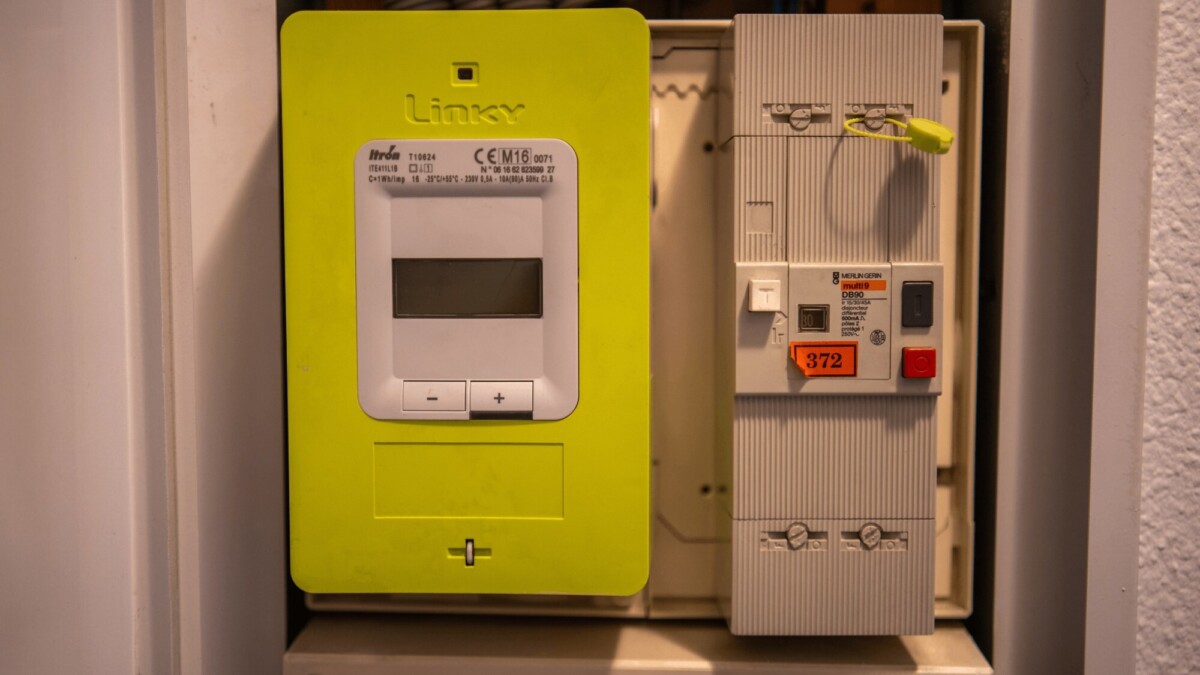
The Court of Justice of the European Union has ruled: European law does not guarantee any consumer the right to keep their old electricity meter. A decision that deprives opponents of the Linky meter of their last legal argument, while confirming that their data remains protected under the GDPR.
In a judgment issued on November 5, the Court of Justice of the European Union (CJEU) established that an electricity network operator « is not obliged to comply with the wish of an end customer » who wants to keep a traditional meter. The 2019 European directive on the electricity market does recognize consumers’ right to request a smart meter, but does not grant them any symmetrical right to refuse the replacement of their old device.
The case behind this ruling is Austrian: a customer opposed the installation of a digital meter citing the protection of her personal data and risks related to electromagnetic waves, while the calibration of her mechanical meter had expired at the end of 2023. Referred by the regional court of Sankt Pölten, the CJEU did not decide on the substance of the dispute, which will return to the Austrian courts. However, its interpretation of Union law is binding on all courts of the Member States.
For French households, the practical impact of the decision is limited, as the national legal framework has already settled the issue. The Energy Code entrusts network operators with the installation and renewal of meters, and the Court of Cassation itself ruled in favor of Enedis against two resistant customers in April 2025. The deployment of the Linky meter is almost complete: Enedis claims 38.7 million devices installed, covering more than 95% of served households. The European ruling mainly deprives opponents of a supranational legal argument on which some still hoped to rely.
Refusal remains materially possible when the meter is inside the dwelling, as the technician cannot access it without the occupant’s consent. However, this blockage has a financial cost. Since August 1, 2026, households not equipped by their own doing pay €6.68 excluding tax every two months, or €40.08 excluding tax per year, even if they submit their consumption readings. When no index has been communicated for more than a year, an additional charge of €4.27 excluding tax is added each period, bringing the annual bill to €65.70 excluding tax, or nearly €80 including all taxes. These fees are suspended as soon as an appointment is made for installation.
The CJEU also ruled on the personal data argument frequently raised by opponents. The Court considers that the « privacy and electronic communications » directive, which notably regulates the use of cookies on the internet, does not apply to an electricity network, whose primary purpose is energy distribution and not the provision of communication services. Consumption data remain subject, however, to the General Data Protection Regulation (GDPR), whose requirements « must necessarily be respected, » the Court specifies.
In France, the National Commission on Informatics and Liberty (CNIL) already regulates these practices. By default, Enedis only collects the household’s daily consumption. More detailed readings, hourly or half-hourly, which could reveal lifestyle habits or absences from the home, are collected only with the subscriber’s explicit consent, except occasionally for technical network needs. Their transmission to an energy supplier or a third party is also subject to prior agreement, and each subscriber can modify these settings at any time from their customer area.










Respond to the article
Be the first to comment on this article.