

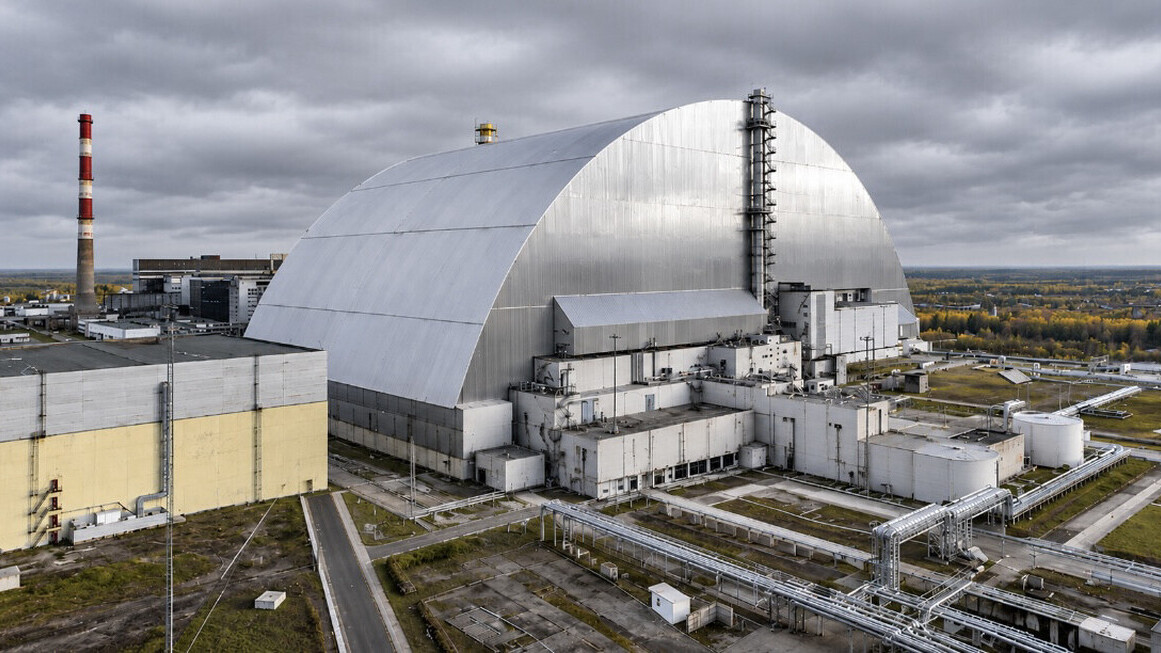
Forty years after the Chernobyl nuclear disaster, the containment structure of reactor number 4 needs to be repaired once again. The immense metal arch built to contain radioactive materials was severely damaged by a Russian drone strike in February 2025. Since then, the structure has lost some of its airtightness, and several pieces of equipment essential to its operation have been affected. This Monday, an international donors' conference is being held in Paris to raise the remaining €240 million needed to finance the repairs, the total cost of which is estimated at at least €500 million.
A Russian drone strike breached the reactor's protection.
On February 14, 2025, a Russian drone struck the containment arch covering the remains of reactor number 4 at the Ukrainian Chernobyl nuclear power plant, destroyed during the nuclear accident of April 26, 1986. The impact caused a fire and pierced the two layers of coating on the metal structure.
Approximately 200 m² of protective panels were damaged, including an opening of about 15 m². Several technical installations were also damaged, compromising the normal operation of this containment structure designed to prevent the dispersion of radioactive substances into the environment.
The structure no longer fully performs its two essential functions: containing radioactive materials present in the reactor ruins and allowing the safe dismantling of the old concrete sarcophagus built in haste after the 1986 disaster.
A gigantic arch designed to protect Chernobyl for 100 years
The Chernobyl arch is one of the largest nuclear containment structures ever built. Standing 108 meters high, 162 meters long and 257 meters wide, it weighs approximately 36,000 tons with its equipment.
Built near the damaged reactor, it was moved over the old sarcophagus in November 2016, before its final commissioning in 2019. Its construction required several years of work and considerable international financial mobilization.
The structure was designed to operate for at least 100 years. Its role is to isolate the radioactive materials still present on the site, to protect the installations against the elements and to allow, eventually, the dismantling of the unstable structures surrounding the remains of the reactor.
Its operation relies in particular on ventilation, humidity control, radiological monitoring, and handling systems. The loss of airtightness caused by the drone strike disrupts this system and exposes certain metal parts to an increased risk of corrosion.
No uncontrolled radioactive releases were detected, but protection measures were weakened.
Post-attack checks revealed no abnormal increase in radioactivity around the plant. Inspections also determined that the main load-bearing structures of the arch had not sustained critical damage.
The situation remains worrying, however. The metal containment structure has lost some of its containment capabilities, while the reactor ruins still contain highly radioactive materials.
The problem also involves humidity. The arch was designed to maintain internal conditions that limit the corrosion of its metal components. The openings caused by the attack disrupt this balance and can accelerate the structure's deterioration.
The repairs must therefore focus on the damaged panels, restoring the watertightness, and refurbishing the technical equipment. The objective is to restore all the safety functions of the installation without waiting for further deterioration of the structure.
Paris is hosting a conference to find the missing 240 million euros.
The French government, the Ukrainian government and the European Bank for Reconstruction and Development organised an international donors' conference this Monday at the Ministry of Economy in Paris.
The amount needed for the complete restoration of the arch is estimated at at least 500 million euros. The G7 countries, comprising Germany, Canada, the United States, France, Italy, Japan and the United Kingdom , have already announced the mobilization of 260 million euros.
Approximately €240 million still needs to be raised to finance the entire program. The conference is intended to secure new financial commitments from states and international institutions.
French Economy Minister Roland Lescure opened the discussions in the presence of Ukrainian representatives and the President of the EBRD, Odile Renaud-Basso. The European Commission and the United States were also among the participants.
The EBRD president had called on international partners to continue their mobilization: "We join the G7 in calling on the entire international community to contribute to these efforts."
France , which holds the G7 presidency in 2026, hopes to raise the necessary funds by spring 2027.
Work to be completed before 2030
The restoration of the arch must be completed by 2030 in order to limit the risks of corrosion and to preserve the originally planned lifespan of the structure.
The EBRD, which has coordinated a large part of the international programs to secure Chernobyl since 1995, has already helped to mobilize more than €2,5 billion in international financing for the site's facilities. It has also committed more than €700 million from its own resources.
An initial allocation of 30 million euros has been approved to prepare for the new operations, including technical studies and procedures necessary for the work.
The restoration of the arch will have to be carried out in a particularly challenging environment, above the ruins of a still-contaminated reactor. The operations will require specialized equipment and radiation protection measures for the personnel carrying out the repairs.
Forty years after the explosion of reactor number 4, Chernobyl remains a nuclear project of very long duration. The plant no longer produces electricity, but securing its facilities and managing the radioactive materials present on the site will have to continue for several decades.



Respond to the article
Be the first to comment on this article.