

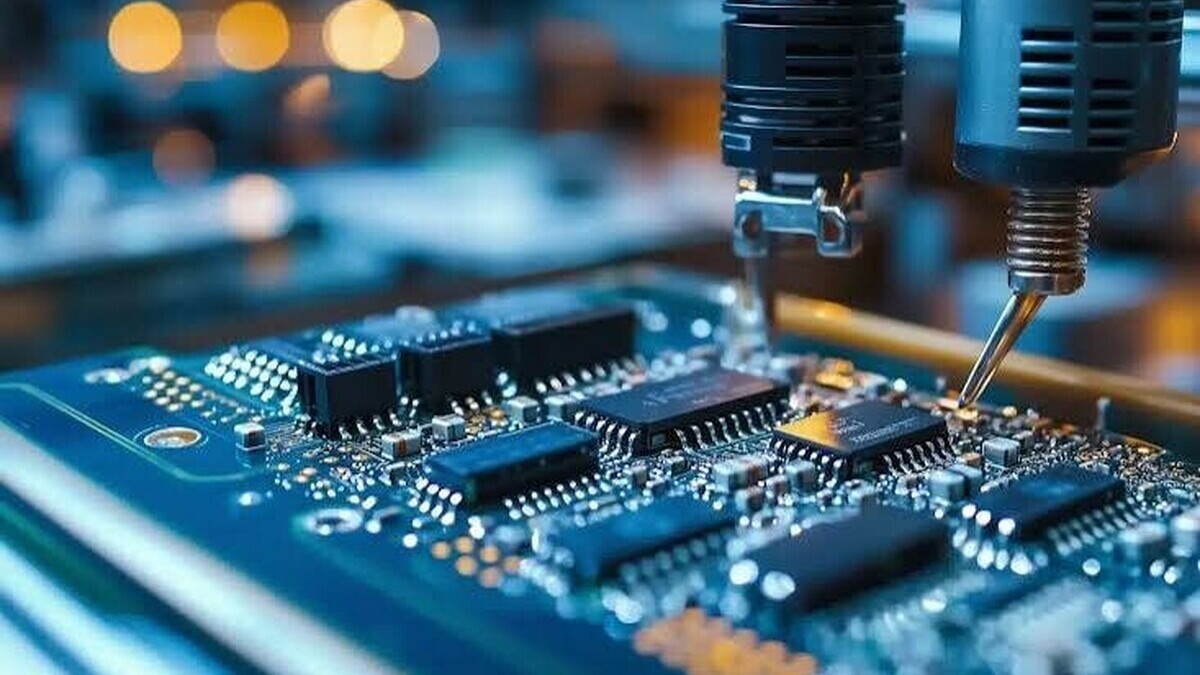
On Wednesday, November 4, 2026, the European Commission announced the launch of a semiconductor design platform mobilizing €525 million in investments. Aimed notably at start-ups and SMEs, this initiative is intended to enable European companies to access costly technologies and strengthen their position in an industry dominated by American and Asian players.
The European Union is taking a new step in its technological sovereignty strategy. The Commission presented the launch of the European electronic chip design platform, a scheme that will mobilize €525 million to support the emergence of new industrial players. This initiative is part of the European semiconductor regulation adopted to strengthen the continent’s capabilities in a sector that has become strategic.
The assessment made by Brussels is concerning. According to the Commission, European companies specialized in chip design currently represent less than 1% of global revenues in this segment. This weakness contrasts with the importance of semiconductors for the automotive, telecommunications, industry, defense, and artificial intelligence sectors. Europe has recognized expertise in several technological fields but struggles to transform certain innovations into companies capable of competing internationally.
Facilitating access to the most costly technologies
The new platform will provide companies with design tools, technical support services, and access to intellectual property components essential for processor development. It also aims to facilitate access to manufacturing capacities. These resources often represent a considerable investment for young companies, which must incur significant expenses even before they can market their products.
The goal is to reduce market entry barriers. A start-up specializing in chips for artificial intelligence, for example, should be able to design, test, and have its components manufactured without immediately having the financial means of a large international group. By pooling certain tools, Brussels hopes to accelerate the transition from research to industrial production.
An industry dominated by the United States and Asia
The global semiconductor chain relies on a complex organization. The United States holds a major position in processor design and specialized software. Taiwan and South Korea play an essential role in manufacturing the most advanced components. Europe, for its part, notably has significant companies in industrial equipment and certain specialized components.
This distribution creates economic and geopolitical dependencies. Trade tensions, export restrictions, and risks weighing on supply chains have heightened European governments’ concerns. The shortages observed in recent years have also shown the possible consequences of supply disruptions for car manufacturers and electronic equipment producers.
An investment that will not suffice on its own
For Henna Virkkunen, Executive Vice-President of the Commission in charge of technological sovereignty, the project must help young companies overcome the obstacles separating promising innovation from industrial realization. The initiative therefore does not only concern building factories: it seeks to strengthen European capabilities from the design phase.
The announced €525 million represent a significant effort but remain modest compared to global investments in semiconductors. The program’s success will notably depend on European companies’ ability to attract customers, private funding, and specialized skills. By supporting the design of new chips, Brussels hopes to develop a European industrial demand capable of complementing its manufacturing ambitions. However, reducing the continent’s technological dependence will be a long-term process.










Respond to the article
Be the first to comment on this article.