

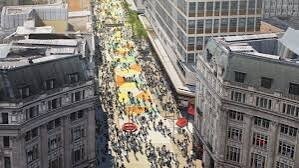
The famous London shopping street Oxford Street has just begun its transformation into a pedestrian zone, with the closure to traffic of a stretch of nearly one kilometer. This change could profoundly alter the outdoor advertising market, especially digital screens and billboards installed along the street. Between increased exposure time, new creative possibilities, and the disappearance of automotive audiences, industry professionals are assessing the consequences of this redevelopment.
Oxford Street is entering a new era. Since the last week of October 2026, a stretch of nearly one kilometer between Selfridges and IKEA has been closed to cars, buses, taxis, bicycles, and other vehicles. This first phase of the pedestrianization project led by London Mayor Sadiq Khan concerns one of the United Kingdom’s main shopping destinations. According to the city council, Oxford Street welcomes about 500,000 visitors daily and generates nearly £3.1 billion in annual spending. The timing of this transformation, a few weeks before Christmas, comes at a strategic period for retailers and advertisers. By the end of 2027, authorities plan to install more than 50 trees, two public squares, new lighting, and over 100 seats intended to make the street more pleasant.
For outdoor advertising players, or Out-of-Home (OOH), this transformation could reshuffle the deck. Oxford Street hosts numerous advertising devices, including JCDecaux’s digital screens, Backlight’s installations, and supports near Bond Street and Oxford Circus tube stations. The removal of buses and taxis mechanically leads to the disappearance of some mobile advertising supports but could enhance the visibility of fixed installations. Martin Pittendreigh, commercial director of the agency billups UK, believes that reducing visual clutter could improve the effectiveness of the remaining billboards. However, he points out that increased time spent on the street does not automatically guarantee greater attention to advertisements, as shop windows and commercial animations also serve as distractions.
From digital screens to new advertising experiences
Pedestrianization could also offer advertisers more creative freedom. JCDecaux’s D6 digital screens, previously associated with certain bus shelters, become standalone devices on the affected stretch. The absence of car traffic could allow for more animated creations, personalized content, and more dynamic advertising messages, subject to applicable rules. Brands could also take advantage of new public spaces to organize events, demonstrations, and experiential marketing operations. Several retailers, including John Lewis and Under Armour, see this redevelopment as an opportunity to strengthen their relationships with consumers beyond the simple shopping experience. Nicole Lonsdale, head of outdoor advertising at WPP Media UK, also believes this evolution could foster interactions between physical advertising and online commerce, notably through QR codes and interactive digital devices.
Advertising measurement specialists also anticipate a possible improvement in the value of existing locations. Mike Follett, general manager of Lumen, points out that pedestrians generally have more time than motorists to notice an advertising panel. Tim Sapsford, general manager of Posterscope, believes that the disappearance of vehicles and improved visual perspectives could strengthen campaign exposure. However, these hypotheses will need to be confronted with actual attendance and attention data. Professionals especially want to rely on Route’s audience measurements, retailer statistics, and observations made directly on site. The Christmas period may distort initial comparisons, so a more representative evaluation should be possible at the beginning of 2027.









Respond to the article
Be the first to comment on this article.