

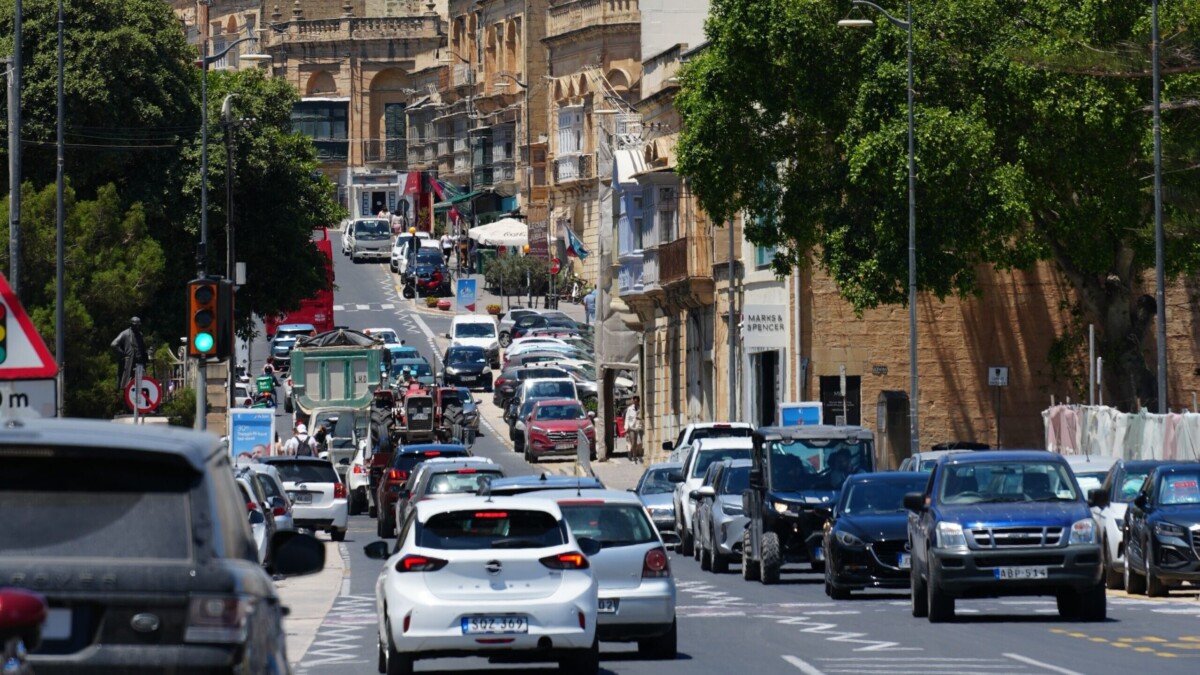
Receive €5,000 per year for giving up driving: this is the initiative launched by Malta to reduce traffic congestion. Aimed at drivers aged 30 or under, this measure can pay up to €25,000 over five years. An experiment that raises questions in Luxembourg, where the car still holds an important place despite free public transport.
Voluntarily giving up driving for five years in exchange for financial compensation: the Maltese government has chosen an original method to fight road congestion. The scheme provides for the payment of €5,000 per year to young drivers who agree to surrender their driving license. To qualify, candidates must be aged 30 or under, have resided in Malta for at least seven years, and have held their license for a minimum of twelve months. At the end of the five years, the total amount received can reach €25,000.
This initiative addresses a particularly important issue in the Mediterranean archipelago. Malta is among the European territories most affected by traffic jams, notably due to its high population density and the prominence of private vehicles. Authorities thus seek to reduce the number of drivers on the roads by offering a financial alternative to daily car use. Unlike traditional measures based on traffic restrictions or taxation, this policy relies on voluntary economic incentives.
In Luxembourg, an idea that revives the debate on the car
The Maltese experience draws attention in Luxembourg, where traffic difficulties also constitute a major issue. The Grand Duchy has about 670 cars per 1,000 inhabitants, placing it among the most motorized European countries. The vehicle fleet now exceeds 460,000 vehicles, while demographic growth continues to fuel travel needs. The road axes connecting main cities and business areas regularly experience slowdowns, especially during peak hours.
However, Luxembourg has a particular advantage: since 2020, national public transport has been free in second class. This policy aims to encourage travel by train, tram, and bus, while reducing dependence on private cars. But free transport alone does not solve all difficulties. In some rural municipalities, connections remain less frequent and journeys sometimes require several transfers. For people working irregular hours or living far from main networks, the car remains considerably important.
Travel habits that are gradually evolving
The Luxmobil 2025 study nevertheless highlights some changes in travel habits. Nearly eight out of ten residents declare themselves satisfied with their daily trips, while carpooling and the use of public transport are growing faster than individual car use. These trends show that a transformation of practices is possible, even if they have not yet resulted in a reduction of the vehicle fleet. Population growth and professional travel continue to support demand for private vehicles.
Implementing the Maltese scheme in Luxembourg would raise several questions. A €25,000 bonus could attract some young drivers living in areas well served by public transport. Conversely, it would probably be less attractive for residents of remote municipalities, families with particular constraints, or people whose professional activity requires regular travel. The effectiveness of such a measure would therefore largely depend on the quality of available transport solutions.
An expensive measure whose effectiveness remains to be demonstrated
Beyond its cost to public finances, the Maltese program also raises the question of its long-term effects. Beneficiaries could resume driving after five years, which might limit lasting changes in mobility habits. Authorities should also assess whether participants in the scheme actually used their car regularly before giving it up. Without these elements, it would be difficult to precisely evaluate the traffic reduction achieved through financial aid.
The experience nevertheless illustrates an evolution in public transport policies. Rather than only seeking to limit car use through bans or taxes, some governments explore mechanisms designed to reward alternative behaviors. This approach could inspire other territories facing traffic jams, provided they take into account their geographic, economic, and social characteristics.
Freedom of movement, a central issue
For many drivers, the car is not only a means of transport but also a form of autonomy. It allows reaching the workplace, accompanying children, or traveling in areas where public transport remains insufficient. Even significant financial compensation does not guarantee that drivers will accept giving up their license. The success of such a program depends notably on the alternatives available and the beneficiaries’ ability to organize their daily lives without a personal vehicle.
For Luxembourg as for Malta, the central question ultimately remains that of freedom of movement. Financial compensation can encourage some drivers to change their habits, but it does not necessarily replace an efficient and accessible transport network. The future of these policies will depend as much on investments in infrastructure as on the authorities’ ability to offer solutions adapted to residents’ daily needs.
Clarify the exact status of the licenseTighten speculative passages










Respond to the article
Be the first to comment on this article.