

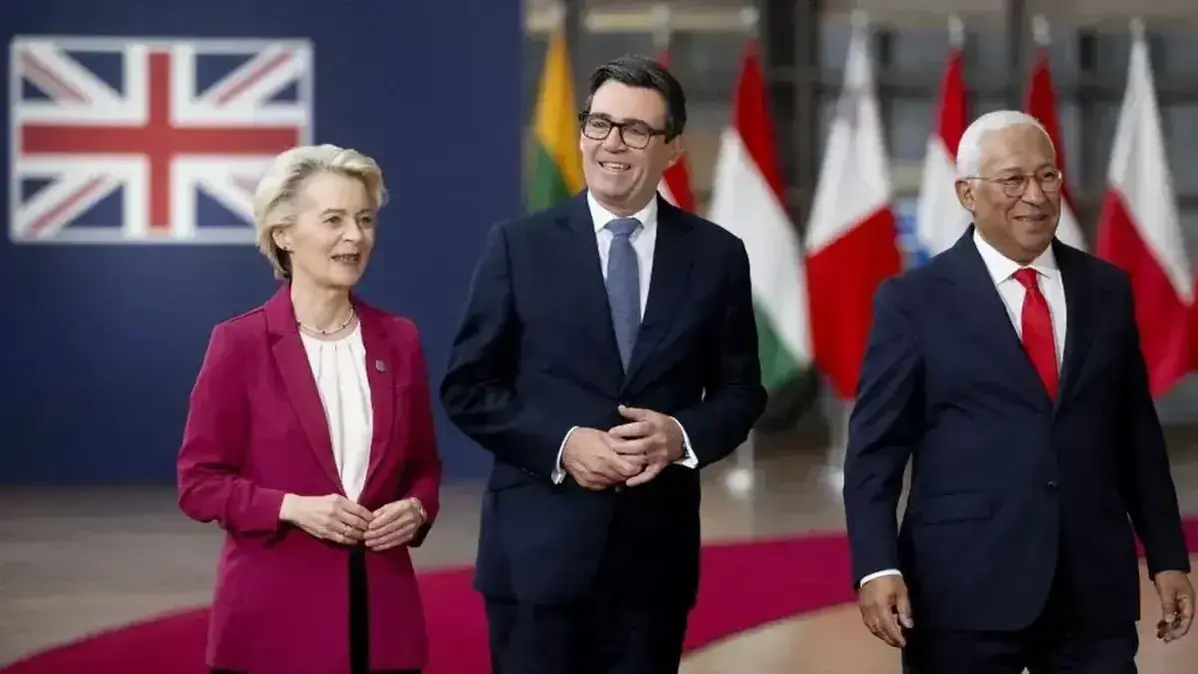
The European Union and the United Kingdom announced on Friday, November 20, a new agreement aimed at strengthening their cooperation. Ten years after the British referendum on Brexit, both parties present this progress as a turning point in their relations. The rapprochement comes as London and Brussels seek to improve their exchanges and jointly address several economic and strategic challenges.
Relations between the United Kingdom and the European Union are entering a new phase. Meeting in Brussels, British and European representatives reached an agreement described as historic. This announcement comes ten years after the June 23, 2016 referendum, during which British voters chose to leave the European Union.
Since the United Kingdom’s effective exit, relations between London and Brussels have been marked by lengthy commercial and institutional negotiations. The new exchange modalities have created administrative constraints for many companies, while several cooperation issues have remained central to discussions.
A desire to overcome Brexit tensions
The announced rapprochement reflects a political will to stabilize bilateral relations. The United Kingdom remains a major economic partner of the European Union member states. Trade in goods, financial services, research, and security cooperation are among the areas in which both parties maintain common interests.
British and European companies are particularly attentive to the practical consequences of this new agreement. The reduction of administrative barriers and the improvement of regulatory predictability can help facilitate exchanges. However, the real effects will depend on the precise provisions adopted and their implementation schedule.
A rapprochement that does not mean a return to the European Union
The new agreement should not be confused with the United Kingdom rejoining the European Union. London retains its status as a third country and its own institutions. The announced rapprochement aims to deepen cooperation in specific areas without necessarily calling into question the fundamental principles of the British exit.
The question of sovereignty remains central in British political debate. Successive governments have had to reconcile economic expectations of rapprochement with the European Union and the political consequences of the 2016 referendum. The new negotiations fit within this balance.
Ten years after the vote in favor of Brexit, the Brussels agreement marks a desire to build a closer relationship. Its historic scope will, however, need to be assessed based on the concrete measures implemented. For citizens and businesses, the main challenge will be to determine whether this strengthened cooperation simplifies exchanges and reduces some difficulties that have appeared since the separation.







Respond to the article
Be the first to comment on this article.