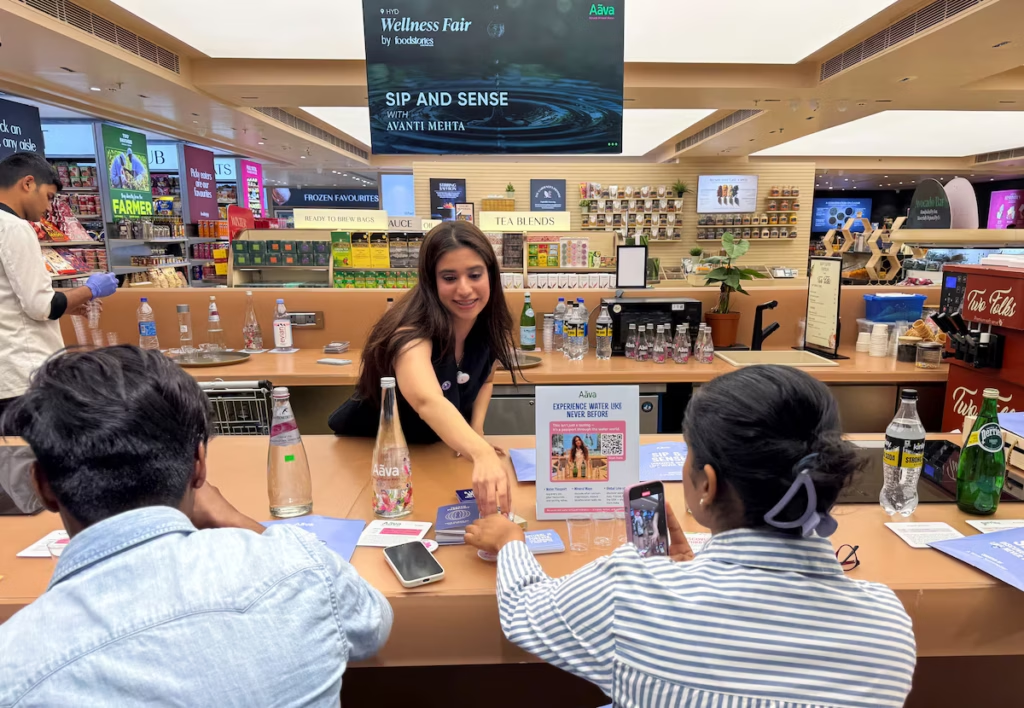
In India, a new social status marker is emerging among the wealthiest: water. In gourmet stores and at private events, blind tastings now compare mineral waters from France, Italy, or Indian springs, evaluated for their minerality, salinity, or carbonation, much like fine wines.
In Hyderabad, Avanti Mehta, 32, presents herself as the country’s youngest water sommelier. Her family owns the Indian brand Aava, sourced from the foothills of the Aravalli mountains. For her, choosing water is not trivial: “They all have a different taste. It is important to choose water that provides nutrients,” she explains during tasting sessions.
This phenomenon occurs in a particular context: tap water is not potable in most parts of the country. According to researchers, nearly 70% of groundwater is contaminated, and deaths linked to polluted water have recently been reported. In this country of 1.4 billion inhabitants, bottled water is therefore a basic necessity, sometimes sold for just a few cents.
But the premium segment, valued at around $400 million, is experiencing rapid growth. High-end Indian mineral waters cost about one dollar per liter, while imported brands often exceed three dollars, up to fifteen times the price of the cheapest bottles. According to Euromonitor, premium waters now represent 8% of the Indian bottled water market, compared to barely 1% in 2021.
Demand is driven by affluent consumers concerned about their well-being. In New Delhi, real estate developer BS Batra states that his family drinks only premium mineral water: “We feel more energetic. Even with whiskey or for the children’s smoothies, we use this water,” he explains.
The market also attracts industrial groups and celebrities. The conglomerate Tata Consumer Products is expanding its portfolio of premium waters, while established players like Pepsi and Coca-Cola still dominate the low-cost water segment. Imported brands such as Danone with Evian, or Nestlé with Perrier and San Pellegrino, remain positioned in a niche market, penalized by high customs duties.
Tata notably focuses on its “Himalayan” brand, bottled at the foot of the Himalayas from natural springs, and plans to expand its range, including sparkling water. Premium water sales tripled last year in some gourmet store chains, prompting distributors to import foreign references sometimes sold out within days.
While enthusiasm is real, price remains a barrier for many. “It’s an interesting experience, but too expensive for daily use,” admits a participant at a tasting. Still, in an India facing often unsafe tap water, premium bottled water is increasingly establishing itself as a symbol of comfort, health… and luxury.