

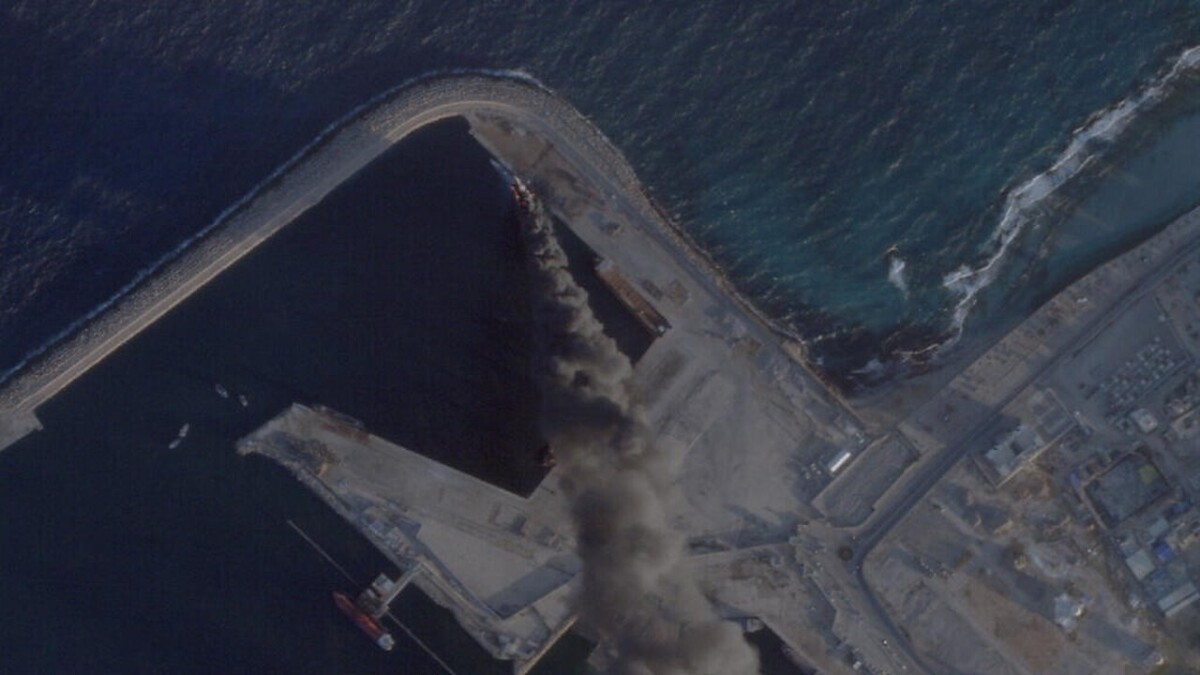
The Benghazi naval base was the scene on Sunday, November 22, 2026, of two successive attacks by maritime drones targeting a Russian ship and a second vessel whose flag has not been officially confirmed. No claims have been made so far.
It was on the morning of Sunday, November 22, that the first information began to circulate from Benghazi: an explosion, then a fire, reported in what initially appeared to be an ammunition depot at the naval base. The reality proved more complex. The eastern Libyan government specified in a statement that the explosion occurred aboard a Russian ship docked at the port, and that the initial elements of the investigation pointed to an attack by maritime drones.
The affected vessel, the Russian corvette “Merkury,” was calling at Benghazi to refuel and resupply before heading back to Russia, as part of bilateral cooperation agreements. Satellite images showed the ship capsized following the presumed strike.
Civil protection initially asked residents not to approach the area. The fire was then brought under control and the site secured. The eastern authorities sought to reassure: the port, the naval base, and their depots remained intact, and activities resumed normally. A thorough investigation was opened in coordination with Russian authorities to establish the origin of the attack and identify those responsible.
That same evening, a second ship was targeted in the same port. The Ministry of Health of the eastern authorities indicated that injured crew members were receiving care, without specifying their number. According to local media sources, this second vessel reportedly flew the Maltese flag. The Libyan naval and air forces also announced having intercepted more than a dozen underwater explosive devices off Benghazi.
These events occur in the context of an increase in long-range Ukrainian strikes against Russian interests. The day before, a Russian cargo ship had been hit by a drone in the Baltic Sea. In early March, a Russian methane tanker sank off the Libyan coast following a strike Moscow attributed to Kyiv.
Both Libyan governments reacted with similar caution. The eastern government recalled that Libya “is not a party to the Russo-Ukrainian war” nor to any armed conflict outside its borders. The Tripoli government, recognized by the UN and led by Abdelhamid Dbeibah, rejected any attempt to turn the country into a battleground for foreign powers’ score-settling, affirming its refusal to allow the use of its ports and territorial waters for military or logistical purposes that could threaten Libyan sovereignty. It warned against hosting “illegitimate foreign forces” which, according to it, would pave the way for an extension of external conflicts on Libyan soil.
Libya remains deeply divided since the fall of Muammar Gaddafi in 2011, with on one side the Tripoli government and on the other the eastern authorities, under the authority of Marshal Khalifa Haftar’s clan and based in Benghazi.







Respond to the article
Be the first to comment on this article.