

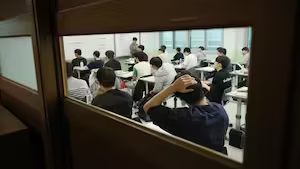
South Korean Education Minister Choi Kyo-jin resigned on Sunday, November 22, following a controversy surrounding the risk of artificial intelligence cheating during exams. The controversy prompted a hasty tightening of oversight measures for the national university entrance exam, a particularly important test in the country.
The scandal erupted following revelations about a candidate who achieved an exceptional score on a national tax accounting exam. He admitted to using a miniature camera and a smartphone to fraudulently obtain answers. This confession sparked widespread concern just days before the Suneung, the university entrance exam taken annually by hundreds of thousands of candidates.
Faced with the risk of cheating, education authorities have decided to strengthen controls on electronic devices and equipment that could be concealed. These last-minute changes have drawn criticism from candidates, their families, and the staff responsible for supervising the exams. The minister acknowledged that his administration had not adequately anticipated the new opportunities for fraud offered by digital technologies.
A resignation that reveals the challenges of artificial intelligence
Choi Kyo-jin ultimately chose to assume political responsibility for this situation by resigning. His resignation comes after the national exam, held on Thursday, November 19. Authorities indicated that the exams proceeded without major incident, despite difficulties encountered during their preparation.
This crisis highlights the challenges facing education systems in the face of developing artificial intelligence. Tools capable of rapidly analyzing questions and generating answers can be misused to circumvent exam rules. In South Korea , where academic success plays a crucial role in career paths, the issue of equality among candidates has become a major political concern.








Respond to the article
Be the first to comment on this article.