

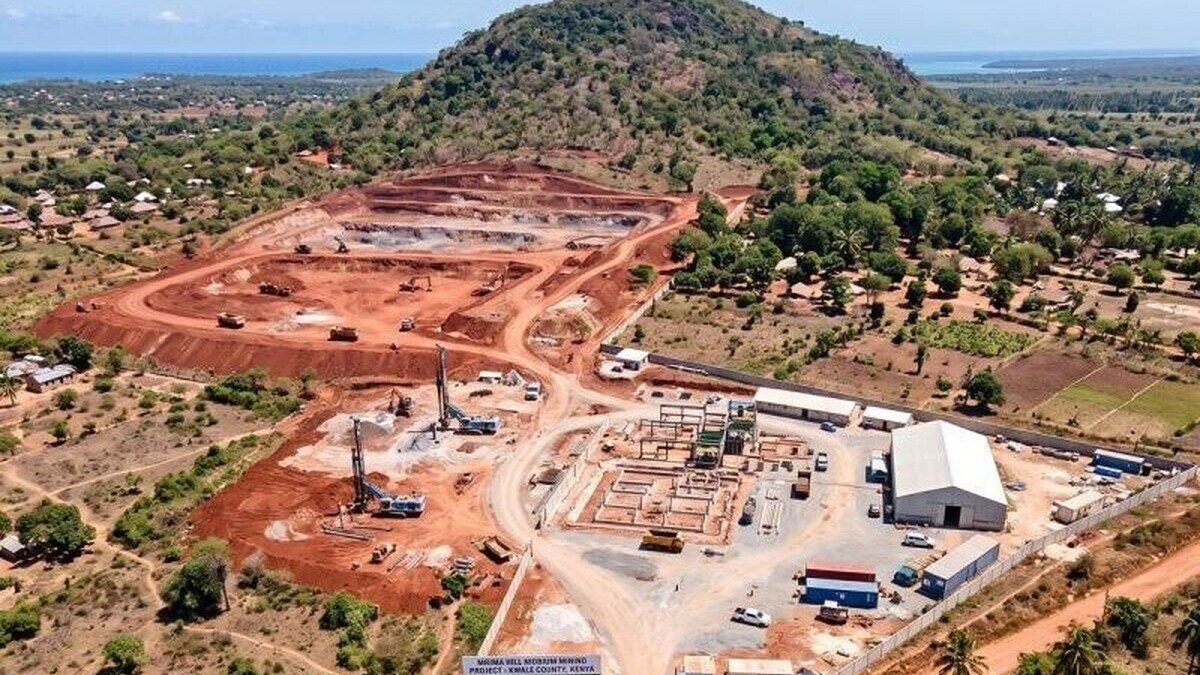
Kenya has designated a consortium of four American companies as the preferred candidate to develop a major critical minerals project at Mrima Hill, in Kwale County. The site, which notably contains niobium and rare earth elements, attracts interest amid international competition for resources essential to modern technologies. However, the project already raises concerns among local populations, who fear its environmental and land-related impacts.
Kenya could become a more significant player in the global supply of strategic minerals. Authorities have selected the Frontier Minerals Consortium, a group of four American companies, as the preferred bidder for a project located at Mrima Hill on the country’s south coast. This decision marks a step in the process of selecting an investor but does not yet grant permission to exploit the deposit.
The site is known for its niobium and rare earth resources, two categories of raw materials that are particularly sought after. Niobium is notably used in certain metal alloys, while rare earth elements are involved in the manufacture of many industrial and technological devices. Their growing importance makes these resources a major economic and geopolitical issue.
The United States seeks to secure its supplies
The interest of American companies in the Kenyan site is part of an international competition around critical minerals. These resources are essential to several strategic sectors, including electronic equipment, energy technologies, and certain defense industries. Their extraction and processing are currently concentrated in a limited number of countries.
For Washington, diversifying supply chains is a priority. Mining investments in Africa can help reduce dependence on certain dominant suppliers. For Kenya, exploiting these resources could represent an opportunity to attract capital and develop industrial activities, subject to favorable economic and environmental conditions.
Locals fear the project’s consequences
At Mrima Hill, the prospects of exploitation raise questions. Residents and farmers report a lack of information about the project’s modalities. They are particularly concerned about risks of displacement, loss of farmland, and potential environmental impacts.
The site also has significant cultural importance. The sacred forest of Mrima Hill is associated with the traditions of local communities, notably the Digo. Community leaders highlight the presence of sites linked to their ancestors and fear that mining exploitation could harm this heritage.
A designation that does not constitute a mining permit
Kenyan authorities have clarified that the selection of the American consortium does not automatically grant the right to extract minerals. The companies will need to initiate the necessary procedures, request appropriate authorizations, and meet the consultation requirements of the affected populations.
This distinction is essential in a case already marked by controversies. A previous attempt to develop mining on the site faced environmental and legal obstacles. The new efforts will therefore need to take into account the difficulties that prevented the project’s completion.
An economic sovereignty issue for Nairobi
The Kenyan government must now reconcile several objectives. Exploiting critical minerals could generate investments, jobs, and public revenues. But benefits will depend on contractual conditions, available infrastructure, and the share of added value retained in the country.
The issue of local processing of resources will be particularly important. Several African countries now wish to move beyond the model of primarily exporting raw materials. Developing processing industries could allow them to better benefit from global demand.
For Kenya, Mrima Hill thus represents both an opportunity and a challenge. The designation of the Frontier Minerals Consortium opens a new phase, without guaranteeing that exploitation will begin. The project’s future will depend on authorizations, environmental studies, and dialogue with local communities. In the global race for strategic minerals, Nairobi will need to demonstrate that foreign investments can be accompanied by effective protection of its territories and populations.









Respond to the article
Be the first to comment on this article.