

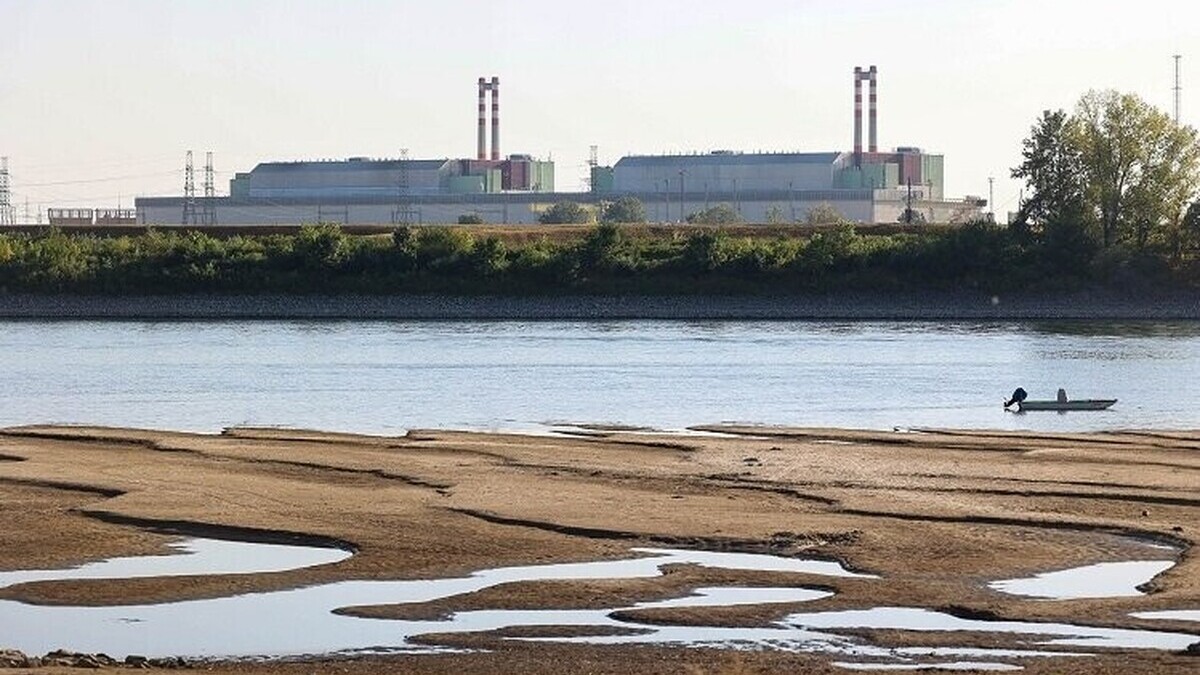
The drop in river levels caused by summer droughts is putting pressure on European nuclear power plants. In France, Hungary, and Romania, several reactors have had to be shut down or reduced in output due to a lack of water available for cooling.
Three French reactors were shut down on Tuesday, August 4: the two units at the Chooz nuclear power plant in the Ardennes region, and one reactor at Cattenom in the Moselle region. EDF cited the drop in the flow of the Meuse and Moselle rivers. For Chooz, the shutdown stemmed from a 1998 Franco-Belgian agreement that mandates reactor shutdowns below a certain flow threshold. "It's a water-sharing agreement," summarized Valérie Faudon, general delegate of the French Nuclear Energy Society. Elsewhere, the shutdowns were in accordance with thermal discharge regulations designed to protect aquatic flora and fauna.
France has 57 nuclear reactors, which cover nearly 70% of its electricity production. All are located along rivers or on the coast, with the water used to cool the facilities before being returned to the environment, either entirely or with more than 90% of the water released, depending on the systems used. Despite ongoing shutdowns, Valérie Faudon emphasizes that "France remains in a significant surplus": the country even broke a record for electricity exports in the first half of 2026, according to figures from the grid operator RTE.
The situation is far more critical in the east of the continent. In Hungary, the Paks power plant, fed by the Danube, nearly shut down completely, an unprecedented event in its 44 years of operation. Engineers managed on Monday to keep at least one turbine running. This plant usually supplies a third of Central Europe's electricity needs. Budapest plans to limit the shortfall by restricting industrial consumption and importing electricity.
In Romania, the Cernavoda nuclear power plant, also cooled by the Danube, required the intervention of the national navy. On August 3rd, the navy carried out controlled explosions on rocks in the Bala Canal to direct water towards the site. One reactor nevertheless had to be shut down.
The Danube is also hitting Serbia: one dam has seen its production divided by five, and the country's hydroelectric power plants have lost up to 20% of their capacity.
These difficulties are fueling the debate on the long-term reliability of nuclear power in the face of climate change. Roger Spautz, nuclear campaign manager at Greenpeace France and Luxembourg, believes that "nuclear power is not a solution for combating climate change." He predicts increasingly longer shutdowns: "In the future, reactor shutdowns will no longer be a matter of one, two, or three weeks as is currently the case, but of much longer periods, during which some regions will no longer be able to rely on their power plants."
The Explore2 research program, coordinated by INRAE, projects an average 15% drop in low water levels on French rivers by 2050, with more pronounced declines in the south of the country. Paul Dorfman, a research associate at the University of Sussex and president of the Nuclear Consulting Group, believes that technical solutions remain limited. Long presented as a controllable energy source, nuclear power is, in his view, becoming a "victim of climate," subject to weather conditions just like solar or wind power.
Proponents of nuclear power cite examples of adaptation, such as the Palo Verde plant in Arizona, which is cooled with treated wastewater from the Phoenix area. But these cases remain marginal. In Europe, the share of nuclear power in the electricity mix remains stable at 23%, while renewables increased from 37,4% to 47,5% between 2020 and 2024, now accounting for the bulk of the sector's decarbonization.








Community
Comments
Write a comment
Be the first to comment on this article.