

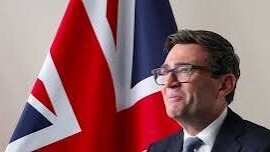
A few days before a summit between London and the European Union, UK Prime Minister Andy Burnham intends to deliver a critical assessment of Brexit. In a speech scheduled for Monday, November 16, he is expected to acknowledge that the UK has lost more than it has gained since leaving the EU. The Labour government leader now aims to strengthen economic relations with Brussels without challenging the main red lines set by his party.
Brexit is back at the center of British political debate. Six years after the UK’s effective exit from the European Union, Andy Burnham is preparing to publicly acknowledge the limitations of the agreement negotiated with Brussels. During the traditional banquet of the Lord Mayor of London on Monday, November 16, the Prime Minister is expected to denounce the consequences of a Brexit he considers unnecessarily rigid, especially for British businesses facing new trade barriers.
According to excerpts of his speech released before his intervention, Andy Burnham is expected to compare the current agreement to the tale of « The Emperor’s New Clothes, » in which no one dares to acknowledge an obvious reality. « The Brexit we were given has not worked. We have lost more than we have gained, » he is set to declare. A particularly striking statement for a head of government now seeking to redefine relations between London and its European partners.
A rapprochement with Brussels without rejoining the European Union
The Prime Minister wishes to initiate a new phase of cooperation with the European Union. A summit scheduled for Friday is expected to conclude several agreements notably on food trade, energy, and youth mobility. These negotiations continue the rapprochement initiated by his predecessor, Keir Starmer, who secured a first agreement with Brussels in May 2025.
Andy Burnham nevertheless intends to uphold several commitments made by the Labour Party during the 2024 general elections. He rules out rejoining the single market, the customs union, or free movement of people. The stated goal is rather to improve trade conditions and facilitate certain exchanges without challenging the principle of the UK’s exit from the European Union.
Three conditions for a new agreement
The head of government is expected to present three criteria to guide the negotiations. The first concerns respecting Labour’s electoral commitments. The second, called the « Makerfield test, » requires that new agreements produce tangible improvements in the daily lives of Britons. Finally, the third demands that arrangements made with Brussels be more advantageous than the initial agreement and more aligned with the expectations expressed during the 2016 referendum.
For Andy Burnham, this approach should help move away from a permanent confrontational logic with the European Union. He wants to prioritize a constructive relationship based on seeking common interests and resolving shared economic difficulties. The Prime Minister believes a pragmatic rapprochement can benefit both parties, especially in a context of international competition and trade tensions.
Agreements expected on food and energy
Discussions between London and Brussels focus on several sectors particularly affected by Brexit’s consequences. A draft agreement notably aims to reduce sanitary and administrative controls imposed on food and agricultural products traded between the UK and the EU. These formalities have been a source of additional costs for some exporting companies for several years.
Other texts concern cooperation on carbon markets and the creation of a system facilitating work and travel stays for young people. The precise terms of these agreements remain to be finalized. The UK government wants to achieve progress likely to simplify exchanges while preserving its ability to define its own economic and migration policies.
Conservatives denounce excessive rapprochement
This new direction has sparked strong criticism from the opposition. The Conservative Party accuses Labour of wanting to gradually bring the UK closer to the European Union without directly consulting voters. Its vice president, Alex Burghart, notably reproaches the government for considering new financial contributions to Brussels while the country faces budgetary and economic difficulties.
Reform UK also defends Brexit’s gains, particularly London’s ability to free itself from certain European regulations. The party believes that too much regulatory alignment could limit the UK’s commercial autonomy. Conversely, the Liberal Democrats consider the proposed agreements insufficient and demand rejoining the single market as well as creating a new customs union with the European Union.
An ongoing debate on the UK’s European future
British environmentalists also advocate for a closer rapprochement with Brussels. The Green Party of England and Wales notably wishes to join the customs union, while its leader Zack Polanski considers that full re-entry into the European Union would be the preferred long-term option.
Andy Burnham adopts a more cautious stance. While he wants to examine the advantages and disadvantages of different forms of cooperation with Brussels, he rules out a major transformation of institutional relations before the next general elections. His government therefore favors a series of sectoral agreements rather than a general renegotiation of the UK’s status.
Friday’s summit will represent an important step in this strategy. For London, the challenge is to reduce economic obstacles inherited from Brexit without immediately reopening the debate on possible European reintegration. By acknowledging that the UK has lost more than it has gained, Andy Burnham mainly intends to justify a change in approach: preserving the sovereignty claimed since 2016 while rebuilding closer commercial and diplomatic relations with the European Union.








Respond to the article
Be the first to comment on this article.