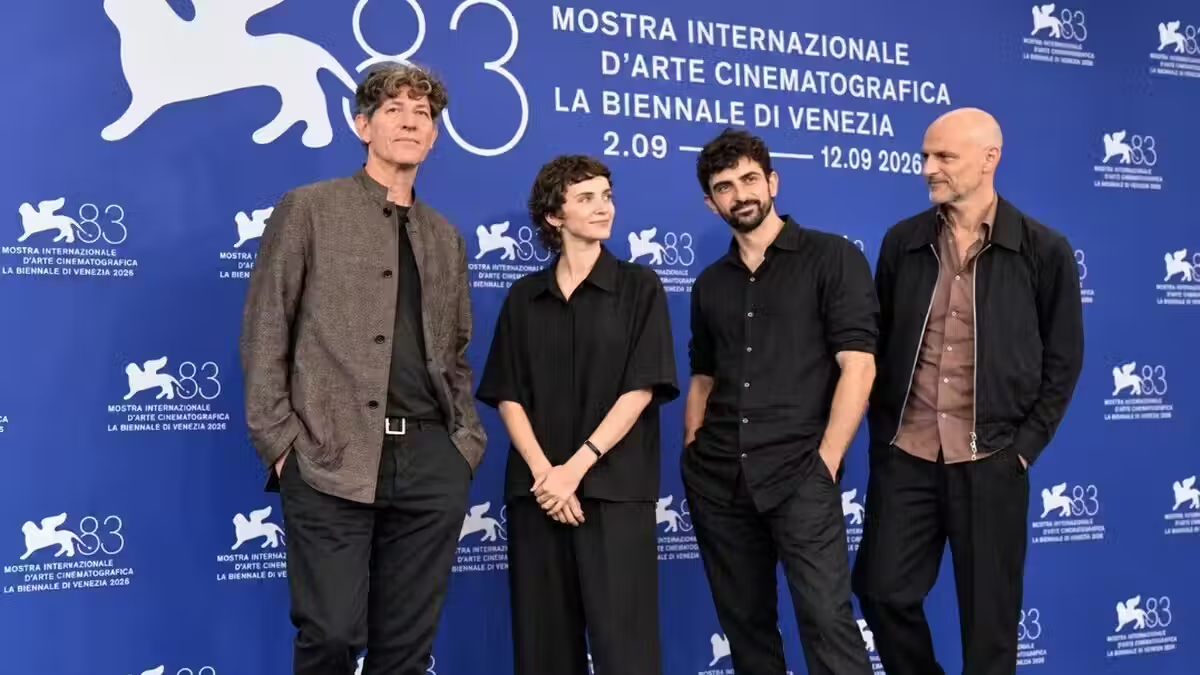
The screening of NAZA triggered a very long ovation this Thursday at the Venice Film Festival. Presented in the official competition, the documentary by Israeli filmmakers Yuval Abraham and Rachel Szor was applauded for about 25 minutes in the Sala Grande. One year after the 23-minute ovation given to The Voice of Hind Rajab, Gaza once again took center stage at the Venice Festival.
With a duration of 80 minutes, NAZA focuses on the methods used by the Israeli army and intelligence services during the war in the Gaza Strip. The film notably gives voice to 24 current or former members of the Israeli army and intelligence, whose identities have been protected.
24 testimonies from inside the Israeli military apparatus
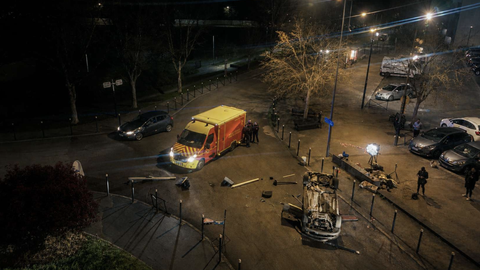
The interviews were filmed at night, mainly on rooftops in Tel Aviv. The faces and voices of the witnesses were digitally altered to prevent identification. Several describe their own work within the surveillance and targeting systems used in Gaza since the start of the war.
Yuval Abraham explains that he asked the military personnel and agents interviewed to detail precisely the procedures in which they participated: “Just describe to us what you did. How do these systems work? Draw them for us.”
The documentary notably describes the use of systems based on artificial intelligence to select a large number of people considered potential Hamas targets. Witnesses also recount the exploitation of phones to locate certain suspects, as well as strikes carried out against homes while the presence of family members was known.
“NAZA,” the number of civilians likely to be killed in a strike
The documentary’s title refers to an Israeli military acronym presented in the film as a term used to assess the number of civilians likely to be killed during an airstrike.
The documentary thus claims that the issue of civilian casualties was not limited to the unintended consequences of bombings, but that a potential number of deaths could be integrated into the decision-making process before certain strikes. One testimony mentions up to 25 civilians being considered collateral damage to reach a presumed Hamas target.
Other witnesses describe bombings of houses, destruction of entire neighborhoods, and the burning of civilian homes. The film also addresses shootings against Palestinians near food distribution zones.
Accusations regarding the use of artificial intelligence in Gaza
A significant part of NAZA focuses on the computer systems used to identify and locate targets. According to testimonies collected in the documentary, some tools allowed the rapid establishment of extensive lists of people suspected of belonging to Hamas or having links to the organization.
The filmmakers thus describe a system in which technology, phone intelligence, and airstrikes were used jointly. The testimonies claim that some people were attacked at night in their homes, including when it was foreseeable that relatives were with them.
The Israeli army has regularly denied accusations that it deliberately targets civilians. It states it targets Hamas, takes measures to limit civilian casualties, and accuses the Islamist movement of using civilian infrastructure and areas to conduct its military activities.
Oscar-winning directors of No Other Land
Yuval Abraham and Rachel Szor are not unknown in major international festivals. They were among the four filmmakers of No Other Land, with Basel Adra and Hamdan Ballal, awarded the Oscar for Best Documentary in 2025.
With NAZA, they have this time chosen to work almost exclusively from testimonies coming from inside the Israeli military system. The film was produced by The Guardian and James Wilson, while Jonathan Glazer, director of The Zone of Interest, is one of the executive producers. Added late to the selection of the 83rd Venice Film Festival, NAZA is the only documentary among the 21 films competing for the Golden Lion.
Gaza again at the heart of the Venice Film Festival
The screening comes one year after the spectacular reception given to The Voice of Hind Rajab. The film by Kaouther Ben Hania, dedicated to the last hours of a 5-year-old Palestinian girl killed in Gaza in January 2024, received an ovation of more than 23 minutes in Venice.
The Palestinian issue is also very present around this 2026 edition. A few days before the screening of NAZA, Susan Sarandon stated in Venice that she had lost roles in Hollywood due to her support for Palestine. The film world had already been shaken by a call from more than 1,500 professionals to boycott certain Israeli film institutions.
A war triggered after the October 7, 2023 attacks
The war in Gaza began after the attack carried out by Hamas and other Palestinian armed groups in Israel on October 7, 2023. About 1,200 people were killed in Israel and 251 were taken hostage.
Israel then launched a large-scale military offensive in the Gaza Strip. More than 73,000 Palestinians have since been killed according to Gaza health authorities, while much of the territory’s buildings and infrastructure have been destroyed or damaged.
NAZA focuses its narrative on decision-making mechanisms and testimonies of those who claim to have directly participated in intelligence and targeting operations. This Thursday evening in Venice, these 80 minutes of testimonies were followed by an ovation of about 25 minutes.