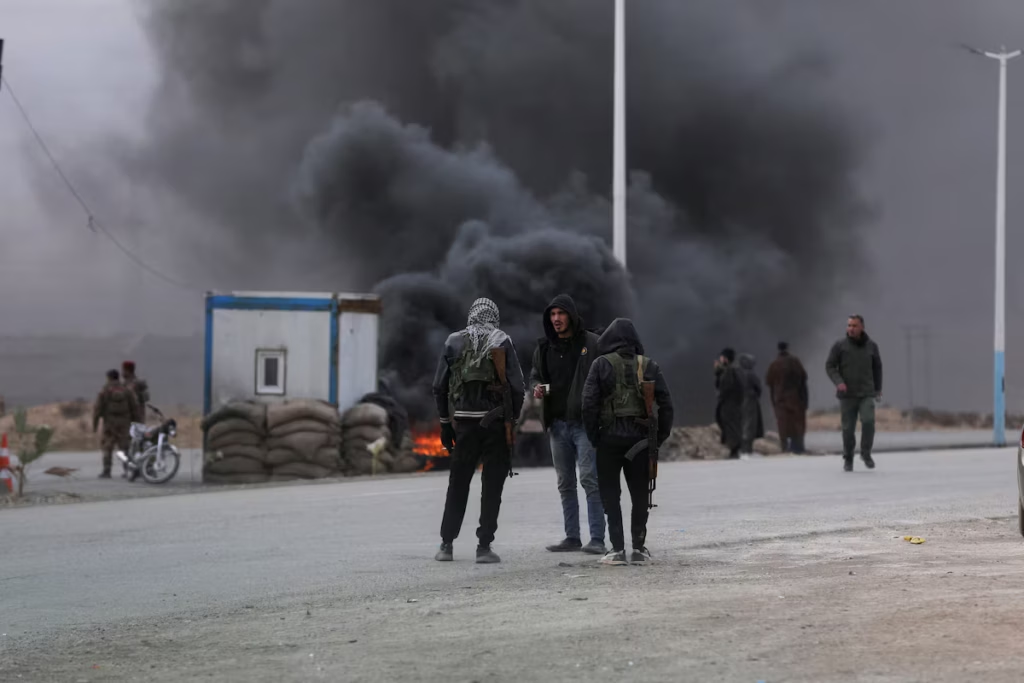
The Syrian army continued its advance on Saturday in the north of the country, in territory controlled by Kurdish forces, despite calls from the United States to suspend its operations. According to state media, government troops took control of the city of Tabqa as well as its strategic dam, west of Raqqa, and the Freedom Dam, formerly known as the Baath Dam.
Syrian Kurdish authorities have not confirmed the loss of these positions, and the situation on the ground remained uncertain, with fighting possibly still ongoing. In recent days, the Syrian army had massed around villages located west of the Euphrates, demanding the redeployment of the Syrian Democratic Forces (SDF), dominated by Kurds, to the eastern bank of the river.
The SDF announced that they had withdrawn from certain areas early Saturday as a goodwill gesture, in accordance with a withdrawal agreement aimed at avoiding a major escalation. However, they accused government forces of violating this agreement by continuing their advance eastward, notably towards towns and oil fields which, according to them, were not covered by the initial terms.
The commander of the U.S. Central Command, General Brad Cooper, publicly called on Syrian troops to cease all offensive actions in the area between Aleppo and Tabqa. Washington is attempting to contain the escalation as U.S.-led coalition aircraft flew over the tension zones, firing warning flares, according to a Syrian security source.
In some localities, the arrival of government troops was welcomed by part of the Arab population. In Deir Hafer, a town retaken without major clashes after the SDF withdrawal, residents expressed relief. “There has already been enough bloodshed in this country. People are exhausted,” Hussein al-Khalaf, a resident of the town, told Reuters.
The Syrian Petroleum Company announced that the nearby oil fields of Rasafa and Sufyan are now under army control and could be put back into operation. However, the main oil and gas fields in the east of the country remain in the hands of Kurdish authorities, in predominantly Arab areas where tensions remain high.
Faced with the deteriorating situation, U.S. envoy Tom Barrack traveled to Erbil, in northern Iraq, to meet with the SDF leader Mazloum Abdi, as well as Iraqi Kurdish leader Massoud Barzani, according to Kurdish sources. This mediation comes as fighting widens the gap between the government of Syrian President Ahmed al-Charia, who promises to reunify the country after fourteen years of war, and local Kurdish authorities, wary of his Islamist-oriented administration.
Despite months of negotiations aimed at integrating Kurdish structures into Syrian state institutions by the end of the year, the expiration of deadlines set by Damascus has reignited clashes. Recent fighting, combined with still vivid memories of deadly sectarian violence last year, fuels fears of a new phase of lasting instability in northern and eastern Syria.