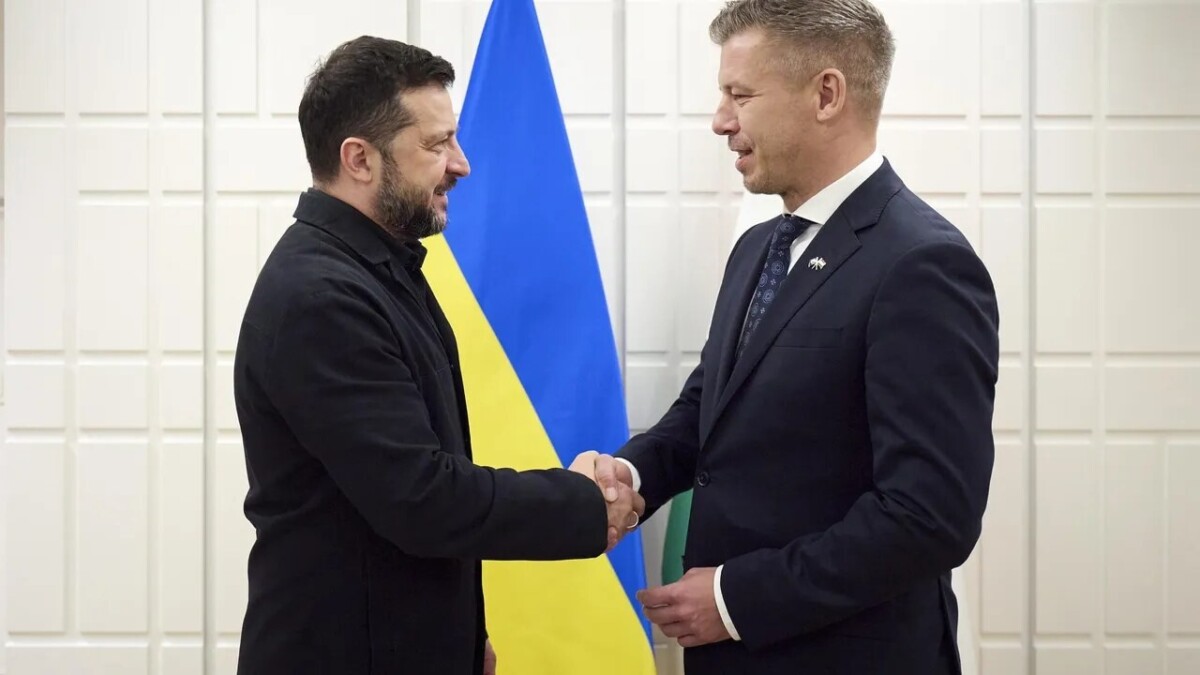
Hungarian Prime Minister Peter Magyar traveled to Uzhhorod for a first meeting with Ukrainian President Volodymyr Zelensky, marking a clear break with the pro-Russian policy of his predecessor Viktor Orbán and opening the way for a bilateral rapprochement with European implications.
The choice of location was no coincidence. Peter Magyar began his first official visit to Ukraine not in a government building, but in a military cemetery in central Uzhhorod, alongside Volodymyr Zelensky. The two leaders laid flowers and bowed before the graves of soldiers fallen in the face of the Russian invasion, including an ethnic Hungarian, one of the first killed since the start of the full-scale war.
The gesture was deliberate. Uzhhorod, called Ungvar in Hungarian, is the capital of the Ukrainian Transcarpathian region, home to some 80,000 members of Ukraine’s Hungarian minority. Thousands of them are currently fighting on the front lines. For Budapest, the war is therefore not a distant reality, and Magyar sought to embody this from the earliest hours of his visit. “I bring with me the solidarity of the Hungarian people. We stand alongside Ukraine against the Russian aggressor,” he declared before the ceremony.
This meeting marks a turning point after years of frosty relations. Under Viktor Orbán, Hungary had repeatedly blocked support for Kyiv within the European Union, regularly labeling Ukraine a “mafia state.” Magyar, who came to power in May 2026, had promised even before taking office to reset these relations. “We have finally ended this totally unnecessary and inexplicable political escalation,” he stated during the visit.
Discussions between the two heads of state focused on several concrete economic issues: supplying Ukraine with Hungarian diesel, increased use of Ukrainian gas storage capacities by Hungarian companies, and joint infrastructure projects including the opening of new border crossings and a direct rail link between Budapest and Kyiv. However, no formal agreement was signed at the end of the day.
The rapprochement remains partial. Magyar maintains his refusal to deliver weapons to Ukraine or to authorize their transit through Hungarian territory. He had previously accused Kyiv of treating ethnic Hungarians as second-class citizens, a claim not supported by the facts, and had at one point blocked the opening of negotiation chapters for Ukraine’s EU accession. On this last point, Budapest ultimately lifted its obstruction after Kyiv adopted, in early October, a law on minority language rights that in some respects goes beyond European standards.
Ukrainian political scientist Olena Halushka, of the International Centre for Ukrainian Victory, nuances the symbolic significance of the visit: “Magyar inherited a deeply polarized country. A visit to Transcarpathia is more a gesture toward the Hungarian population than toward Ukraine.” A poll conducted in November 2026 by the think tank Globsec indicates that 33% of Hungarians would now support military aid to Ukraine, an increase compared to the Orbán era, but still reflecting a largely reserved public opinion.
On the Ukrainian side, Laszlo Zubanics, president of the Hungarian Democratic Federation of Ukraine, called the meeting “historic” and welcomed the prospect of concrete improvements in minority rights protection “within a few months, well before the end of 2027.” A Hungarian diplomat speaking anonymously emphasized the need to rebuild trust after the Orbán years, while highlighting Budapest’s interest in participating in Ukraine’s reconstruction.
For political scientist Daniel Hegedus of the Institut für Europäische Politik in Berlin, the day represents “an important symbolic step,” but the challenge will now be how the two leaders capitalize on this political capital. Zelensky, for his part, summarized the current mindset by referring to “all the opportunities to build, hopefully, constructive relations.”
Sources citées dans l’article Sondage Globsec