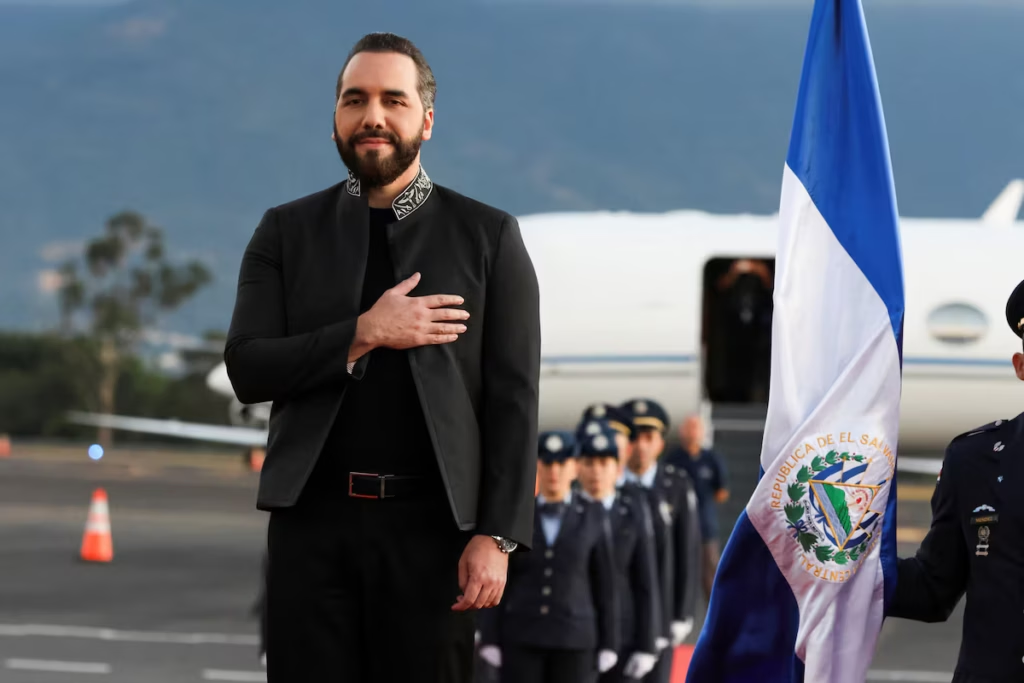
Less than three weeks before the presidential election on February 1, Costa Rica inaugurated a new high-security prison on Wednesday in the presence of Salvadoran President Nayib Bukele, a highly symbolic visit as crime dominates the election campaign.
The project, supported by Bukele’s government, was announced last year by Costa Rican President Rodrigo Chaves as part of a toughening of security policy in response to rising violence linked to drug trafficking. El Salvador provides both technical assistance and its prison model.
The new prison, named the High Security Center for the Fight Against Organized Crime (CACCO), is directly inspired by El Salvador’s Terrorist Detention Center (CECOT), a cornerstone of Bukele’s strategy against gangs. With a capacity of 5,100 inmates, it will increase Costa Rica’s prison capacity by 40% and is expected to be completed by mid-year.
At the inauguration, Bukele stated that “everything done at CECOT will be reproduced in the Costa Rican version,” presenting his action as a response to what he calls the “dictatorship of organized crime.” His policy has led to a dramatic drop in homicides in El Salvador but is strongly criticized by human rights organizations, which denounce inhumane detention conditions and deaths in prison, accusations rejected by his government.
Long considered one of the safest countries in Central America, Costa Rica is facing a rise in homicides fueled by drug cartels. Opinion polls now place insecurity at the top of voters’ concerns ahead of the election.
Rodrigo Chaves, whose term ends on May 8, hopes that the security policy will positively influence the election of his party’s candidate, Laura Fernandez, who is leading in the polls. The ruling party aims for a first-round victory and a parliamentary majority sufficient to pass reforms inspired by the Salvadoran model, notably in the judicial field.
Bukele’s visit, however, sparked criticism from the opposition, which sees a risk of electoral interference. The Supreme Electoral Tribunal recalled that no law prohibits this visit, while asking the Salvadoran president not to publicly support any political camp.
With a homicide rate of about 17 per 100,000 inhabitants, much lower than El Salvador’s a decade ago, Costa Rica still has, according to Bukele, room to maneuver to avoid a spiral of violence. “Otherwise, crime will continue to increase,” he warned, while acknowledging that the security challenges of the two countries remain different in nature.