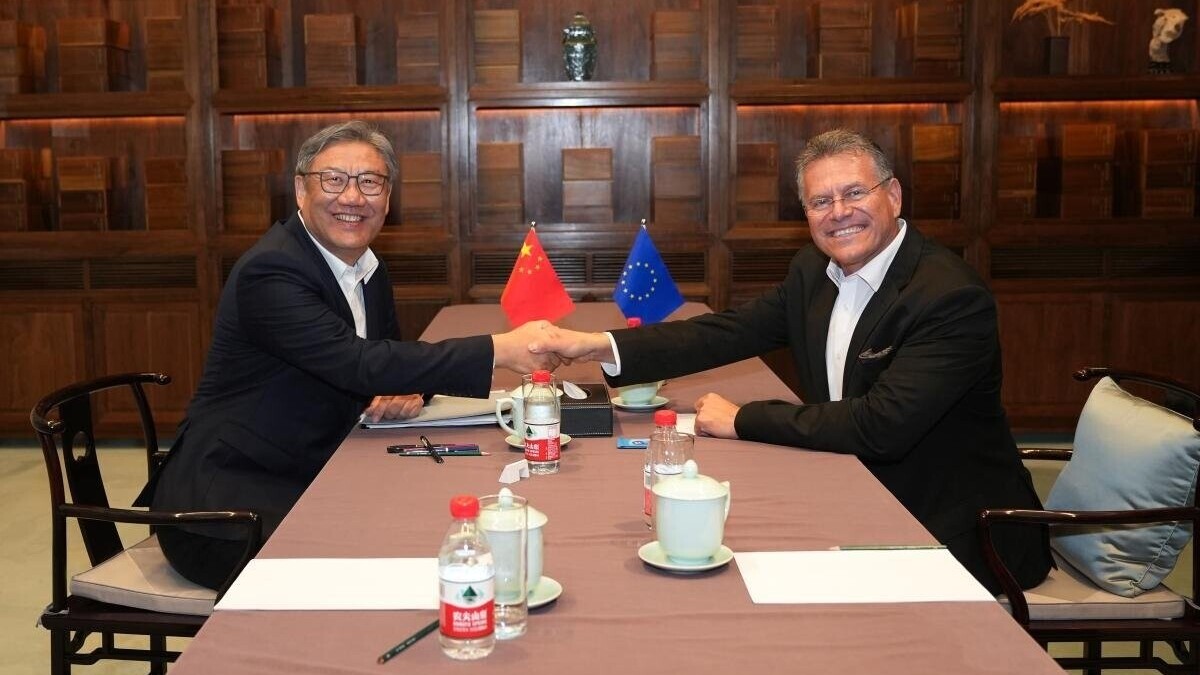
After two days of negotiations in Beijing, the European Union and China announced an agreement aimed at reducing Chinese exports of hybrid vehicles to Europe by more than half, while lowering tariff barriers on several European products.
The European Commissioner for Trade, Maros Sefcovic, announced on Friday the conclusion of an agreement with Beijing intended to rebalance a trade relationship considered increasingly unbalanced. According to him, the text would reduce Chinese exports of hybrid and plug-in hybrid cars to the European market by more than half over a four-year period. “This way we prevent the export of several million vehicles from China to the European Union,” he said.
This agreement is the result of three months of intensive work, the last phase of which took place in Beijing over two days. Sefcovic did not specify the concrete implementation modalities but expressed confidence that both parties had achieved “a very good result.”
The automotive component is only part of the text. The two parties also agreed on a reduction of Chinese tariffs on four billion euros worth of European products, including automotive parts, olive oil, and shoes. An agreement was also reached to simplify Chinese export licensing procedures for rare earths and permanent magnets, strategic materials for which China controls a predominant share of global production.
The agreement will need to be submitted for approval by the leaders of the twenty-seven EU member states, who will discuss it at the European summit scheduled in Brussels next Thursday.
The pressure to reach such a text is explained by the growing scale of the European trade deficit. Chinese exports to the EU reached 500 billion euros last year, compared to 460 billion in 2023, while European imports from China slightly declined to 240 billion euros. The President of the European Commission, Ursula von der Leyen, warned last month that this imbalance had reached “a tipping point” and that Europe would mobilize all tools at its disposal to address it.