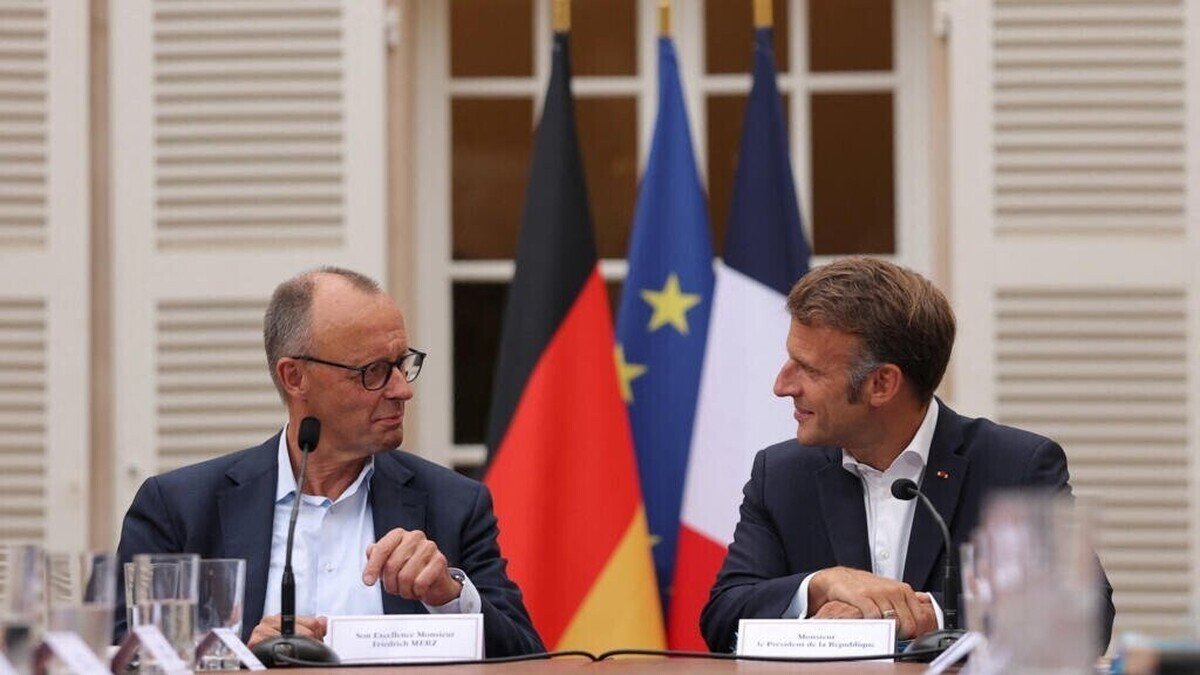
Emmanuel Macron and Friedrich Merz jointly sent a letter to the European Commission requesting new instruments to enable the European Union to respond more quickly to trade distortions. Without naming any country, the text clearly targets China, and to a lesser extent the United States.
The French president and the German chancellor submitted a joint document on Monday to the President of the European Commission, Ursula von der Leyen, asking her to strengthen the Union’s trade arsenal. The two leaders believe that existing mechanisms are no longer suited to current economic tensions.
The letter, described as a “non-paper” in European diplomatic jargon, has no binding value. This type of informal document is used to launch ideas and open discussions without officially committing its signatories. Macron and Merz propose two concrete measures.
The first would aim to reduce European companies’ dependence on single suppliers by promoting supply diversification. The second, more radical, would allow for the accelerated exclusion of a third country from access to the single market when circumstances require it. Currently, such a decision requires a lengthy process and the agreement of member states. The two leaders propose reversing the logic: the Commission could act alone, but member states would retain the possibility to block the measure by a qualified majority vote, that is at least 55% of states representing at least 65% of the total EU population.
In their letter, the two heads of state or government justify this request by what they describe as a profound challenge to the international trade system. “The open, rules-based trading system is massively compromised by the instrumentalization of trade, systemic market-distorting practices, and global macroeconomic imbalances,” they write, adding that these phenomena generate increasing “geoeconomic risks” for Europe.
The text does not name any state explicitly, but the context leaves little ambiguity. The European Union’s trade deficit with China reached approximately 360 billion euros in 2025, according to European figures, and the Union remains heavily dependent on Beijing for several strategic raw materials, notably rare earths. The unpredictable trade policy of the US administration forms the other implicit backdrop of the document.
The letter comes a few days before the European Commissioner for Trade, Maros Sefcovic, visits Beijing, and one week before the European leaders’ summit scheduled for October 15 and 16. Earlier this year, Sefcovic had expressed hope for “tangible results” on the Sino-European trade dossier by October. China, for its part, has warned that it could take retaliatory measures if it deems European initiatives contrary to its interests.