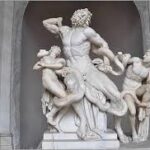
On January 14, 1506, workers excavating near Nero's former imperial palace, in the area of the Colosseum in Rome, unearthed a striking collection of marble statues. It quickly became clear that these fragments belonged to a famous work from antiquity described by the writer Pliny the Elder: the Laocoön group, a masterpiece of Hellenistic sculpture.
A mythological scene frozen in stone
The group depicts Laocoön, a Trojan priest, and his two sons entwined by enormous serpents. In Virgil's account, Laocoön tries to warn the Trojans about the wooden horse left by the Greeks on the shore. His warning is ignored, and to silence him, sea monsters sent by the gods suffocate him and his children. The scene, captured in marble, blends physical pain, desperate struggle, and dramatic tension, offering a striking vision of ancient tragedy.
Sculpted during the Hellenistic period, probably in the 1st century BC by artists from the island of Rhodes, the work had been admired in imperial Rome before being buried over the centuries under ruins and fill.
A discovery that revolutionized the Renaissance
When the sculpture reappeared in 1506, the news spread immediately throughout the city. Artists and scholars flocked to the site, including Michelangelo and the architect Giuliano da Sangallo. All recognized the exceptional importance of the work, whose expressiveness and anatomical mastery embodied, in their eyes, the perfection of ancient art.
Pope Julius II immediately decided to acquire it. He had the Laocoön installed in a specially prepared courtyard in the Vatican, the future Belvedere Courtyard, where the statue was displayed to the public. This gesture marked a pivotal moment: for the first time, a papal collection was organized around ancient masterpieces accessible to visitors, giving birth to what would become the Vatican Museums.
A turbulent destiny between Rome and Paris
For over two centuries, the Laocoön remained one of the Vatican's treasures. But at the end of the 18th century, Napoleon's conquests disrupted the balance of power among Europe's major collections. Through treaties imposed on the Pope, France demanded the surrender of numerous important works. In 1798, the Laocoön was transported to Paris and installed in the Louvre, then the Musée Napoléon, where it was presented as a cultural trophy of the Republic and the Empire.
After Napoleon's fall, the European powers demanded the restitution of looted works of art. In 1815, thanks to the efforts of the Italian sculptor Antonio Canova, the Laocoön returned to Rome. Once reinstalled in the Vatican, it was restored and placed back in the papal collections, where it remains today.
The discovery of January 14, 1506, was not merely an archaeological event; it profoundly transformed Renaissance Europe's view of antiquity. The Laocoön became a model for generations of artists, captivated by the expressive intensity and formal perfection of this sculpture. More than five centuries after its rediscovery, it remains one of the most powerful images of human tragedy inherited from the Greek world.