

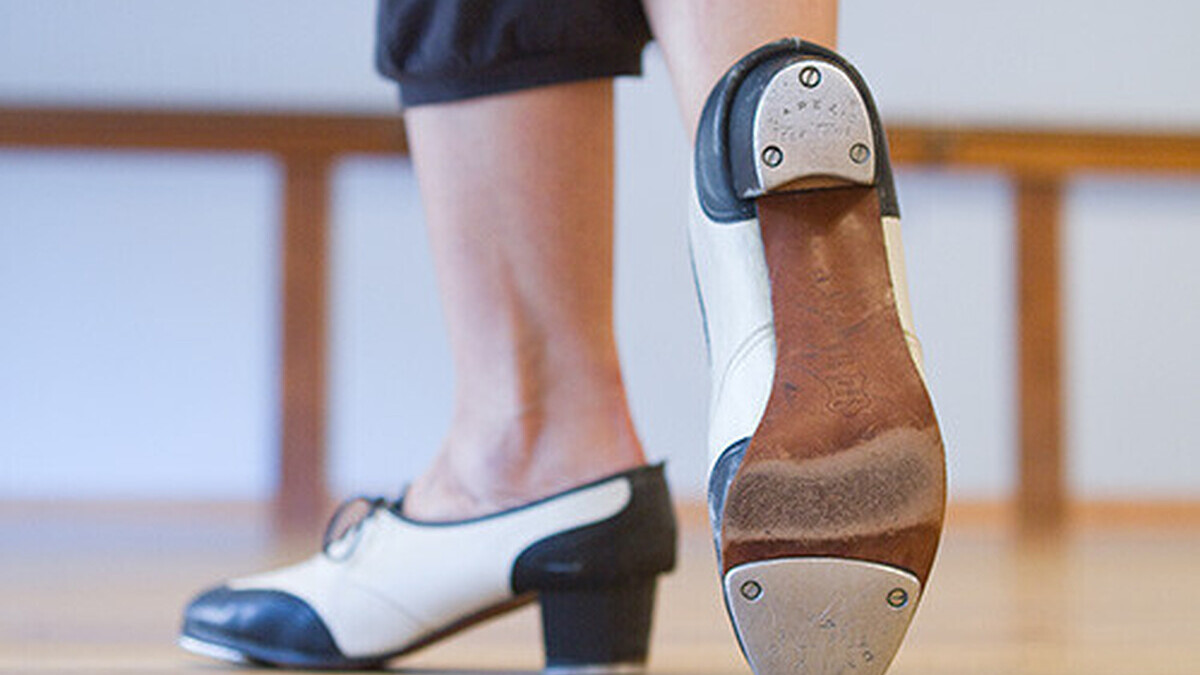
Halfway between dance and percussion, tap dance is a spectacular art form where the feet become musical instruments. Popularized by American musicals and Hollywood legends, it has a rich history influenced by African, Irish, and American cultures. Even today, this discipline continues to captivate dancers and musicians worldwide thanks to its unique blend of rhythm, movement, and improvisation.
Unlike other dance forms, tap dance, called tap dance in English, does not rely solely on the aesthetics of movement. Its uniqueness lies in producing sounds through small metal plates attached to the shoes, usually at the heels and toes. Each contact with the floor produces a percussion sound that allows the dancer to build true rhythmic sequences. The strikes can be fast, slow, powerful, or almost imperceptible, creating a multitude of sound combinations. The dancer thus becomes simultaneously performer, choreographer, and percussionist.
The history of tap dance takes shape in the United States in the 19th century, at the crossroads of several cultural traditions. The rhythmic dances practiced by African American populations, notably in the context of slavery and its aftermath, played a fundamental role in its development. These gradually merged with certain dances from Europe, particularly from Ireland and Great Britain. This meeting gave birth to a new discipline that developed in popular shows before conquering theater stages and movie theaters.
From Broadway to Hollywood, the golden age of tap dance
At the beginning of the 20th century, tap dance became essential in vaudeville shows, revues, and American musicals. Its success accompanied the rise of jazz, with which it maintained particularly close ties. Dancers use syncopations, offbeats, and tempo variations to interact with musicians. Some artists even developed a primarily musical approach to the discipline, where the feet could improvise like a drum set or percussion instrument. Major figures such as Bill “Bojangles” Robinson, John Bubbles, and the Nicholas Brothers helped transform tap dance into a recognized art form.
Hollywood cinema then played a decisive role in its international popularization. Fred Astaire and Ginger Rogers became iconic figures of musicals, while Gene Kelly helped renew the aesthetics of dance on screen. Films like Top Hat in 1935, Singin’ in the Rain in 1952, or The Band Wagon in 1953 helped establish tap dance in popular culture. Behind these major productions, however, lies a more complex history marked by racial discrimination that long limited the recognition and professional opportunities of many African American dancers who were essential to the evolution of this art.
A musical discipline based on rhythm and improvisation
Tap dance stands out for its ability to produce a true musical composition without traditional instruments. Dancers work on toe taps, heel strikes, scrapes, and rapid sequences to create rhythmic patterns. Some techniques allow producing multiple sounds in a single movement, resulting in highly complex sequences. Precise foot placement, body balance, and tempo control are essential to achieve a harmonious result. At an advanced level, dancers can improvise in response to a melody or directly interact with a jazz band.
This musical dimension explains why tap dance holds a special place in the history of performing arts. It does not necessarily require instrumental accompaniment, since the dancer can produce the rhythm themselves. In some performances, several artists exchange sound phrases, like musicians improvising together. This practice, sometimes called tap jam, recalls jazz principles and highlights individual creativity. Tap dance can also accompany very different musical styles, from swing to funk, including contemporary music.
A living art that captivates new generations
While major musicals have greatly contributed to its fame, tap dance has never disappeared from international stages. Artists like Gregory Hines and Savion Glover helped renew it by developing more contemporary styles and emphasizing its rhythmic power. Savion Glover, in particular, popularized a highly percussive approach to the discipline, close to some forms of modern jazz and urban music. Today, festivals, shows, and specialized schools help pass this heritage to new generations of dancers.
Tap dance also has the advantage of being practiced at various ages. Learning it promotes coordination, concentration, musical listening, and sense of rhythm. While the most complex movements require significant training, the first sequences remain accessible to beginners. Beyond physical performance, this discipline offers an original way to feel music. Each step becomes a note, each sequence a rhythmic phrase, and each dancer a full-fledged musician. More than a century after its emergence, tap dance continues to demonstrate that sometimes all it takes is a pair of shoes and a suitable floor to create a true musical show.





Respond to the article
Be the first to comment on this article.