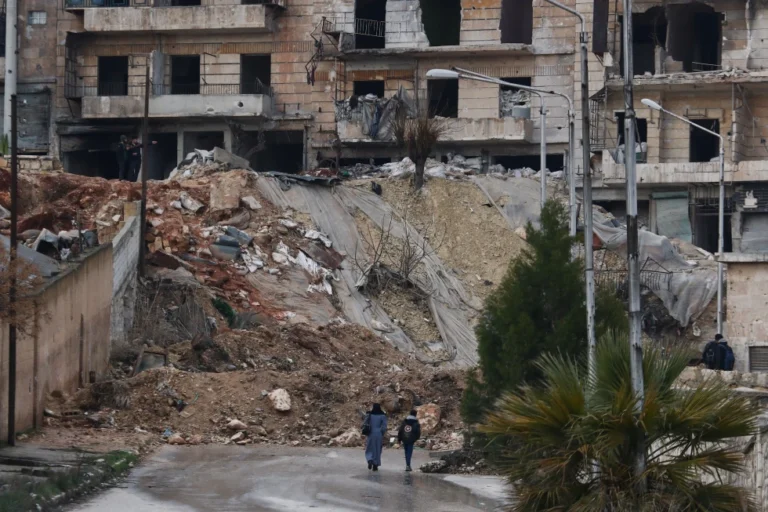
One month after violent clashes in a predominantly Kurdish neighborhood of Aleppo, in northern Syria, life has largely returned to normal. Most of the tens of thousands of residents who had fled the fighting between government forces and the Syrian Democratic Forces (SDF), dominated by Kurds, have returned—an unusually rapid return in a country where many displaced people have lived far from home for years.
“Ninety percent of the people have returned,” says Aaliya Jaafar, a hairdresser in the Sheikh Maqsoud neighborhood. “And it didn’t take long. It may have been the shortest displacement in Syria.” Her family only briefly left their home after a drone strike by government forces targeted a nearby area where weapons were stored, triggering explosions.
The clashes broke out on January 6 in the predominantly Kurdish neighborhoods of Sheikh Maqsoud, Achrafieh, and Bani Zaid, following the failure of negotiations between the government and the SDF regarding the integration of what constitutes the largest still-active armed group in the country into the national army. After several days of intense fighting, at least 23 people were killed and more than 140,000 displaced before security forces took control of the affected areas.
Unlike other recent episodes of violence on the Syrian coast or in the southern province of Sweida, where hundreds of civilians from the Alawite and Druze minorities were killed in sectarian reprisal attacks, the new Syrian government claims to have taken measures to limit civilian casualties in Aleppo. Before the army entered the contested neighborhoods, corridors were opened to allow residents to flee.
Ali Sheikh Ahmad, a former member of a local police force affiliated with the SDF and now a merchant, was among the displaced. He returned with his family a few days after the fighting ended. He acknowledges that residents feared reprisals after the Kurdish forces withdrew and government troops took control. “But that did not happen,” he says, emphasizing that the ceasefire holds and progress has been made toward political and military integration. According to him, the new security forces “treated us well,” gradually dispelling fears.
Businesses have reopened, traffic has resumed normally, and residents, both Kurdish and Arab, are once again interacting in the streets. The checkpoint at the neighborhood entrance is now held by government forces. Despite this return to calm, scars remain: children play near a damaged school or handle surgical staplers recovered from a neighborhood hospital affected during the fighting, which the government accuses the SDF of using for military purposes—a claim the SDF disputes, asserting they sheltered civilians there.
While the security situation has stabilized, the economic crisis has worsened, according to residents. Many depended on jobs linked to local authorities affiliated with the SDF, now removed from power. “The economic situation has really deteriorated,” laments Aaliya Jaafar. “For more than a month, we have barely worked.” Others remain hopeful. Sheikh Ahmad, displaced multiple times since the start of the conflict triggered by the 2011 protests against Bashar al-Assad, who was overthrown in November 2024, hopes to one day return to his hometown, Afrin, which he left during the 2018 Turkish offensive.
In this fragile context, interim president Ahmad al-Sharaa recently issued a decree strengthening the rights of the Kurdish minority, which represents about 10% of the Syrian population. The text recognizes Kurdish as a national language alongside Arabic, makes Nowruz an official holiday, and restores citizenship to tens of thousands of Kurds from the northeast of the country who had been stripped of it during the 1962 census. “We want more than mere tolerance. We want people to love each other. Fifteen years of war is enough,” concludes Sheikh Ahmad.