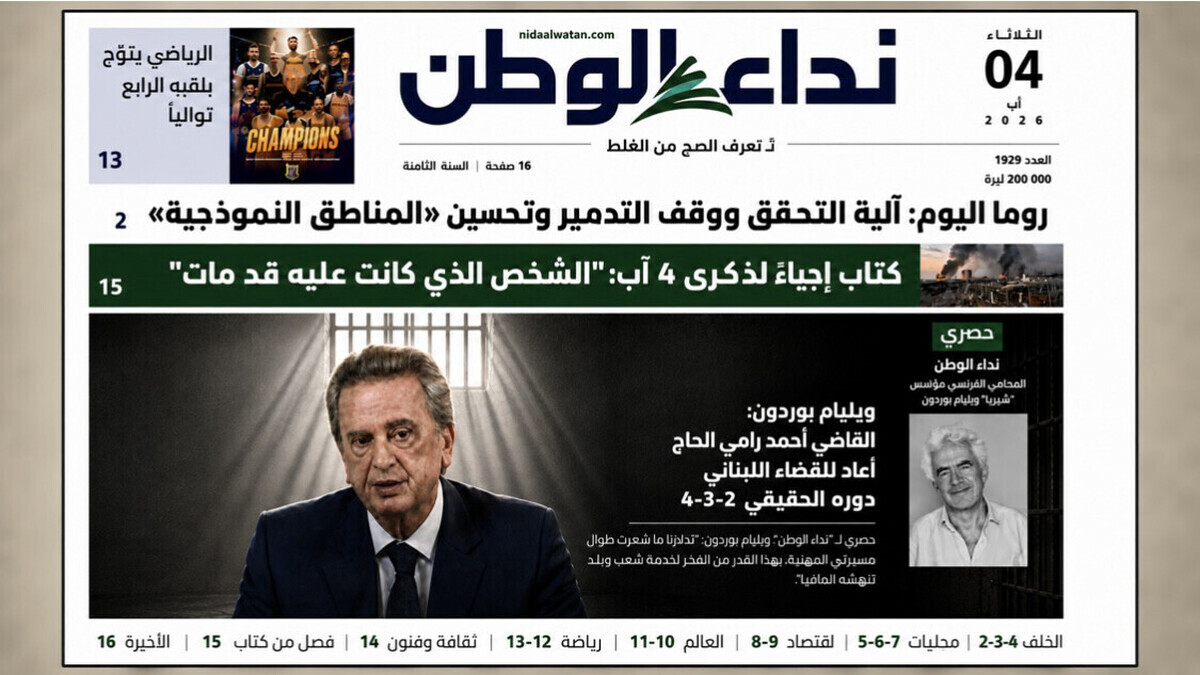
Nidaa Al Watan , one of Lebanon's most influential daily newspapers, has published an exclusive interview with French lawyer William Bourdon, a leading figure in the fight against international corruption. This interview comes as former Bank of Lebanon governor Riad Salameh faces multiple legal proceedings in Lebanon and Europe on suspicion of embezzling public funds, money laundering, and illicit enrichment. Following an arrest warrant issued by the French judiciary, an Interpol Red Notice has been issued to facilitate his location and provisional arrest through international police cooperation. The investigations, led in particular by the French National Financial Prosecutor's Office, have made this one of the most significant financial corruption cases involving a high-ranking Lebanese official in recent decades. In the interview, William Bourdon discusses the latest developments in the case and uses a particularly strong term to describe the system he is fighting: an "ecumenical mafia."
A leading figure in the fight against corruption international
William Bourdon, a lawyer at the Paris Bar, is one of France's leading specialists in financial crime, corruption, and human rights abuses. Founder of the Sherpa association, he has initiated several landmark cases, particularly in the "ill-gotten gains" cases, which have led to the seizure in France of assets considered to be the proceeds of embezzlement of public funds. In the Riad Salamé case, he represents several civil parties before the National Financial Prosecutor's Office. His work, conducted over several years with French magistrates and European judicial authorities, contributed to the indictment of the former governor of the Bank of Lebanon and the subsequent issuance of an international arrest warrant against him. Since the opening of this case, he has been advocating for the identification, seizure, and return of the embezzled assets to the Lebanese people.
"An ecumenical mafia"
In an interview with Nidaa Al Watan, William Bourdon explained that this case holds a special place in his career: “It is very rare, in an already long professional career, to be so proud and honored to serve a people and a country riddled with an ecumenical mafia whose only ‘inverted morality’ is greed.” The lawyer emphasized this expression “ecumenical mafia ,” which he uses to describe a system of corruption that transcends political, sectarian, or communal divisions and, according to him, unites common interests to the detriment of the Lebanese state.
"The arrest of Riad Salamé marks a turning point."
William Bourdon believes the latest legal developments mark a significant step: “Riad Salameh’s arrest is part of the new complaint filed against him by the Bank of Lebanon, after he was released on $14 million cash bail in the previous proceedings. This development is a major turning point.” According to him, this development confirms the acceleration of the proceedings against the former governor.
The awakening of Lebanese justice is welcomed
The lawyer paid tribute to the work of Lebanese magistrates: “First, we must commend the role of the Lebanese justice system which, under the leadership of the new Attorney General Ahmad Rami El Hajj, is finally beginning to fully carry out its mission, more than two years after European courts, and in particular French courts, initiated proceedings against Riad Salamé based on already overwhelming evidence.” He believes this development sends a strong signal in favor of restoring the rule of law in Lebanon.
"A first step against impunity"
For William Bourdon, this arrest represents a first victory in a long struggle: "This arrest constitutes a first step in the right direction, after the numerous obstacles faced by magistrates Ghada Aoun, Jean Tannous and Hélène Iskandar in their fight against impunity."
Dismantle the entire "ecumenical mafia"
The lawyer believes, however, that the work has only just begun: “We must now accelerate. Lebanon continues to suffer because justice has been paralyzed for too long. It is essential to tackle the entire mafia and criminal network involved, as well as the entire Lebanese political and financial system and its leaders, who continue to block reforms and obstruct justice.”
August 4th, a symbol of impunity
On the occasion of the commemoration of the Beirut port explosion, William Bourdon reiterated that this catastrophe remains, in his view, the symbol of a lack of political accountability: “With the commemoration of August 4th, the date of the Beirut port explosion, it is more necessary than ever to remember that justice is essential. This tragedy remains the symbol of an intolerable impunity. Lebanese political leaders must answer for their collective failure to meet their responsibilities. History will judge them.”
France will continue its commitment
William Bourdon affirms that the legal proceedings initiated in France will continue to enable the recovery of the embezzled funds: “Lawyers and the French justice system remain committed to supporting Lebanon and its justice system in recovering stolen money, whether in the Optimum and Bank Audi cases, the Stolen Asset Recovery (StAR) program, or the proceedings targeting accomplices involved in illicit financial networks. More broadly, we will continue to defend Lebanon’s rights against all those who have attacked or continue to attack it, whether internal actors, Israel, whose actions are denounced as genocidal, or Hezbollah, which is subservient to Iran.”
In this exclusive interview with Nidaa Al Watan , William Bourdon presents the arrest of Riad Salamé as a decisive step in a legal battle that has been ongoing for several years and calls for the continued dismantling of what he calls an "ecumenical mafia," believing that only coordinated action by Lebanese and European justice will restore confidence in the institutions.