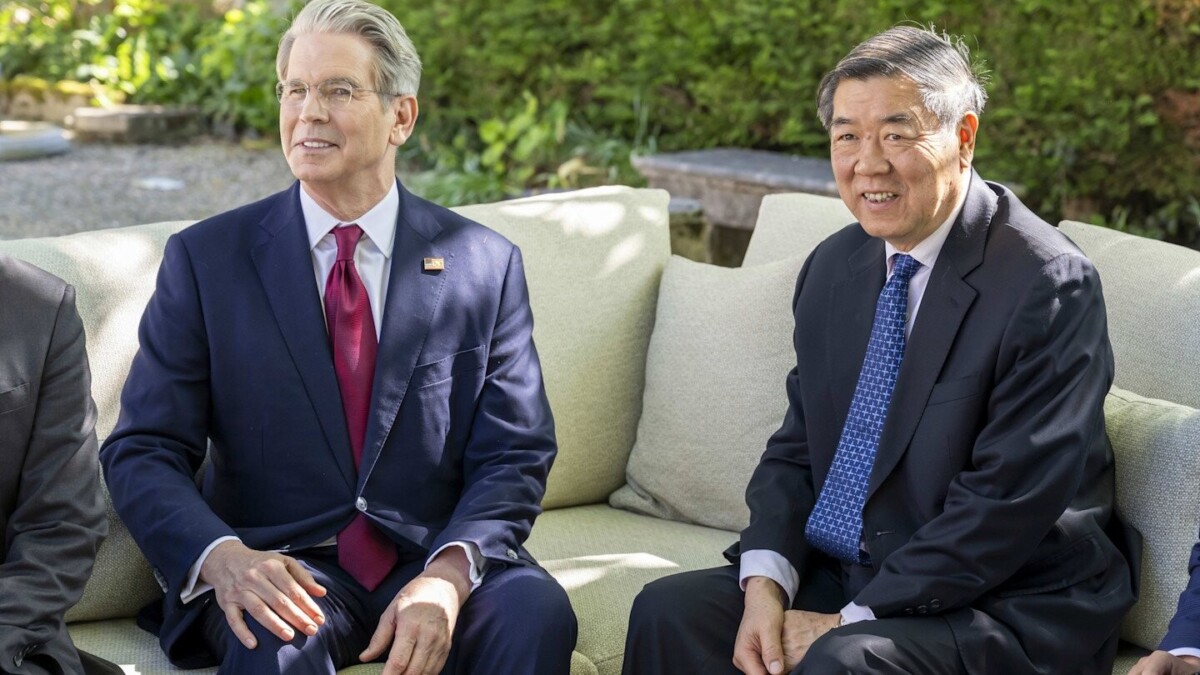
U.S. Treasury Secretary Scott Bessent and Chinese Vice Premier He Lifeng opened preparatory talks on Sunday in New York ahead of the summit scheduled for Thursday between Donald Trump and Xi Jinping. Trade, artificial intelligence, and critical minerals are at the heart of the discussions.
The two delegations met Sunday morning at JPMorgan Chase’s New York offices. Scott Bessent, accompanied by U.S. Trade Representative Jamieson Greer, met with He Lifeng for a series of discussions that Washington hopes will be fruitful enough to lay the groundwork for the presidential meeting on Thursday at the White House. “I look forward to targeted, comprehensive, and constructive exchanges today that will set the foundation for the meeting between our leaders,” Bessent said upon arrival.
The immediate priority concerns the trade truce concluded in Busan, South Korea, last November, which expires on November 10. This agreement ended a dizzying tariff escalation, with reciprocal duties briefly reaching triple-digit levels before being reduced to about 20% on Chinese products imported into the United States.
The issue of critical minerals is another major point of friction. Washington accuses Beijing of failing to honor its commitments to restore exports of rare earths and magnets, essential for manufacturing vehicles and advanced semiconductors. A senior U.S. official said Friday that China’s performance in this area “has not been up to par.”
Artificial intelligence is playing a central role for the first time in this type of bilateral negotiation. Bessent mentioned the possibility of discussing common “safeguards” to prevent shared risks, notably to stop powerful AI models from falling into the hands of malicious non-state actors. The two countries might also address the issue of so-called “open” models, whose Chinese versions are increasingly attracting American companies due to their lower cost compared to proprietary systems developed by actors like OpenAI or Anthropic. “The United States remains the leader in artificial intelligence,” Bessent reminded. “We are open to discussions to avoid shared risks and the bifurcation of our two systems.”
Iran also figures in the background of the discussions. China remains one of Tehran’s main economic partners and absorbs a large share of its oil exports, making Beijing an essential interlocutor for Washington, which seeks to increase economic pressure on the Islamic Republic as the conflict involving the United States and Israel against Iran enters its seventh month.
Despite the breadth of the agenda, analysts temper expectations. “There will probably be some results to show because of the upcoming presidential summit, but I don’t think we are on the verge of a major breakthrough,” said Anna Ashton, an analyst specializing in trade with China and founder of Ashton Intelligence. Former U.S. Deputy Secretary of State Kurt Campbell shares this cautious assessment: “One of the only realistic short-term goals is a truce, which will likely extend until the end of the year.” The two delegations thus find themselves in a logic of managing tensions rather than durable resolution of the disputes that have structured their relations for several years.