

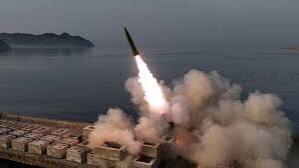
On Thursday, October 29, 2026, North Korea launched about ten short-range ballistic missiles toward the Sea of Japan. Initially reported as an unidentified projectile by South Korean authorities, these launches occur amid rising tensions between Pyongyang and Seoul, notably following several military incidents at their shared border.
The South Korean Joint Chiefs of Staff announced that on Thursday, October 29, around 12:30 p.m. local time, multiple launches were detected from the Wonsan region on North Korea’s east coast. Initial reports indicated an unidentified projectile before military authorities clarified that about ten short-range ballistic missiles were involved. According to data provided by Seoul, the missiles traveled approximately 250 kilometers toward the Sea of Japan, known as the East Sea in Korea. South Korean forces immediately increased surveillance in coordination with the United States and Japan to detect any potential new launches.
Japanese authorities also monitored these launches. The coast guard urged vessels in the area to remain vigilant. Military analyses aim to determine the exact characteristics of the missiles used. Several experts mention the possibility that the launches were conducted using very large caliber multiple rocket launchers, a category of weaponry that Pyongyang has been developing for several years. The North Korean regime continues to modernize its military capabilities with systems intended to improve the range, accuracy, and speed of its strikes. These new tests are part of a series of military demonstrations organized since early October.
Persistent tensions between the two Koreas
These launches come as relations between Seoul and Pyongyang have sharply deteriorated following incidents in the demilitarized zone separating the two countries. In September, three South Korean soldiers were injured by mine explosions near the border. A joint investigation by South Korean authorities and the United Nations Command concluded that these devices had been installed by North Korean military personnel. Pyongyang denies these accusations and condemns Seoul’s statements. In an attempt to ease tensions, South Korea proposed military talks aimed at clarifying the demarcation line and preventing new incidents. This initiative did not receive a favorable response from North Korean authorities.
The launch also occurs in a sensitive diplomatic context, marked by questions about a possible resumption of dialogue between the United States and North Korea. Washington seeks to maintain pressure on North Korea’s nuclear and ballistic programs, while Kim Jong-un refuses to give up his deterrence capabilities. United Nations Security Council resolutions prohibit Pyongyang from conducting tests using ballistic missile technology. Despite these restrictions and international sanctions, the regime continues its armament programs. The two Koreas officially remain in an armistice situation since the end of the Korean War in 1953, with no peace treaty signed. The increase in military tests thus fuels concerns about the security of the peninsula and the stability of Northeast Asia.










Respond to the article
Be the first to comment on this article.