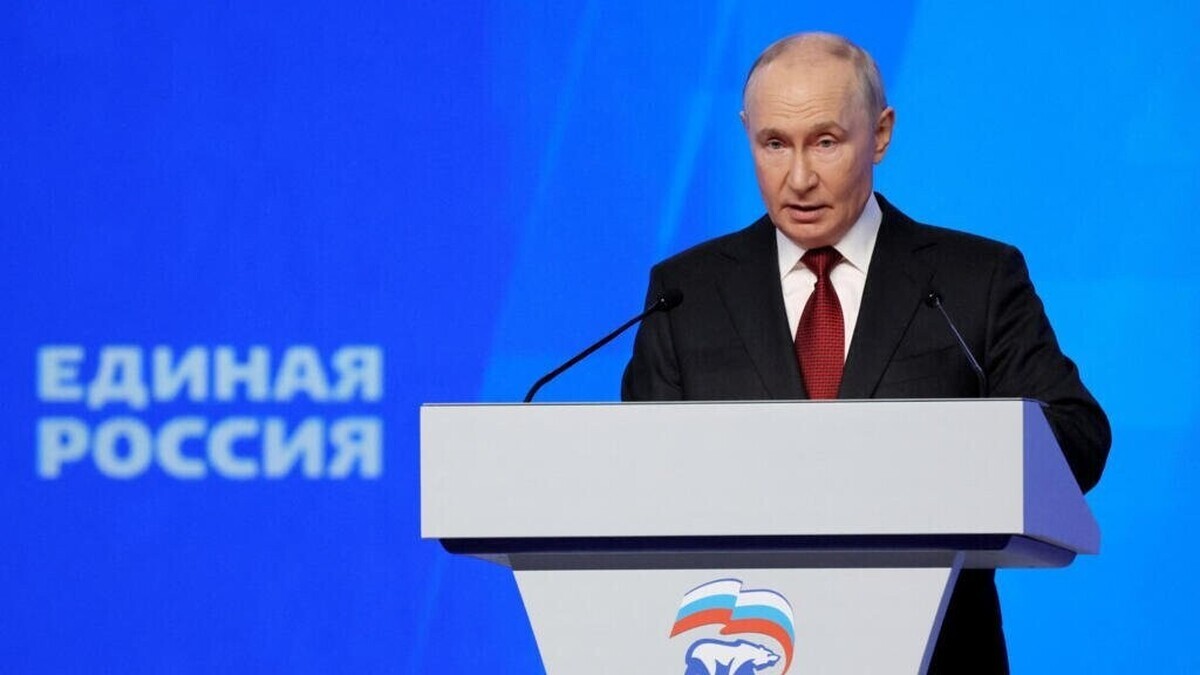
The Kremlin party won Sunday’s elections to the Duma with nearly 50% of the vote, in a poll without real opposition and disrupted by a massive Ukrainian drone attack as well as unprecedented cyber offensives.
The result was expected and is confirmed. United Russia, Vladimir Putin’s party, emerged victorious in the Russian legislative elections on September 20, 2026, with 49.4% of the vote according to an exit poll conducted by the Russian Public Opinion Research Center, a state agency. This score is almost identical to that obtained in the previous election in 2021. Dmitry Medvedev, former president of the Federation and current party chairman, expressed his « thanks to the citizens who participated in the vote. »
These legislative elections, the first held since the launch of Russia’s large-scale offensive against Ukraine in February 2022, aimed to renew the 450 seats of the Duma, the lower house of Parliament. They were also held in Ukrainian territories occupied and annexed by Moscow. The Communist Party (KPRF) came in second with 14.2% of the vote, followed by the nationalist LDPR party with 10.7%. Official preliminary results are expected to be announced Monday morning by the chairwoman of the Electoral Commission, Ella Pamfilova.
The election took place in a tightly controlled political environment: the only party openly opposed to the war, Yabloko, had been excluded from the competition. Only parties supporting, to varying degrees, the continuation of the conflict in Ukraine were allowed to run. The European Union condemned the elections as being held under a regime of « systematic and institutionalized repression. »
Voting day was marked by an unusually large Ukrainian attack. More than a thousand drones were deployed, hitting notably a refinery in Moscow as well as residential areas. At least two people were killed and about twenty injured on Russian territory. Moscow’s mayor, Sergey Sobyanin, reported more than 1,600 drones shot down by air defense, including 450 heading toward the capital, calling the attack « unprecedented » and « clearly planned to disrupt the elections. » In the Kherson region, controlled by Russia, a Ukrainian drone struck a bus, killing two people including an employee of the Electoral Commission.
Ukrainian President Volodymyr Zelensky claimed strikes that had « a very significant impact in the Moscow region, » specifying that about ten different types of weapons had been used. In response, the Russian Ministry of Defense announced that Moscow would « continue and intensify » its own high-precision strikes against military targets in Kyiv.
Alongside physical attacks, the Electoral Commission reported more than a thousand waves of cyberattacks aimed at saturating the electronic voting system, as well as attempts to destabilize Russian telecommunications infrastructure. Ella Pamfilova described operations carried out by « highly professional and well-coordinated groups using artificial intelligence tools, » and saw « signs of Ukrainian interference. » A first cyberattack described as « powerful » had already occurred the day before without succeeding in bringing down the systems.
This vote took place in a country under economic and social pressure: Western sanctions, fuel shortages, internet access restrictions in several regions. In Moscow, the few voters interviewed expressed diverse motivations, some voting for the communists due to inability to live on their pensions, others choosing a minor party to avoid supporting United Russia. In Berlin and London, members of the Russian diaspora in exile protested against the war and Putin’s power.