

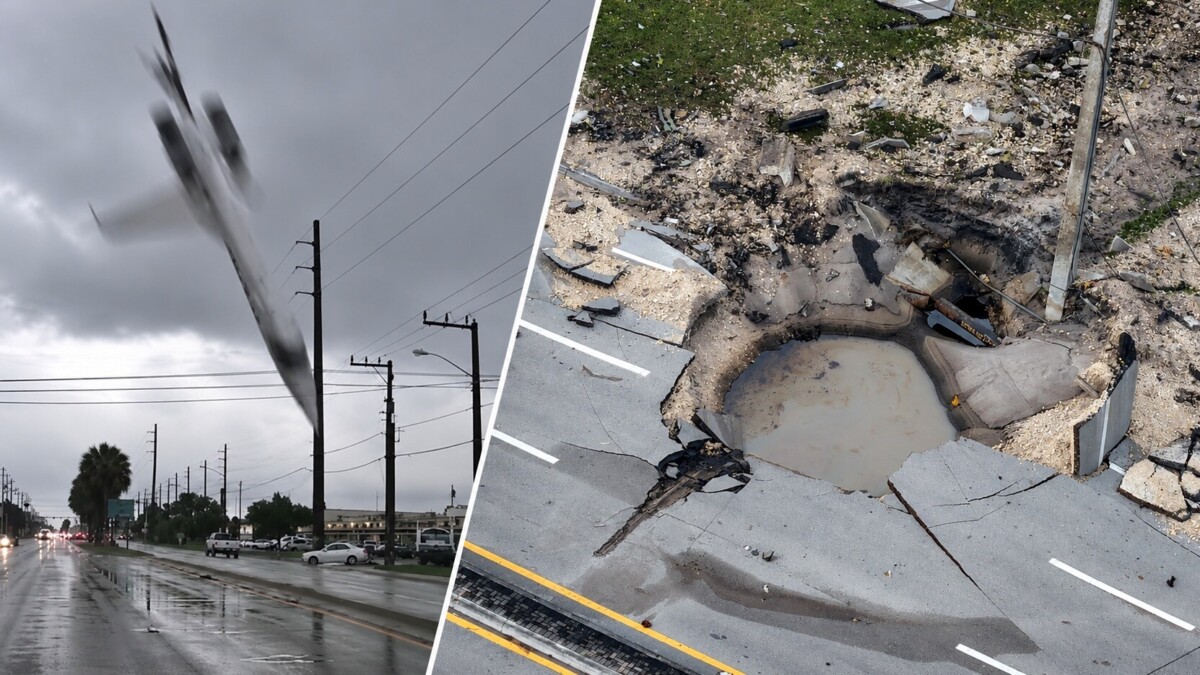
A crucial discovery was announced in the investigation of the Learjet 60 crash that claimed nine lives on Sunday in Florida. American investigators found part of the aircraft’s tail in three pieces, scattered up to 6 kilometers from the impact site. This discovery confirms that the plane began to break apart mid-flight before crashing to the ground. It now remains to be determined whether this break caused the disaster or occurred during the jet’s uncontrolled descent.
Three pieces of the elevator found several kilometers away
On Tuesday, during a press conference, Tom Chapman, a member of the National Transportation Safety Board, the U.S. agency responsible for transportation accident investigations, announced that most of the left elevator had been found in three pieces.
These parts were scattered between 2.1 and 6.1 kilometers from the crater dug by the plane in Greenacres, near West Palm Beach. Their distance confirms they detached before impact.
The elevator is a movable surface located on the horizontal stabilizer at the rear of the aircraft. It controls the aircraft’s pitch, meaning it directs the nose up or down. On the Learjet 60, the horizontal stabilizer is mounted atop the vertical fin, forming a T-tail.
Tom Chapman emphasized the importance of this discovery: « Knowing that this part was lost is very important evidence, which points us to other avenues to investigate. »
Did the break cause the crash or did it happen during the fall?
The question now is when this part of the tail tore off. As we explained in our previous article on the storm, icing, and the hypothesis of tail failure, the Learjet underwent an extremely violent descent, losing about 7,700 meters of altitude in just 62 seconds.
At very high speeds, aerodynamic forces can exert considerable stress on an aircraft’s structure. A sudden recovery attempt can also cause structural overload.
Tom Chapman acknowledged that investigators still cannot determine whether the elevator was torn off before the loss of control or during the descent: « We do not yet know what this exactly means regarding the causes of the aircraft’s loss of control, nor if the disappearance of this part resulted from the forces the plane was subjected to. »
The NTSB official also explained that losing the elevator severely compromised any recovery attempt. But he added: « At those speeds, I don’t know if it would have been effective even if it had remained attached to the plane. »
A brief 8-second stabilization before the final plunge
Another element draws specialists’ attention. Former NTSB investigator John Goglia indicated that trajectory data seemed to show the Learjet briefly interrupted its descent for about 8 seconds while at approximately 2,400 meters altitude.
According to him, a high-speed recovery attempt could have imposed excessive stress on the tail, causing some parts to separate. This hypothesis remains to be verified. Investigators will need to examine the fracture surfaces of the recovered pieces for signs of fatigue, mechanical failure, or aerodynamic overload.
Videos of the accident are also important elements. In some footage filmed from vehicles, the horizontal stabilizer already appears missing as the plane dives toward the ground.
Icing and turbulence: the copilot’s last alarming messages
Weather conditions remain central to the investigation. The Learjet had taken off Sunday from Austin, Texas, bound for the Bahamas, before encountering a rapidly developing storm cell over southern Florida.
The crew reported ice on the aircraft and turbulence causing sudden altitude changes. The pilots requested permission to climb to 37,000 feet, about 11,300 meters, before the situation deteriorated.
As shown in the last radio exchanges of 20-year-old copilot Nathalia Gadelha Filgueiras, the jet then plunged at a vertical speed momentarily exceeding 32,000 feet per minute.
The young woman reported an overspeed situation and an uncontrollable descent. In her last communications, she said: « We are going to crash! » before adding: « We don’t have time anymore! »
The NTSB will need to determine if icing or turbulence contributed to the initial loss of control and if the stresses during the descent caused the elevator to break.
9 dead, including two young children and their parents
The Learjet crashed Sunday around 12:50 p.m. local time in a residential area of Greenacres. The impact created a deep crater before causing a massive explosion and fire.
The nine victims have since been identified. Among them are American entrepreneur Adam Robinson, his wife Helen Sharp, their two young children, their nanny, two relatives, and the two crew members.
The violence of the impact greatly complicated investigators’ work. Part of the wreckage is buried in the crater, which filled with water after heavy rains. Teams must drain it to access elements still beneath the roadway.
The three pieces of the left elevator have been preserved for in-depth technical analyses. Investigators will especially try to determine if the breaks occurred simultaneously or successively.
The NTSB plans to publish a preliminary report in about a month. The full investigation, aimed at establishing the probable causes of the disaster, could take more than a year.








Respond to the article
Be the first to comment on this article.