

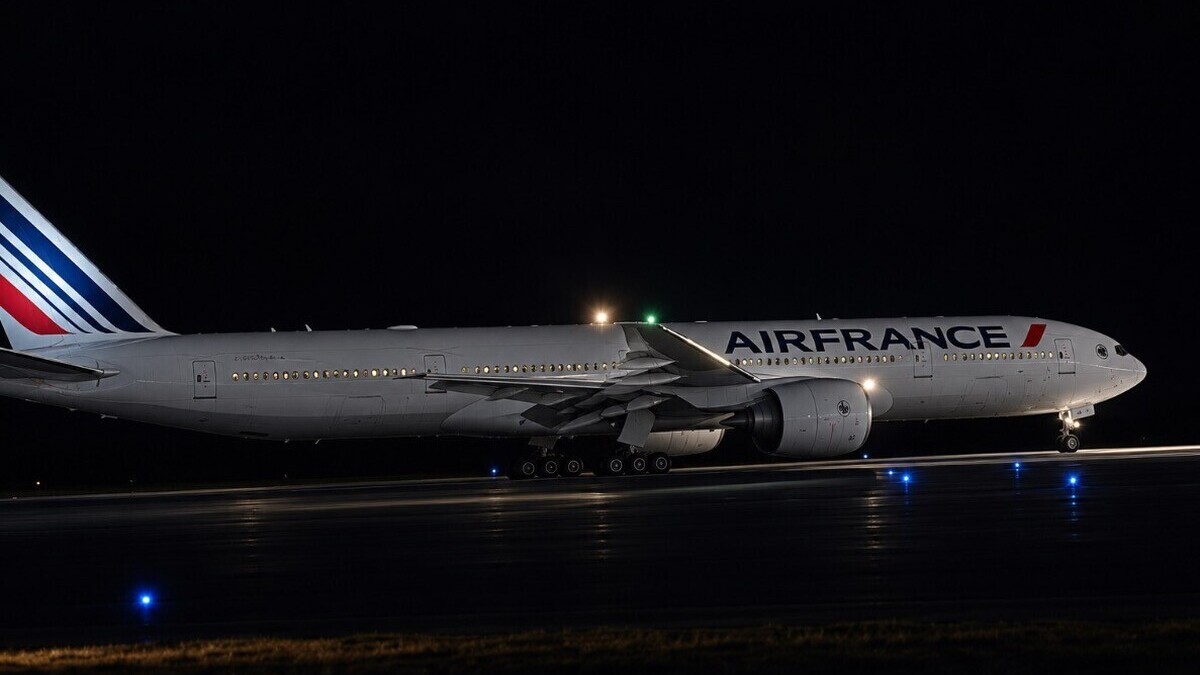
An Air France Boeing 777-300ER aborted its takeoff roll at Ottawa International Airport, Canada. The incident occurred last Sunday. As the aircraft accelerated down the runway to take off, the pilots decided to abort the takeoff and activated the engine thrust reversers to slow the plane. The long-haul aircraft ultimately came to a stop without leaving the ground.
The incident involved a Boeing 777-300ER registered F-GSQO, assigned to flight AF327 from Ottawa to Paris-Charles-de-Gaulle. The abort happened at low speed during the acceleration phase before takeoff. The reasons that led the crew to stop the maneuver have not been specified.
Pilots activate thrust reversers to stop the aircraft
The maneuver performed by the crew is called Rejected Takeoff. It consists of aborting the takeoff after the aircraft has already begun accelerating on the runway. Pilots reduce engine power, apply brakes, and may use thrust reversers to help slow the aircraft.
On the Boeing 777, these reversers redirect part of the engine airflow to produce a force opposing the aircraft’s movement. Usually used after landing, they can also be employed during a rejected takeoff. In the case of the Air France aircraft in Ottawa, their activation accompanied the deceleration of the long-haul plane until it stopped.
Why might an aircraft abort takeoff?
A rejected takeoff can be decided for several reasons: a technical alert, engine anomaly, aircraft configuration problem, obstacle on the runway, or air traffic control instruction. The decision notably depends on the speed reached and the nature of the detected problem.
Crews are trained for this procedure on simulators. They must especially respect criteria related to V1 speed, the decision speed calculated before each takeoff. Beyond this speed, an abort is normally only considered if the aircraft cannot fly, as the remaining runway distance may be insufficient to stop.
Air France has previously faced several incidents involving its long-haul aircraft. In February, a Boeing 777 had to return to Fort-de-France after an engine incident. In December 2025, an Airbus A320 flying from Paris to Ajaccio was diverted to Lyon following an engine anomaly.
Regarding the Ottawa episode, no precise information has been established about the anomaly or event that motivated the pilots’ decision. Flight tracking data for AF327 confirms that the Boeing 777-300ER ultimately reached Paris-Charles-de-Gaulle on Monday, November 2.








Respond to the article
Be the first to comment on this article.