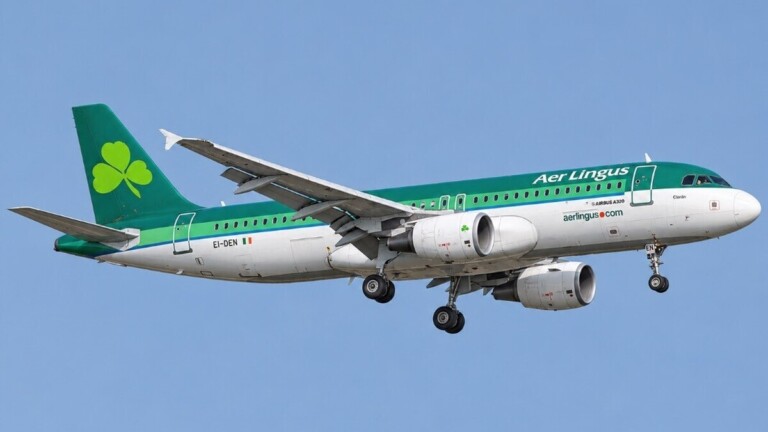
A particularly rare scene unfolded this Saturday at Los Angeles International Airport in the United States. As a Delta Air Lines plane was preparing to land, an earthquake shook the area, forcing air traffic control to order the pilot to immediately abort the landing. The scene, filmed live by a camera pointed at the airport, also captures the exchanges between the control tower and the crew.
"Delta 1972, throttle up, we have a major earthquake!"
The aircraft, an Airbus A319 operating flight DL1972 from Kansas City, was on final approach, landing gear down, when the ground began to shake.
In the footage, the camera suddenly begins to vibrate violently. Car alarms blare as the air traffic controller intervenes on the radio: "Delta 1972, go-around, we have a major earthquake!"
The crew immediately carried out the instruction. A few seconds later, the Airbus raised its nose, gained altitude and moved away from the runway.
A magnitude 5 earthquake strikes Los Angeles
The earthquake occurred around 9:30 a.m. local time, or 18:30 p.m. in France. Initially reported as having a magnitude of 5,2, the earthquake was ultimately assessed at 5 by the United States Geological Survey.
Its epicenter was located in the Pacific Ocean, about six kilometers off Manhattan Beach, near Los Angeles International Airport, at a depth of about twelve kilometers.
Several dozen aftershocks were recorded in the following hours. Broken windows and falling ceiling panels were among the damage observed inside the airport.
Why did the air traffic controller immediately abort the landing?
When an earthquake occurs, air traffic controllers cannot immediately determine if runways have been damaged. Cracks, deformations in the surface, or the presence of debris can compromise the safety of an aircraft upon impact with the ground.
A go-around is a safety procedure that pilots have mastered. It also helps prevent accidents when landing conditions present a danger.
In the event of an earthquake, the aircraft can remain airborne while ground crews inspect the runways. If the airport closure is prolonged and fuel reserves are insufficient to allow the aircraft to remain airborne for an extended period, the captain may decide to divert to an alternate airport.
Passengers generally cannot feel the earthquake.
Unlike people on the ground, pilots and passengers of an aircraft in flight generally do not feel the shaking caused by an earthquake, even when the aircraft is at low altitude.
Indeed, seismic waves propagate mainly through the Earth's layers . When they reach the surface, some of their energy is transmitted into the atmosphere in the form of low-frequency acoustic waves, generally imperceptible on board an aircraft.
Without the intervention of the air traffic controller, the crew could therefore have continued their approach without being aware of the earthquake.
The Airbus finally landed without incident.
After interrupting its approach, flight DL1972 performed another maneuver before being allowed to land at 10:01, about thirty minutes after the earthquake.
Runway inspections revealed no problems that would compromise aircraft traffic. Despite material damage observed in some terminals, Los Angeles International Airport was able to continue operations.
No serious injuries were immediately reported.
Sources cited in the article Institut d’études géologiques des États-Unis