

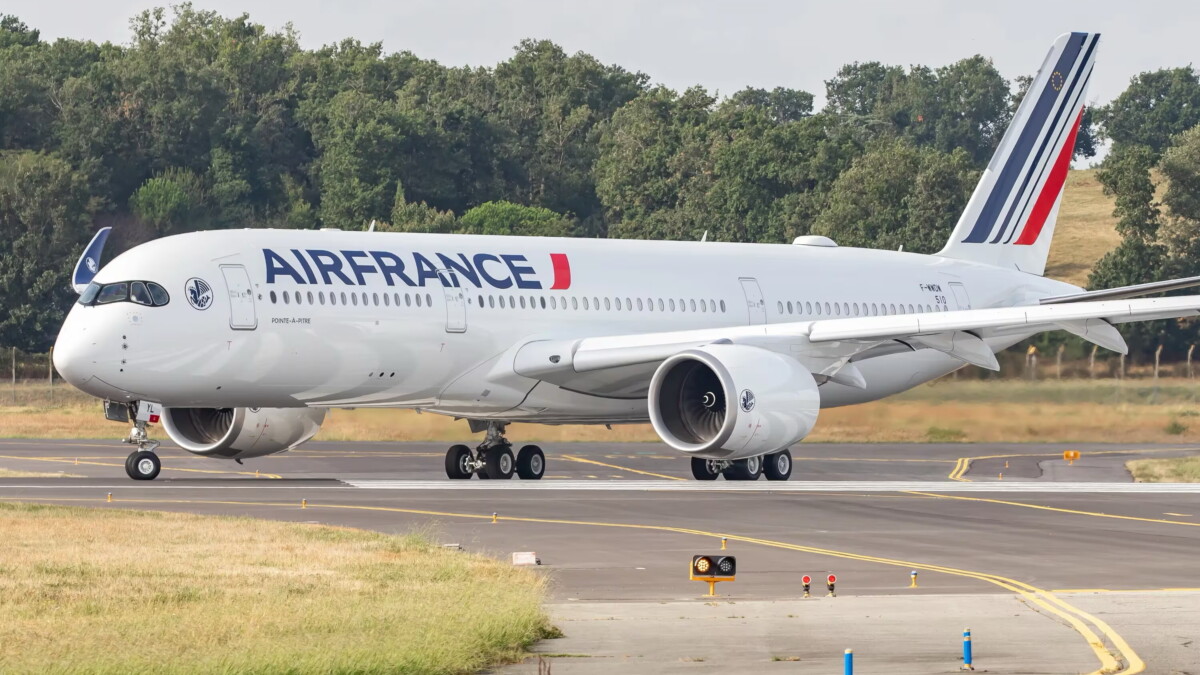
An Air France Airbus A350 avoided a collision with an American Airlines plane during the night from Friday to Saturday, shortly after its takeoff from Los Angeles International Airport, USA. The two aircraft found themselves on dangerously converging paths, with vertical separation dropping to about 120 meters. An unexpected turn by the French plane required immediate air traffic control intervention. Both planes, carrying passengers, ultimately continued their flights without damage.
Two planes take off one minute apart
The incident occurred this Saturday around 12:15 a.m. local time at Los Angeles International Airport, California. An Air France Airbus A350-900, registered F-HUVK, took off from runway 24L to operate flight AF28 to Papeete, French Polynesia.
About one minute later, an American Airlines Airbus A321-200, registered N191UW, departed from the parallel runway 25R. It was operating flight AA1660 to Dallas-Fort Worth, Texas.
Both aircraft began their climb over Los Angeles. The French crew had received clearance to follow the SUMMR2 departure procedure, a published navigation route designed to organize departures and maintain sufficient separation between planes.
But shortly after leaving the ground, the Air France Airbus initiated a left turn that did not correspond to the authorized trajectory. This maneuver brought it closer to the departure corridor used by the American plane, which was also climbing.
Only 120 meters apart vertically, the two Airbuses avoid disaster
Flight tracking data shows the two aircraft came dangerously close. Their vertical separation dropped to approximately 90 to 120 meters, according to available measurements. The minimum recorded horizontal distance was about 1.4 kilometers.
The departure air traffic controller immediately noticed the convergence. He ordered the French crew to promptly take a heading of 270 degrees, corresponding to due west, to move the A350 away from the other plane’s path.
At the same time, he instructed the American Airlines pilots to maintain their altitude at 2,000 feet, about 610 meters, although they had initially been cleared to climb to 5,000 feet, or 1,524 meters.
The controller also warned the American crew that another plane was directly ahead, less than one nautical mile away. The pilots immediately followed instructions, and both aircraft gradually regained sufficient separation.
« I need a response »: the controller demands explanations from Air France
Once the danger was averted, the air traffic controller questioned the French pilots to understand why they had made this turn. Recorded radio exchanges show the Air France crew was not immediately able to provide the requested details.
The controller notably asked them: « Under which procedure did you take off? I need a response. » After requesting additional time, the pilots eventually confirmed they had been instructed to follow the SUMMR2 procedure.
The controller then indicated a possible pilot deviation, a term used in U.S. aviation regulations, pilot deviation. He provided a phone number to contact for explanations regarding their trajectory change.
Addressing the American Airlines crew, he explained: « Sorry, the plane turned right in front of you, due to pilot deviation. » The American pilot acknowledged the intervention by responding: « Copy that, good job. »
Both planes continued their flights without injury or damage
After trajectory corrections, Air France flight AF28 was cleared to resume its climb and follow its route to Tahiti. The American Airlines aircraft also continued its route to Dallas-Fort Worth after receiving new climb clearance.
Both planes reached their destinations without further incident. No injuries or material damage were reported.
The reasons for the turn made by the French Airbus remain to be determined. Available information does not specify whether this deviation resulted from a misinterpretation of the departure procedure, incorrect programming of the flight management system, or another difficulty encountered in the cockpit.
The report of a possible pilot deviation by the air traffic controller does not constitute a definitive conclusion regarding the crew’s responsibilities.
A previous incident on Los Angeles runways
Los Angeles International Airport, one of the busiest in the United States, has several parallel runways allowing simultaneous takeoffs and landings. Departure paths are precisely defined to prevent planes leaving neighboring runways from coming dangerously close.
Other incidents involving trajectory changes after takeoff have already been reported at this airport. On October 20, a TAP Air Portugal Airbus A330-900 notably made an unexpected turn after departing runway 24L, forcing controllers to intervene to correct its path.



Respond to the article
Be the first to comment on this article.