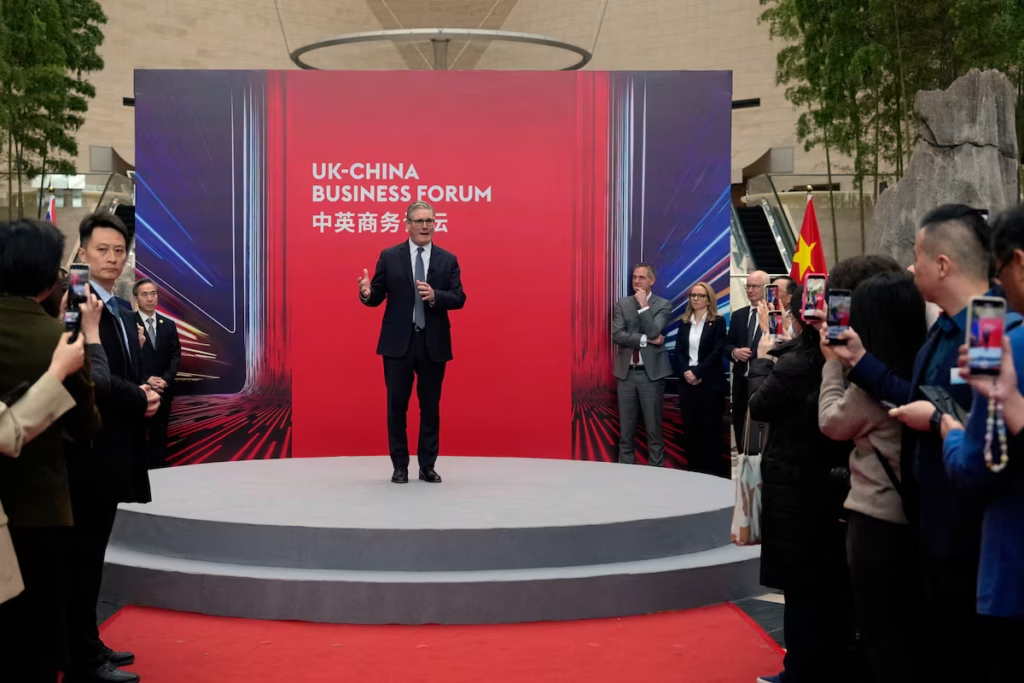
British Prime Minister Keir Starmer defended on Friday the necessity for the United Kingdom to maintain and strengthen its relations with China, rejecting the warnings of American President Donald Trump, who called the commercial rapprochement with Beijing “dangerous.”
While visiting China, Keir Starmer considered it “foolish” for London to turn away from the world’s second-largest economy. “For the UK to be the only country refusing to engage would not be in our national interest,” he said, emphasizing that other European leaders, including the French president and the German chancellor, have also increased exchanges with Beijing.
Starmer’s visit takes place amid diplomatic tensions linked to the unpredictability of American policy. Donald Trump recently criticized Western countries seeking to deepen their economic ties with China and threatened some allies with punitive trade measures. Asked about the Sino-British rapprochement, he said it represented “a great danger,” without providing further details.
The talks between Keir Starmer and Chinese President Xi Jinping lasted nearly three hours and resulted in several concrete announcements. Beijing agreed to reduce tariffs on British whisky, ease certain visa rules, and improve market access in China for British professional services.
On the investment front, the move was mainly favorable to China. The pharmaceutical group AstraZeneca announced a $15 billion investment in China, while more modest Chinese investment projects in the UK were also mentioned, notably in the automotive industry and research.
Keir Starmer assured that Washington had been informed of his visit and recalled that relations between London and the United States remain “very close.” He again affirmed that the UK does not have to choose between the United States and China, highlighting the American investments recently announced in Great Britain.
More willing in recent weeks to publicly challenge Donald Trump, the British Prime Minister has already criticized some of the American president’s statements on NATO and rejected his claims on Greenland. This firmness contrasts with his initial caution and reflects the Labour government’s desire to defend a foreign and trade policy it considers aligned with the country’s economic interests.