

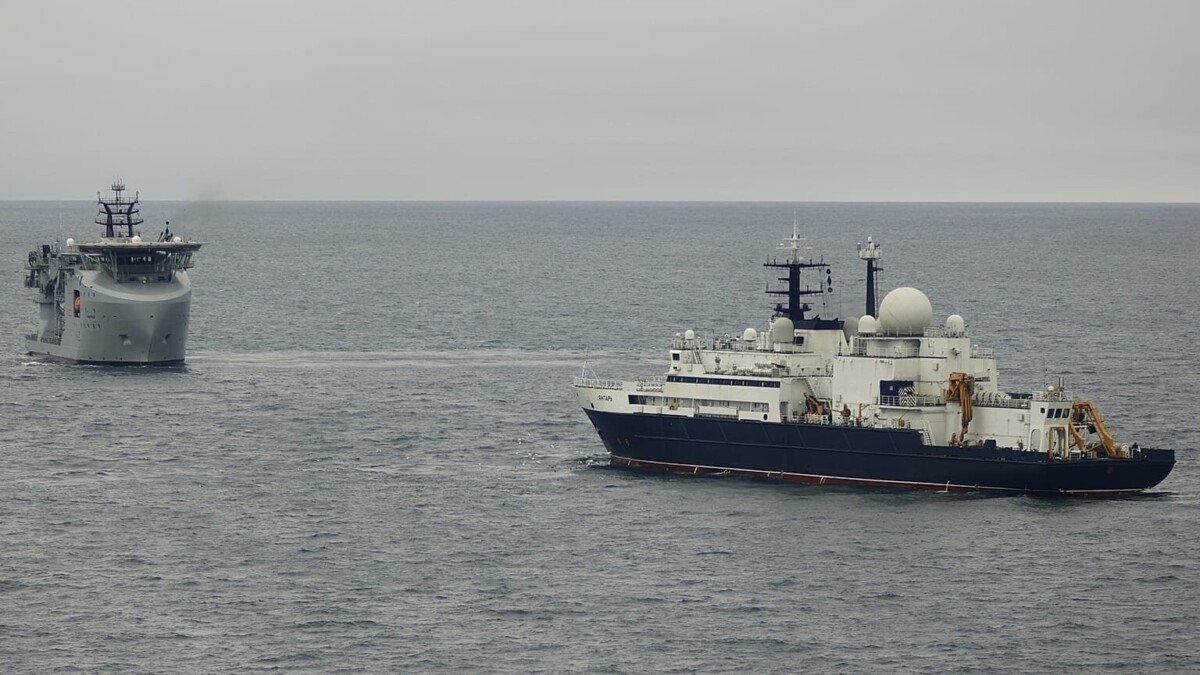
Three British warships and a helicopter spent three days tracking a Russian flotilla crossing the North Sea and the English Channel. The operation included monitoring two sanctioned cargo ships escorted by a Russian destroyer.
The operation lasted 72 hours and took place last week. The Royal Navy deployed the destroyer HMS Duncan, the frigate HMS St Albans and the patrol boat HMS Severn, supported by a Merlin helicopter, to monitor four Russian ships moving from the North Sea towards the English Channel.
Among the vessels observed were the cargo ships General Skobelev and Sparta, both subject to sanctions, escorted by the destroyer Admiral Levchenko towards Dover. Russia, for its part, deployed the frigate Neustrashimy to protect the convoy.
Admiral Gwyn Jenkins, Chief of the Naval Staff of the Royal Navy, described the operation as "intense" and warned that there was "no room for complacency" regarding the ships of the Russian shadow fleet, which he considers "an unacceptable risk" to British security. "This approach forces Moscow to divert its warships from their primary mission," he added, specifying that Russia "knows we are prepared to act again if necessary."
The Royal Navy had already reported a marked increase in Russian activity in its waters: in July, it spent 21 days monitoring ships coming from Moscow, a 25% increase compared to the previous year. Russian warships were observed on several occasions in the Strait of Dover and the North Sea.
In June, the Royal Marines seized the Russian oil tanker Smyrtos, a first: British soldiers had then directly boarded a ship from the ghost fleet, of which more than 500 units are under British sanctions.
These maritime tensions are occurring against a backdrop of deteriorating diplomatic relations. The Kremlin issued threats against the United Kingdom following Prime Minister Andy Burnham's visit to Kyiv, during which he announced the provision of military support to Ukraine, including plans for components for the Scalp long-range missiles. Former Russian Foreign Minister Andrei Fedorov stated that he could not "100% rule out" "semi-military" action against Great Britain, raising the possibility of attacks on British drone factories by "unknown sources."






Community
Comments
Write a comment
Be the first to comment on this article.