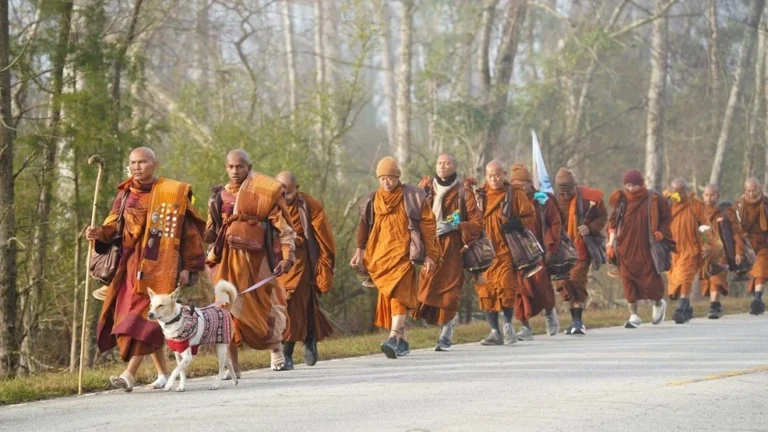
In saffron or ochre robes, walking silently along secondary roads and highways in the southern United States, a group of Buddhist monks draws the attention and emotion of Americans from all walks of life. Their journey, both spiritual and deeply human, consists of walking for peace, a meditative tradition more common in South Asia but now finding an unexpected resonance across the Atlantic.
Their trek began on October 26, 2025, at a Vietnamese Buddhist temple in Texas. It is scheduled to end in mid-February in Washington, where the monks hope to ask the United States Congress to recognize Vesak, the day of the Buddha’s birth and enlightenment, as a federal holiday. But beyond this symbolic goal, their priority remains meeting and sharing with the people they encounter along the way.
Their spiritual guide, the venerable Bhikkhu Pannakara, walks barefoot. At each stop, he teaches mindfulness, forgiveness, and inner healing. “My hope is that once this walk is over, the people we have met will continue to practice mindfulness and find peace,” he explains.
Sleeping under tents, the monks have been surprised by the scale of the welcome. Crowds gather in churchyards, in front of town halls, or in public squares, often well beyond religious circles. Their rescue dog, Aloka, who has become the group’s mascot, also contributes to this popularity: their journey is followed by millions of people on social media. In South Carolina, several thousand curious people gathered to see them sing in front of the State Capitol, where the mayor presented them with an official proclamation.
The walk is not without challenges. In November, in Texas, their escort vehicle was hit by a truck, injuring two monks, one of whom lost a leg. The group, reduced to 18 members, continued nonetheless. The long distances, the scorching asphalt, foot injuries, and fatigue make the effort grueling. But, according to Pannakara, the meditative practice allows transcending the pain.
Everywhere, churches, families, and local communities open their doors to them. At Christmas, a Methodist congregation in Alabama expected a small vigil: nearly a thousand people ultimately came to meet them. “Anyone who works publicly and sacrificially for peace is close to the heart of Jesus,” testified the pastor who welcomed them.
The monks emphasize one point: their walk is not a tool for conversion. It aims above all to inspire. “It is about showing, by example, that another relationship to the world is possible,” summarizes a university scholar specializing in Theravada Buddhism. This tradition of “walking for peace” is part of the legacy of monks who, since the 1990s, have crossed war zones to promote reconciliation.
Along their path, many say they find unexpected calm. Some come seeking a moment of quiet, others comfort in the face of grief or divisions in American society. As a woman who traveled several hundred kilometers to see them confided: “I looked them in the eyes, and I saw peace there. It gave me the strength to move forward.”