

Levent Alpöge, a 34-year-old Turkish-American mathematician working at Anthropic, claims to have found a solution to the Riemann Hypothesis. This conjecture, formulated in the 19th century, is one of the seven Millennium Prize Problems. If a proof were validated by the scientific community, it would constitute one of the most important advances in the recent history of mathematics.
A spectacular announcement has shaken the world of mathematics. Levent Alpöge, a 34-year-old researcher employed by the artificial intelligence company Anthropic, claims to have solved the Riemann Hypothesis. This problem, posed in 1859 by the German mathematician Bernhard Riemann, concerns the distribution of prime numbers and remains one of the great open questions in mathematics.
The announcement does not, however, mean that the conjecture is now considered proven. A resolution of this importance requires a thorough examination of the proof by independent specialists. Mathematicians will have to verify each step of the reasoning before any scientific consensus can emerge.
Why is the Riemann hypothesis so important?
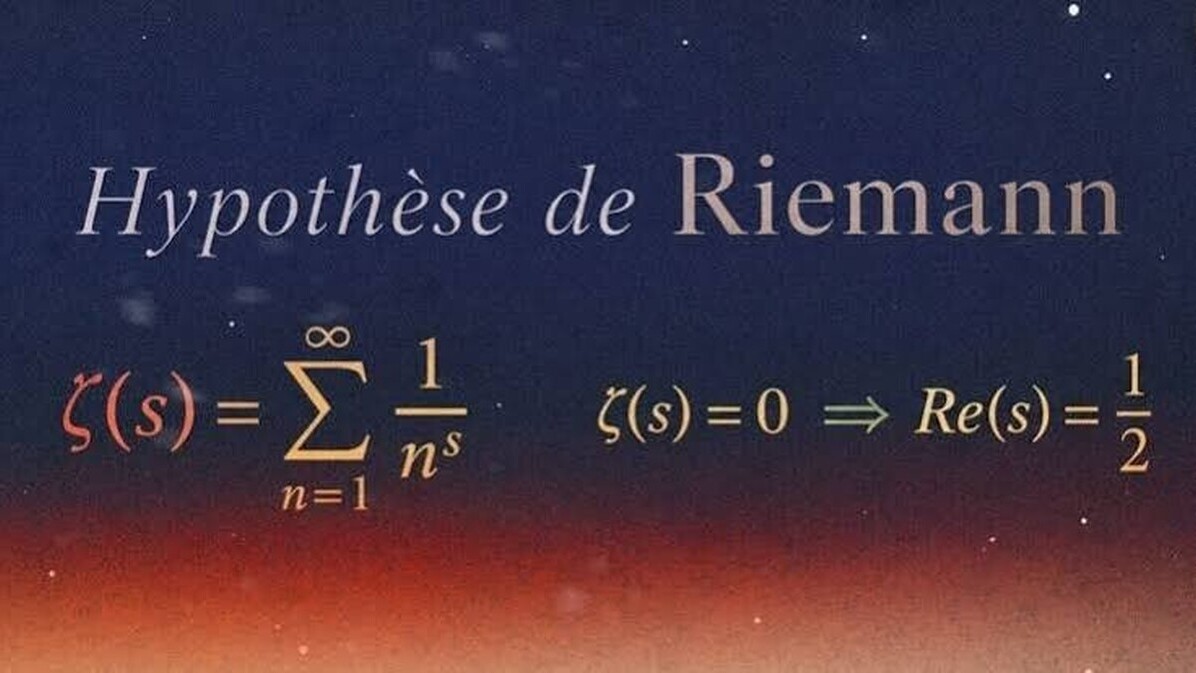
The hypothesis concerns the non-trivial zeros of a mathematical function called the Riemann zeta function. It states that all these zeros have a real part equal to one-half. Behind this abstract formulation lie profound consequences for understanding the distribution of prime numbers.
These numbers, divisible only by one and themselves, occupy a central place in number theory. They also play a role in certain cryptographic systems. A proof of the Riemann Hypothesis would confirm many conditional mathematical results and improve the understanding of several arithmetic phenomena.
Can artificial intelligence transform basic research?
The involvement of a researcher working at Anthropic draws attention to the relationship between artificial intelligence and mathematics. Computer systems can already help explore conjectures, verify certain proofs, and assist researchers in complex reasoning.
However, it remains essential to distinguish the exact role that AI may have played in the announced work. Levent Alpöge's employment at Anthropic alone is not sufficient to conclude that the solution was discovered by an artificial intelligence model. This question will need to be clarified by a detailed presentation of the methodology.
The Riemann Hypothesis is one of the seven Millennium Prize Problems defined by the Clay Mathematics Institute, each associated with a $1 million reward. Levent Alpöge's announcement could therefore mark a new chapter in mathematical research. But only rigorous validation will determine whether one of the most famous scientific enigmas has truly been solved.










Respond to the article
Be the first to comment on this article.