

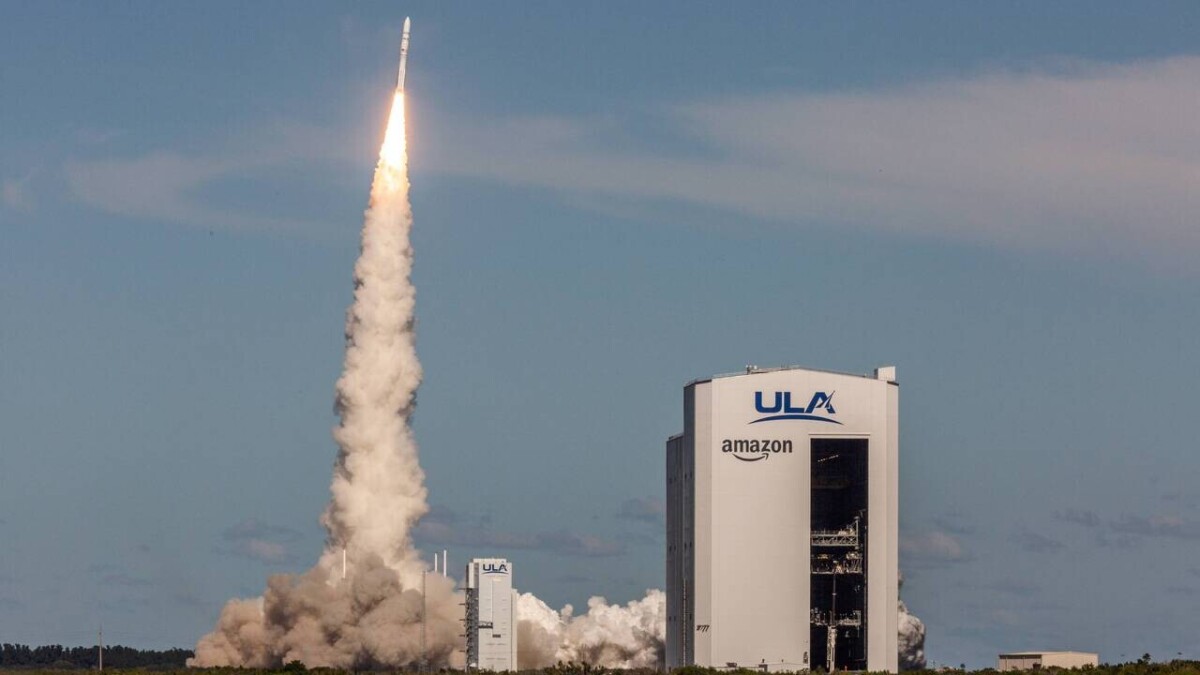
A mission aimed at strengthening Amazon’s Internet constellation was cut short after an anomaly occurred during the launch of a rocket carrying 40 satellites. Ten minutes after liftoff, a malfunction compromised their orbital deployment. This failure highlights the technical challenges faced by the American giant in its effort to compete with Starlink in the satellite Internet market.
Amazon’s space Internet network development has just suffered a setback. A rocket loaded with 40 new satellites to be placed in orbit encountered an anomaly about ten minutes after liftoff, compromising the entire mission. The devices were to join the telecommunications constellation developed by the American group to offer high-speed Internet connections from space. This technology relies on deploying hundreds, then thousands, of satellites operating in low Earth orbit, at altitudes much lower than traditional telecommunications satellites. The goal is to reduce communication latency and extend Internet coverage to areas where terrestrial networks are insufficient or difficult to install. The loss of a complete mission thus represents a setback for Amazon, whose strategy depends on a sustained launch pace.
The precise sequence of the incident will need to be established by technical investigations. An orbital deployment mission includes several successive phases, from engine ignition and initial ascent to stage separation and satellite deployment. An anomaly occurring after several minutes of flight can prevent the devices from reaching the speed or altitude necessary to remain in orbit. In such a situation, the satellites may be lost before even beginning their operation. The consequences do not only concern the onboard equipment: a failure can also lead to additional inspections, technical modifications, and postponements of future missions. The recovery schedule will notably depend on the origin of the malfunction and the conclusions of the teams analyzing the flight data.
Increasing competition with Starlink
For Amazon, this incident occurs during a decisive period. The group is seeking to develop its own space telecommunications infrastructure to compete with Starlink, the network operated by SpaceX. Elon Musk’s company already holds a considerable lead thanks to the massive deployment of satellites and the commercialization of its services to individuals, businesses, and some public actors. Amazon intends to gradually build an alternative, with the ambition to provide extensive coverage and high-performance connections. The project involves significant industrial investments, covering satellite manufacturing, ground infrastructure, reception terminals, and launch contracts. Each successful mission increases the network’s capacity, while a failure delays the constellation’s growth.
The development of satellite Internet also relies on a complex logistical organization. Operators must mass-produce their equipment, reserve launch capacities, and coordinate satellite commissioning with ground stations. Devices placed in low orbit also have a limited operational lifespan, requiring their gradual replacement. This constraint makes launch regularity essential. A lost mission can therefore impact industrial planning, even when the satellites involved represent only a fraction of the planned constellation. The multiplication of projects also raises issues of space traffic management, collision prevention, and orbital debris limitation.
Despite this setback, competition in space Internet is expected to continue intensifying. Connectivity needs in rural areas, isolated regions, and certain professional sectors offer significant commercial prospects. Satellite networks can also serve as a backup solution when terrestrial infrastructures are damaged or unavailable. For Amazon, the priority will now be to understand the causes of the anomaly and secure the next steps of its program. The incident reminds us that despite advances in launch technologies, access to space remains a demanding activity, where a malfunction lasting only a few moments can compromise several months of preparation and high-value equipment.









Respond to the article
Be the first to comment on this article.