

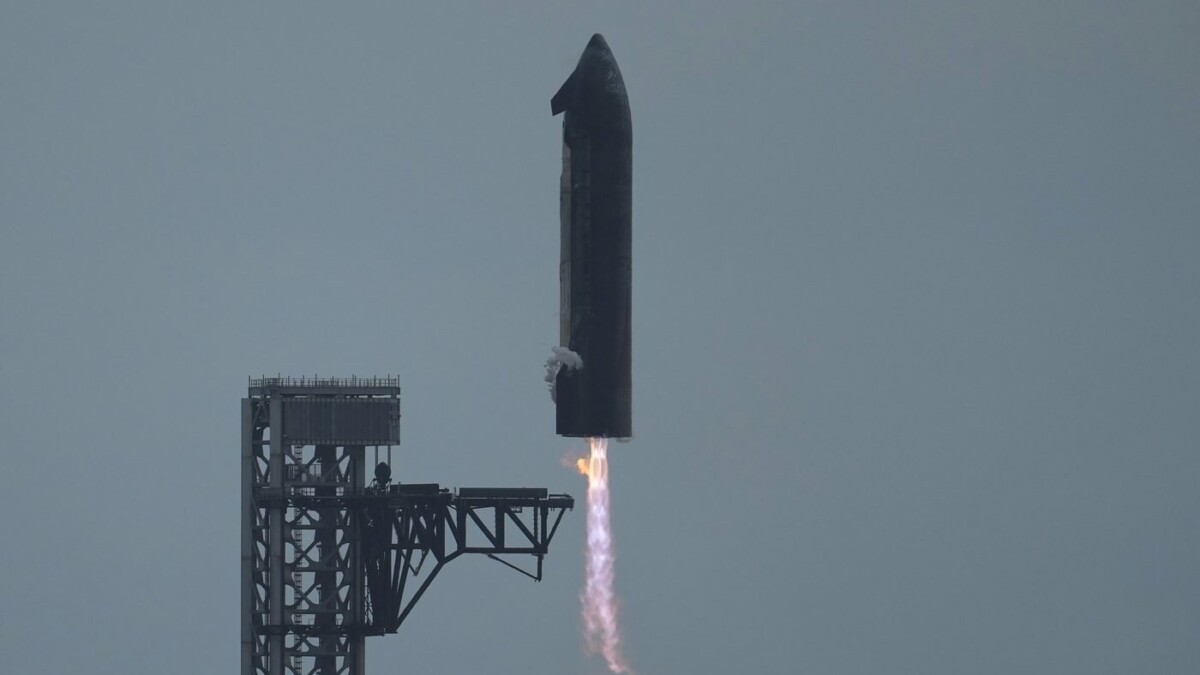
SpaceX 's Starship spacecraft landed on the robotic arms of its launch tower in Texas on Saturday, after more than 22 hours in orbit. This world first marks a decisive step in the race to develop a fully reusable rocket.
The Starship spacecraft accomplished on Saturday what no spacecraft had ever achieved before: returning precisely to the launch pad from which it had lifted off the previous day, slipping between the robotic arms nicknamed "wands" atop Launch Complex 2 in Texas . The maneuver, performed without a crew on board, prompted an immediate reaction from SpaceX commentator Dan Huot, who exclaimed live on air: "Can you believe it? Look at it! It's back!"
This was the fifteenth test flight of the largest and most powerful launch system ever built. During its mission, Starship completed fourteen orbits around the Earth and deployed twenty-six Starlink satellites , before returning safely after more than twenty-two hours of flight, the longest duration ever achieved by the vehicle.
This successful recovery represents a major milestone in the multi-billion dollar Starship program. Elon Musk considers this spacecraft the centerpiece of SpaceX's satellite business, as well as its ambitions to transport humans to the Moon and then to Mars. NASA, which itself funds part of the program to the tune of several billion dollars, hailed the event. The American space agency is counting on Starship to land its astronauts on the Moon as part of the Artemis program by the end of the decade, and to contribute to the establishment of a permanent lunar base. Its administrator, Jared Isaacman, summed up the achievement with the phrase: "It was almost magic."
The day was not without its setbacks, however. SpaceX had also planned to recover the rocket's lower stage, the Super Heavy booster, using the same method. This attempt had to be abandoned after the booster's engines shut down prematurely. Its guidance system, detecting an incorrect trajectory, triggered the self-destruct protocol, and the rocket exploded over the Gulf of Mexico shortly after liftoff. SpaceX engineers are still investigating the cause. This booster had, however, been successfully captured during three previous test flights.
Mastering the complete reuse of its launch vehicles is central to SpaceX's strategy for drastically reducing the cost of space launches. The recovery of the Starship spacecraft represents the most significant advancement in this regard since the program's inception.






Respond to the article
Be the first to comment on this article.