

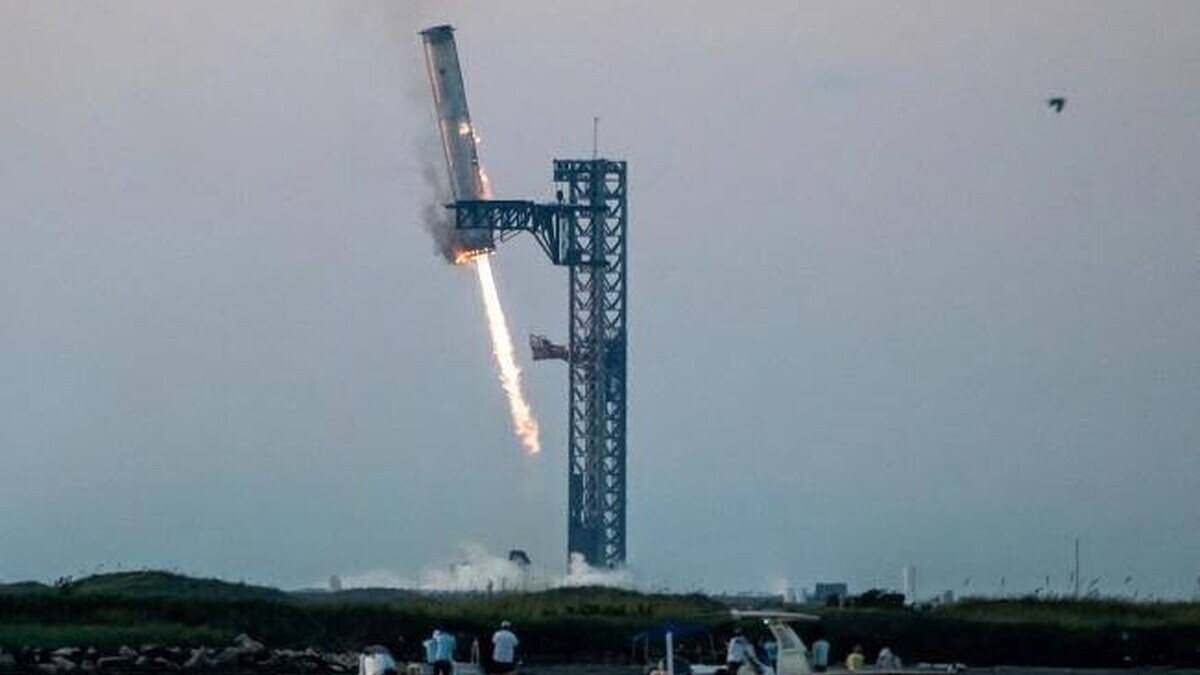
SpaceX is about to reach a new milestone in space exploration. This Friday, November 13, Elon Musk’s company is set to conduct the fifteenth test flight of its giant Starship rocket, with an unprecedented goal: to recover both stages using the mechanical arms of its launch towers. A particularly complex operation that could revolutionize the reuse of space launchers.
A major new event awaits SpaceX in Texas. The American company plans to launch its Starship rocket from its Starbase facility in the southern part of the state this Friday, November 13. The liftoff is scheduled from 10:45 PM French time, subject to weather conditions and regulatory approvals. This fifteenth test flight aims to test a maneuver never before attempted: to successively recover both parts of the rocket without landing them on a traditional platform.
Starship consists of two main components: the Super Heavy booster, responsible for providing the necessary thrust for liftoff, and the upper Ship vehicle, designed to carry payloads and eventually crews. SpaceX has already succeeded in recovering the first stage using the massive articulated arms of its launch tower, nicknamed “chopsticks.” However, the company has never yet attempted to catch the upper Ship vehicle after an orbital stay. This new step is precisely the main challenge of the mission.
Two recoveries separated by more than twenty hours
The scenario planned by SpaceX relies on two very different maneuvers. About six and a half minutes after liftoff, the Super Heavy booster must return to Starbase and slow down enough to be caught by the mechanical arms of the tower. This operation, already successful in previous tests, remains delicate due to the size of the launcher and the precision required to position it between the metal structures.
The recovery of the Ship vehicle will be much more complex. After reaching Earth orbit, it must complete about fourteen revolutions around the planet at an altitude near 275 kilometers. Its mission should last more than twenty-two hours before an attempted return to Texas, scheduled for Saturday, November 14. The vehicle will then have to withstand the extreme temperatures of atmospheric reentry, control its trajectory, and perform a final braking maneuver to reach the launch tower.
A mission also dedicated to Starlink satellites
Beyond recovering both stages, SpaceX plans to deploy 26 next-generation Starlink satellites. These devices are intended to contribute to the development of the company’s telecommunications constellation, which provides internet access services in many regions worldwide. The mission will also collect data on the vehicle’s behavior during an extended orbital flight and on the resilience of its heat shield.
The previous test, conducted on September 28, allowed Starship to reach orbit, but several technical difficulties led to shortening the mission. For this fifteenth flight, engineers have notably made modifications to the thermal protection system and continued testing the equipment necessary for recovery. SpaceX specifies, however, that the attempt to catch the vehicle will only be authorized if all safety parameters are satisfactory. In case of anomaly, a controlled reentry over the ocean remains planned.
A major challenge for future lunar and Martian missions
The full recovery of Starship represents a strategic objective for SpaceX. The company aims to develop a fully reusable space transport system capable of multiplying launches while gradually reducing their cost. Unlike traditional rockets, some elements of which are destroyed or abandoned after each mission, Starship must be able to be put back into service after inspection and maintenance.
This ambition far exceeds SpaceX’s commercial needs. The Starship program plays an important role in American plans for returning to the Moon, notably through NASA’s Artemis program. In the longer term, Elon Musk also intends to use this vehicle to transport humans and equipment to Mars. A successful double recovery would constitute a major technical advance, even though many tests will still be necessary before considering regular operation. For SpaceX, this Friday’s event could therefore mark a new step in the development of reusable space transportation.





Respond to the article
Be the first to comment on this article.