

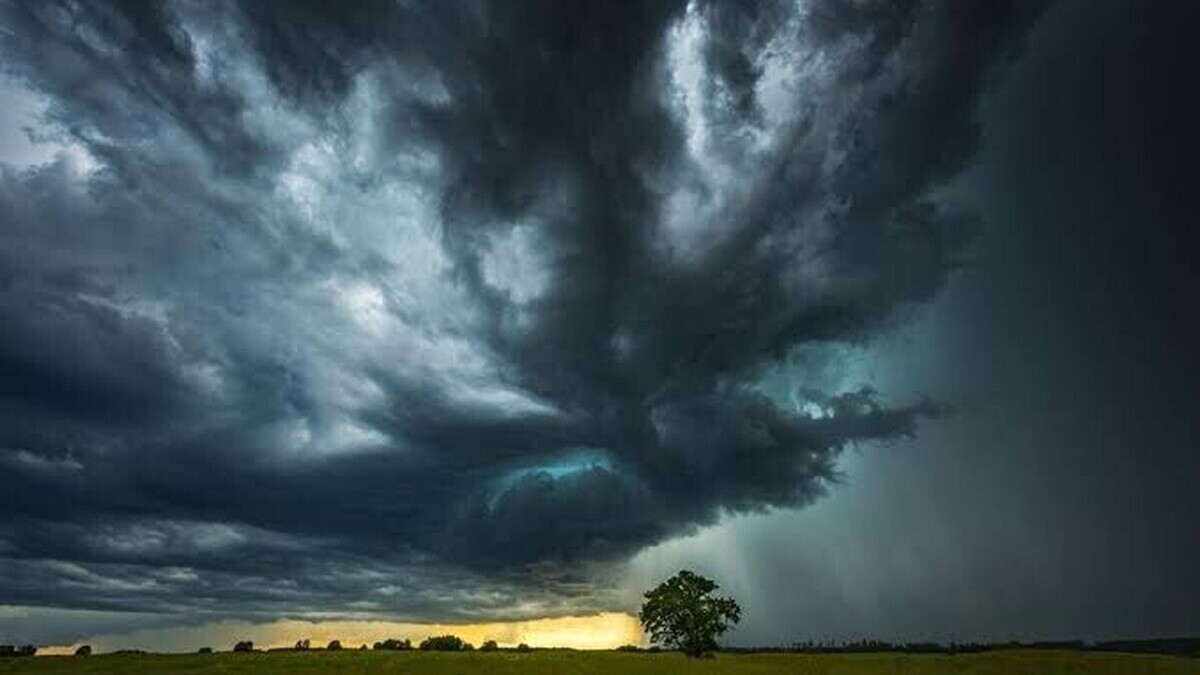
Still little known to the general public, atmospheric rivers nevertheless play a major role in the global climate. These immense corridors of water vapor, transported thousands of kilometers through the atmosphere, can cause exceptional precipitation when they reach continents. Between an essential resource for water reserves and a threat of devastating floods, this natural phenomenon is attracting increasing attention from meteorologists.
They are invisible to the naked eye but can carry considerable amounts of moisture over the oceans. Atmospheric rivers are one of the most important mechanisms in the global water cycle. Unlike terrestrial rivers, they are not composed of liquid water flowing in a bed but of water vapor concentrated in long, narrow atmospheric corridors. These structures can extend over several thousand kilometers and reach several hundred kilometers in width. Their movement mainly depends on prevailing winds and low-pressure systems circulating over the oceans.
The phenomenon is particularly frequent over the Pacific and North Atlantic. When an atmospheric river encounters a mountain range or a region subject to conditions favorable to condensation, the transported moisture can turn into heavy precipitation. The rains can then last for several hours or even days and cause significant flooding. Some atmospheric rivers are notably responsible for extreme weather episodes observed on the west coast of the United States, in Canada, and in several European regions.
Invisible highways that carry moisture from the oceans
The formation of an atmospheric river depends on the meeting of a large amount of water vapor and winds capable of transporting it over long distances. Warm air can hold more water vapor than cold air. Over the oceans, evaporation thus feeds moist air masses that can be carried by atmospheric circulation. When conditions are met, this moisture concentrates in relatively narrow bands, creating true corridors for water vapor transport.
Scientists use satellite observations and weather models to track these structures. Contrary to what their name might suggest, atmospheric rivers are not necessarily synonymous with disasters. They contribute to the transport of moisture between tropical regions and temperate latitudes. In some parts of the world, they even represent a significant portion of annual precipitation and help fill reservoirs, recharge groundwater, and accumulate mountain snow.
Why can they cause major floods?
The danger arises when an atmospheric river transports a particularly large amount of moisture to a region already exposed to heavy precipitation. When air masses encounter mountainous terrain, they are forced to rise. As altitude increases, the air cools, which promotes condensation of water vapor and precipitation formation. This mechanism, called orographic lift, can significantly enhance rainfall on windward slopes.
The consequences depend notably on the duration of the episode, the intensity of precipitation, and soil conditions. When the land is already saturated with water, new rains run off more quickly into watercourses, increasing the risk of overflow. In mountainous regions, heavy precipitation can also cause landslides. If rain falls on a snowpack and is accompanied by a thaw, snowmelt can exacerbate floods. Atmospheric rivers thus constitute an important factor in several hydrological disasters.
A phenomenon also present in France and Europe
While atmospheric rivers are particularly studied in the United States, they also affect Western Europe. The Atlantic Ocean is an important source of moisture for weather systems that regularly reach the continent. Some disturbances can carry large amounts of water vapor from subtropical regions to the British Isles, the Iberian Peninsula, or France. These episodes are sometimes associated with persistent rains and significant accumulations, especially when disturbances slow down or encounter terrain.
In France, regions exposed to oceanic flows can be affected, particularly on the Atlantic coast and in certain mountain ranges. The Pyrenees, Massif Central, and Alps can experience precipitation enhanced by terrain. However, not all heavy rains observed in the country are caused by atmospheric rivers. Mediterranean episodes, for example, rely on mechanisms that can be different, although concentrated moisture transport can sometimes contribute to their intensity.
Climate warming could intensify some episodes
Climate change is an important factor in the evolution of these phenomena. According to the physical principles described by the Clausius-Clapeyron relation, the atmosphere’s capacity to hold water vapor increases by about 7% per degree Celsius of warming, when other conditions remain comparable. A warmer atmosphere can therefore favor greater moisture transport and contribute to intensifying some extreme precipitation episodes.
Climate projections suggest that atmospheric rivers could become more intense in several regions of the world. Their frequency, trajectory, and local effects remain variable depending on geographic zones and climate scenarios. Researchers also emphasize that flood risk does not depend solely on the amount of moisture transported but also on urbanization, soil artificialization, and the capacity of territories to absorb precipitation. The evolution of these phenomena thus represents an important challenge for climate change adaptation.
How do meteorologists monitor these phenomena?
Monitoring atmospheric rivers relies on several complementary tools. Satellites allow observation of water vapor distribution over the oceans, while numerical weather prediction models analyze air mass movements. Meteorologists notably use an indicator called integrated water vapor transport, which measures the amount of moisture moved horizontally in the atmosphere. This tool helps identify the most active corridors and anticipate regions likely to receive significant precipitation.
In the United States, scientists have developed a scale to classify some atmospheric rivers according to their intensity and duration, from category 1 to category 5. This classification takes into account both potentially beneficial effects and associated risks. In Europe, meteorological services also integrate moisture transport analysis into their forecasts. In France, meteorological vigilance and flood monitoring systems inform populations when significant precipitation threatens territories.
An essential phenomenon for the water cycle, but difficult to control
Despite the risks they represent, atmospheric rivers play an essential role in the hydrological balance of many regions. They help supply water resources, replenish reserves after drought periods, and maintain certain ecosystems. In California, for example, several atmospheric river episodes can provide a significant portion of annual precipitation. Their prolonged absence can therefore contribute to worsening water deficits.
The real challenge is to better anticipate their consequences. Improving weather forecasts, monitoring watersheds, and land planning can help limit damage caused by the most intense episodes. As the climate evolves, these immense moisture currents should occupy an increasing place in scientific work dedicated to extreme events. Invisible from the ground, atmospheric rivers remind us that some of the most powerful phenomena on our planet occur several kilometers above our heads.









Respond to the article
Be the first to comment on this article.