

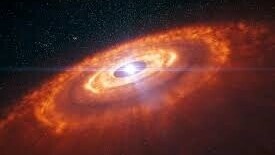
Astronomers have identified water ice and carbon dioxide ice in the protoplanetary disk of Beta Pictoris, a young star located 64 light-years away. These ices, whose composition resembles that of comets in our solar system, could indicate that the ingredients necessary for forming water-rich worlds are widespread in the universe.
This is a discovery that challenges the usual timeline of planetary formation. Thanks to the James Webb Space Telescope, a team of researchers led by Sarah Betti, an astronomer at the Space Telescope Science Institute in Baltimore, detected water ice and carbon dioxide ice in the dust and debris disk surrounding Beta Pictoris. The results are published in the journal Science.
Beta Pictoris is a young star, about 20 million years old, located approximately 64 light-years from Earth. Its circumstellar disk, one of the first to be directly imaged as early as 1984, is observed almost exactly edge-on from Earth, making it a natural laboratory for studying the genesis of planetary systems. Astronomers have already confirmed the existence of three forming planets there.
What James Webb revealed intrigues the scientific community: the water ice present in this disk is glassy in nature, not crystalline. This characteristic suggests it formed in a very cold environment, well before the star itself ignited, making it ice older than Beta Pictoris. It is mixed with carbon dioxide in proportions very close to those observed in comets of our own solar system.
The Beta Pictoris disk is classified as a debris disk: the dust composing it is continuously regenerated by collisions between comets and planetesimals, these small rocky and icy bodies that constitute the building blocks of planets. It is precisely in this context of ongoing collisions that the ice detected by James Webb would have survived, trapped in fragments resulting from these impacts.
The compositional similarity with solar system comets is the element that draws the most attention from researchers. It suggests that the materials necessary for forming oceanic, and potentially habitable, planets are not unique to our cosmic neighborhood but could be found around many young stars across the galaxy.










Respond to the article
Be the first to comment on this article.