

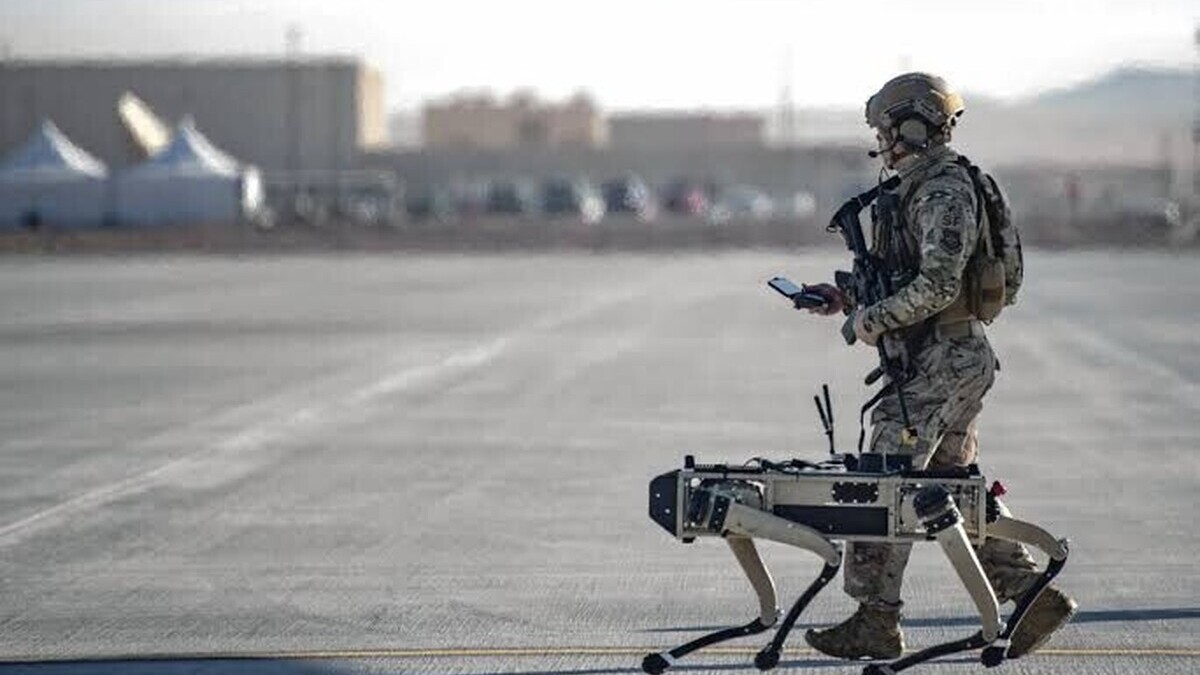
As artificial intelligence takes an increasing role in armed conflicts, France is trying to advance its international regulation. At a conference organized in Geneva starting November 16, Paris advocates for the regulation of autonomous weapon systems based on maintaining human control. This ambition faces resistance from several military powers, in a context of a global race for new defense technologies.
Artificial intelligence is gradually becoming one of the major transformations of modern warfare. Capable of analyzing images, identifying threats, and assisting military personnel in their decisions, it now equips a growing number of systems used on battlefields. But its development raises a particularly sensitive question: how far can a machine be allowed to decide on the use of force? This is notably the question that states must try to answer during international discussions held in Geneva.
The seventh Review Conference of the Convention on Certain Conventional Weapons brings together representatives of the States Parties around several issues related to armaments. Among the most debated topics is the possibility of adopting an international instrument to regulate autonomous weapon systems. France is among the countries in favor of progress on this matter, while wishing to preserve its military innovation capabilities and avoid constraints that would not be applied by its main strategic competitors.
Human control at the heart of the French position
French doctrine has gradually evolved in response to technological advances. For several years, Paris defended the principle that an operator must systematically intervene in the decision to engage a weapon. This approach was based on a distinction between fully autonomous systems, which France opposed, and those integrating only certain automated functions.
Now, French authorities favor the notion of « meaningful » or « appropriate » human control. Presented notably on November 12 by Rear Admiral Vincent Sébastien, Deputy Director of the Ministry of Defense’s Artificial Intelligence Agency, this orientation aims to ensure that a military operator retains sufficient understanding of the system’s functioning and its consequences. It would also allow for more automation in certain situations, notably to intercept enemy drones.
The war in Ukraine accelerates transformations
The evolution of this doctrine is partly explained by lessons from recent conflicts. In Ukraine, the massive use of drones and automated systems has profoundly changed military operations. Armies now seek to detect threats more quickly, protect their positions, and limit the exposure of their soldiers. In some situations, the speed of attacks requires extremely short reaction times.
France is also developing its capabilities in this field. The army is notably experimenting with the Pendragon project, aimed at integrating more robotic systems into its operations. Artificial intelligence technologies are also used for intelligence analysis, mission preparation, and decision support. These innovations present operational interest but raise questions about algorithm reliability and responsibility in case of error.
Disagreements among major powers
International negotiations remain complicated by differing positions among states. Several European countries, including France, Spain, Italy, Finland, and the Netherlands, support the idea of a common framework. Others, such as Austria, Belgium, and Ireland, advocate for broader restrictions on certain categories of autonomous weapons.
The United States is much more reserved about creating new legal obligations. Washington considers that existing international humanitarian law already regulates the use of military technologies, provided that some form of human judgment is preserved. Russia also opposes adopting new binding rules, while China takes a cautious position, favoring discussions without committing to a precise timeline.
Humanitarian organizations warn of risks
For advocates of strict regulation, the development of autonomous weapons carries major dangers. A computer system can make identification errors, operate based on incomplete data, or produce results difficult to anticipate. These limits become particularly concerning when decisions made can lead to human casualties.
Human Rights Watch, Amnesty International, and the Stop Killer Robots campaign have recently called on governments to act quickly. These organizations fear that the absence of specific international rules leaves civilian populations exposed to technologies whose capabilities advance faster than control mechanisms. The International Committee of the Red Cross also advocates for strengthened regulation of autonomous weapon systems.
France simultaneously invests in defense AI
Despite its regulatory ambitions, Paris continues to develop its own technological capabilities. The Ministry of the Armed Forces announced the creation in Rennes of an International Center for Defense Artificial Intelligence, with operational opening planned for summer 2027. This structure is intended to strengthen cooperation among partner countries, share experiences, and develop common methods to improve system reliability.
The future center is expected to initially host at least 34 civilian and military personnel, including 17 French. Several allied countries have already expressed interest in this initiative. The project illustrates the French strategy: to develop sovereign military artificial intelligence while seeking to define common principles with its partners.
The question of regulation remains unresolved. Between the demands of international humanitarian law, the need to protect civilian populations, and national defense imperatives, states struggle to find a compromise. The Geneva conference could allow progress toward an agreement, but no binding result is guaranteed. For France, the challenge now is to demonstrate that it is possible to develop increasingly autonomous military technologies without abandoning human responsibility in the use of force.










Respond to the article
Be the first to comment on this article.