

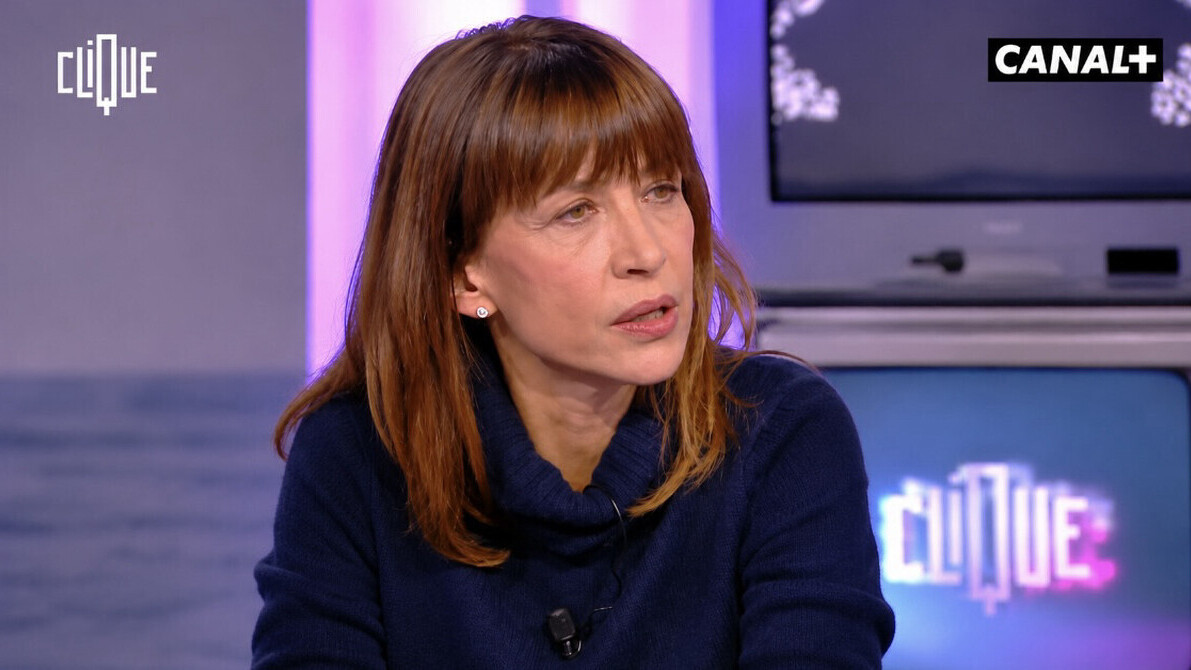
Sophie Marceau still hasn’t gotten over the songs in which Julien Clerc and Alain Souchon mentioned her chest. A guest on Clique on Canal+ this Monday, the actress strongly condemned the lyrics of the two singers, who had used her name in their songs in the late 1990s. Nearly thirty years later, she still considers these references to her anatomy an invasion of her privacy.
Two songs that openly talk about her breasts
It all started in 1997. Julien Clerc released Assez… assez…, a song written by David McNeil in which he mentions Sophie Marceau’s breasts. The song immediately provoked the actress’s anger, as she had obviously not been consulted before the release of the track.
Two years later, in 1999, Alain Souchon echoed this reference in Au ras des pâquerettes. Again, Sophie Marceau’s chest is explicitly mentioned in the lyrics.
On the set of Clique, Mouloud Achour revisited these two songs by discussing how the actress had been presented as an object of desire throughout her career. The host notably played her an excerpt from Alain Souchon’s song.
Initially amused upon hearing the song again, Sophie Marceau quickly changed her tone. The 60-year-old actress recalled how badly she had experienced this public exposure of her body, decided without her consent.
“Women’s bodies were appropriated like ordering an ice cream”
Sophie Marceau denounced the habits of a time when an actress’s fame seemed to allow all remarks about her physique: “They stripped you bare without asking your opinion. I find that unbearable.”
The actress then responded much more bluntly to the two singers, reminding that she had never sought to expose her anatomy: “Okay, I don’t show my breasts, they’re there, under my sweater. I’m not going to talk about the guy’s balls! It wouldn’t even cross my mind.”
For Sophie Marceau, these songs were not simply humor or a clumsy tribute. She believes they contributed to normalizing comments on the female body, regardless of the wishes of those concerned.
Sophie Marceau had already protested to the singers
The actress also revealed that she did not wait nearly thirty years to express her dissatisfaction. At the time, she had directly voiced her disapproval to those involved, without feeling heard.
Her reaction was even met with irritation. Sophie Marceau explained that she was reproached for not knowing how to take these references with humor, while she simply considered that her body should not become a song subject without her consent.
This controversy particularly marked her relationship with Julien Clerc. In May 2025, the singer himself addressed the matter during an interview with Jean-Luc Reichmann. He acknowledged that Sophie Marceau had badly experienced the lyrics of Assez… assez… and that she defended her right to control her image and body.
Julien Clerc then admitted that the actress was right to be offended and expressed his wish to apologize to her.
“We were props”: the actress also denounces 1980s and 1990s cinema
Beyond Julien Clerc and Alain Souchon, Sophie Marceau took advantage of her appearance on Clique to denounce how actresses were regarded in French cinema.
Revealed at only 13 years old in La Boum, in 1980, the actress grew up under the spotlight. Very early, her physical appearance and status as a glamour icon took a significant place in the commentary surrounding her career.
She believes that this attention to her body was also reflected in the role offers she received. The artistic qualities of actresses sometimes came after their appearance and their ability to bring a sexual dimension to a film: “We women, actresses, what interested them was neither our humor nor our intelligence.”
Sophie Marceau explained that some scene proposals seemed unjustified in the scripts. She sometimes felt that an actress was simply called on screen to provide a female presence or a touch of sensuality.
These statements extend her recent revelations about her difficult relations with Gérard Depardieu, notably on the set of Police, directed by Maurice Pialat in 1985.
A new statement on the occasion of her book release
Sophie Marceau was a guest of Mouloud Achour on the occasion of the publication of Warszawa, her autobiographical book released on October 29 by Seghers editions.
The actress notably reflects on her personal journey, childhood, memories, and relationship with fame. Her appearance on Canal+ allowed her to discuss several episodes of her career, including this controversy with Julien Clerc and Alain Souchon.
Nearly 30 years after the two songs, Sophie Marceau maintains her position: neither her fame nor her status as a sex symbol gave artists the right to freely use her body in their lyrics.






Respond to the article
Be the first to comment on this article.