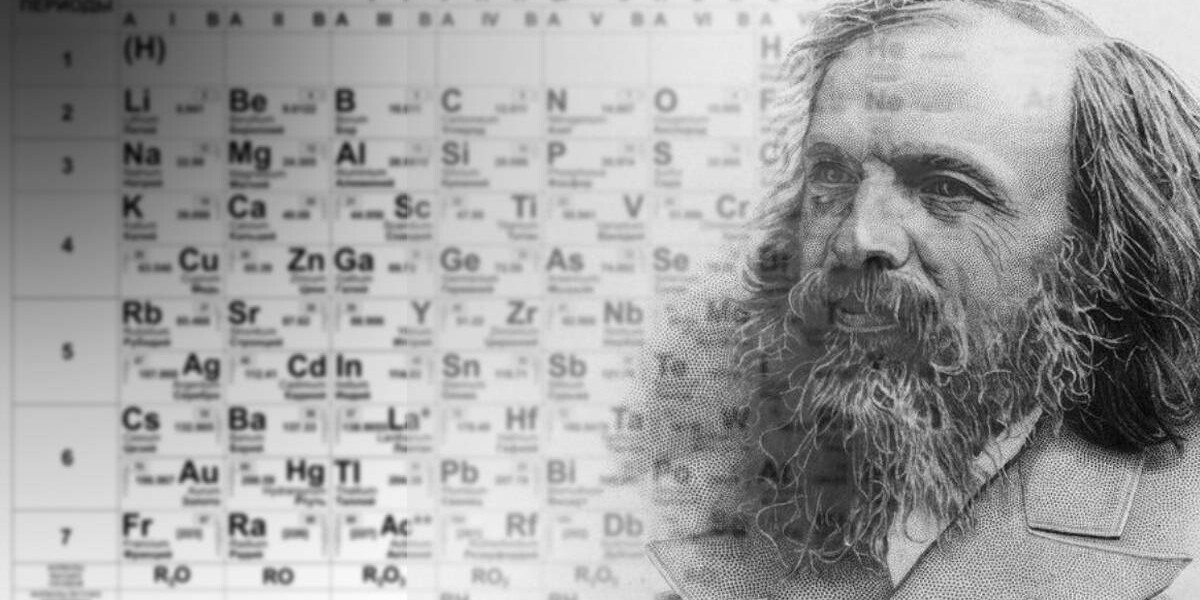
On March 6, 1869, the Russian chemist Dmitri Ivanovich Mendeleev presented to the Russian Chemical Society a new way to classify the known elements. His work resulted in the first version of the Periodic Table of Elements, an arrangement that helps to understand the relationships between the substances that make up matter. With this table, Mendeleev succeeded in bringing order to a still confusing field of 19th-century chemistry.
Classifying Elements to Understand Matter
At the time, chemists already knew about around sixty elements, such as hydrogen, oxygen, carbon, and iron. But there was no clear organization to relate their properties. A professor at the University of Saint Petersburg, Mendeleev was preparing a textbook titled Principles of Chemistry. While considering how to explain these elements to his students, he decided to classify them according to their atomic mass.
By arranging the elements in a table with rows and columns, he noticed that certain chemical properties repeated regularly. Elements with similar characteristics were then grouped in the same column. This regular repetition of properties gave rise to the idea of “periodicity,” hence the name periodic classification.
A Predictive Table
The originality of Mendeleev’s work was not only in the classification. Convinced that nature obeyed a logic still incomplete, he deliberately left empty spaces in his table for elements that had not yet been discovered. He even went as far as predicting their physical and chemical properties.
This scientific boldness was confirmed a few years later. In 1875, the French chemist Paul-Émile Lecoq de Boisbaudran discovered a new element, gallium, which corresponded exactly to one of the spaces predicted by Mendeleev. Other elements, such as scandium and germanium, later confirmed the validity of his classification.
Advances in Atomic Physics
At the beginning of the 20th century, studies on atomic structure helped explain why the properties of elements repeat. In 1913, physicist Ernest Rutherford showed that these regularities are explained by the electronic structure of atoms. Elements in the same row correspond to the progressive filling of an electron shell around the nucleus.
Thanks to these advances, the periodic table became a fundamental tool for chemistry and physics. It allows predicting the behavior of elements and understanding chemical reactions.
A Universal Tool of Science
Since its creation, the periodic classification has continuously been improved. New elements have been discovered or synthesized, bringing their total number to 118 today. Some, like uranium, occur naturally, while the heaviest are artificially produced in laboratories.
Despite these developments, the principle imagined by Mendeleev remains at the heart of modern chemistry. His table is still found in every classroom and laboratory worldwide. It remains one of the great symbols of the 19th-century scientific rise, an era marked by faith in progress and the desire to understand the laws governing nature.