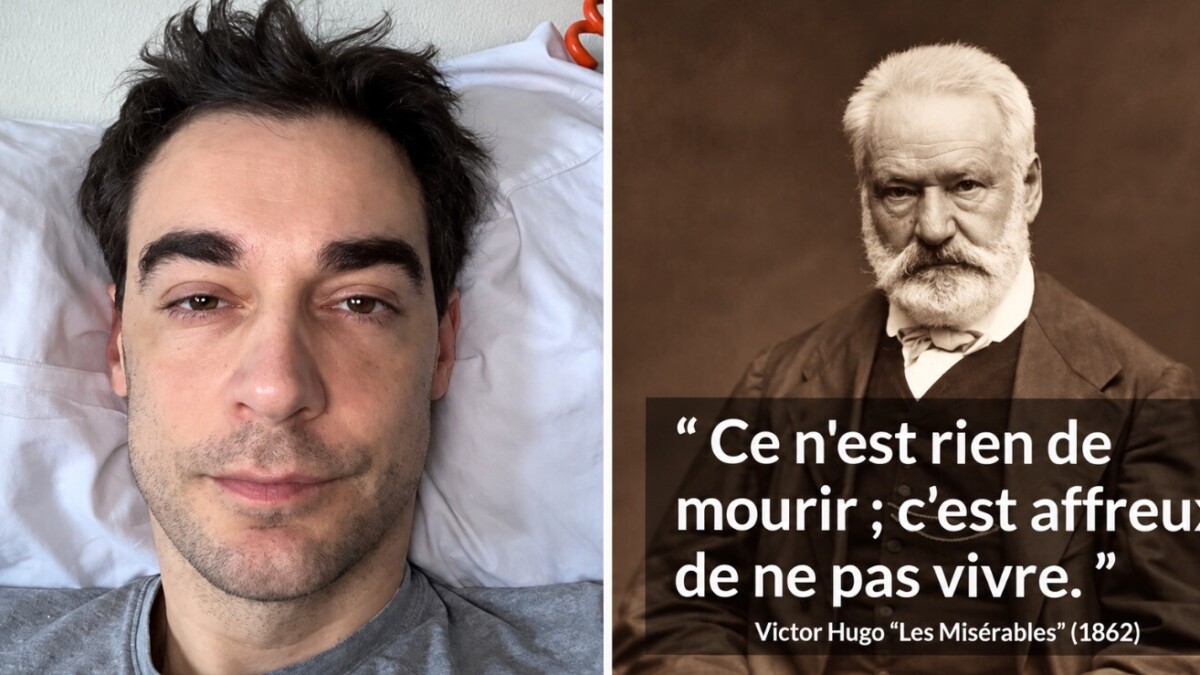
Arnaud Denis left a final, very long message before his death. The French actor and director died on September 22nd, at the age of 43, after undergoing euthanasia in Belgium. A few hours before his death, he published a text in which he recounts three years of suffering, accuses several actors of mishandling his medical treatment, and explains his decision one last time.
Since undergoing surgery for an inguinal hernia in 2023, Arnaud Denis had said he was living with very serious medical complications. In January 2026, he had already explained why he wished to resort to euthanasia after his health deteriorated . A prosthesis was removed in 2024, but the actor maintained that his condition had continued to worsen.
A final text published before his euthanasia in Belgium
On September 22, the death of Arnaud Denis at the age of 43, following his euthanasia in Belgium, brought to an end a battle he had been waging publicly for several years. The artist attributed many of his health problems to the hernia implant he had received in 2023 and denounced what he considered a series of failures in his medical care. In his final message, he gave his own account of his medical journey, named several institutions and organizations, and made serious accusations, the terms of which he personally endorsed.
Here is its full text:
"I'm done with medical mistreatment."
"I'm done with medical mistreatment."
I've already told my story at length. Three interminable years of deteriorating general health since hernia surgery in 2023.
Hernia prostheses: a health scandal.
ASIA Syndrome
debilitating pain
Gastroparesis
sexual mutilation
vascular mutilation
malabsorption
digestive and muscular collapse
Myalgic encephalomyelitis, abandonment and medical denial in France.
I am not thanking the APHP (Paris Public Hospitals) for abandoning me to my multiple and degrading suffering for three years of continuous deterioration of my general health, despite my efforts. I am not thanking them, especially since I had lost 17 kilos in three months after my inguinal hernia surgery in 2023, and I could no longer eat due to impaired intestinal motility. That wasn't enough for them. "Take laxatives." I had asked to be hospitalized. The response was: "The scan is normal," go home.
I wholeheartedly thank my attending physician, who is the only one who has tried everything, to no avail.
I am not thanking the neurologists for repeatedly refusing a muscle biopsy, even though I could no longer walk or support my back, neck, and hips. I am not thanking the Institute of Myology at the Pitié-Salpêtrière Hospital, which only performed a single EMG in 2024, without any follow-up, because it showed no abnormalities. Yet an EMG done at the Rothschild Foundation in 2026 clearly showed "chronic neurogenic abnormalities of the lower limbs." Nor am I thanking that neurologist at Kremlin- Bicêtre Hospital, who dared to note in a report "no gait disturbances," even though I was on crutches and wearing a neck brace. This man treated me with unimaginable aggression.
I went to the emergency room 12 times in one year. They started by telling me, "There's nothing wrong with you." And when I couldn't walk anymore, they told me one day, "Yes, but it's chronic now, there's nothing to be done. Go home."
I am not thanking the doctors of the CASPER Protocol at the Hôtel-Dieu hospital for minimizing the seriousness of my condition and writing a permanent note in my medical file, mentioning a "chronic" illness, thus preventing me from any further examinations or access to care, despite the continuous worsening of my condition. Not even pain management. I was abandoned in a medical dead end, without any support, told to "do some exercise," even though I had been pedaling at home on an elliptical trainer for two years, all the while continuing to lose muscle mass. And I'm now facing osteopenia, with risks of spontaneous fractures and tendon ruptures.
I have not even had access to palliative care in France, despite my requests, even though I am reduced to a bedridden state.
Someone in the care pathway failed to do their job on time, and afterwards it was too late.
I am not thanking the headache emergency department at Lariboisière Hospital for repeatedly refusing to record my appointments, which is against patients' rights, while I was suffering from excruciating headaches and had just lost 20% of my bilateral hearing, as well as part of my vision. "It's age, sir." Yes, at 40, it's normal to lose the ability to walk, to lose your hearing, and to have sudden blurred vision, of course. When I demanded to be recorded, they threw my file at me, saying, "Since you're being so insistent." They spoke to me as if I were an animal, a child, when all I was asking for was help.
People generally think, somewhat naively, that all it takes to get better and receive treatment is "going to the hospital." Unfortunately, that's not true. I used to think that too, before I was the victim of repeated medical errors. I was still a bit of a dreamer. My medical file is full of serious mistakes. It started with a lumbar puncture taken far too late (eight months after the neurological problems started) and analyzed "by special arrangement" because it arrived too late at the lab in Lyon, even though it had been taken in Paris , which reduced the chances of proper analysis. The result was an elevated cerebrospinal fluid protein level, which isn't specific enough and is more indicative of persistent neurological inflammation, likely due to a past infection that probably crossed the blood-brain barrier. My file states, "The person taking the sample must ensure it arrives within the required timeframe. There is a risk of underestimating the cerebrospinal fluid level." The sample arrived too late.
When illnesses stem from surgery, as in my case, doors close one after another, and you continue, powerless, to watch your own decline, without any help. A recent, damning report from the Court of Auditors demonstrates a massive underestimation of adverse events in French hospitals. "7000 reports of adverse effects in 2024, for an actual number estimated to be 20 to 50 times higher." (Source: France Info) This includes hospital-acquired infections, diagnostic errors, and serious medical malpractice. This phenomenon is responsible for at least 4000 deaths per year in France. I am a victim of repeated medical errors and of treatment that was far too late in relation to the appearance of my first alarming symptoms. Patients like me end up blacklisted by the public healthcare system.
I do not thank the radiologists for having ordered no less than 4 pelvic MRIs, to finally write in black and white that the inguinal prosthesis was "displaced to the right" and "compressed the spermatic cord" and caused a reduction of the iliac artery.
I'm not thanking Medtronic, the company that manufactured the implant that destroyed my body from the inside out—my immunity, my digestion, my sexuality. Nor am I thanking the surgeon who operated on me for never showing me the implant's information leaflet, with all its side effects. Otherwise, I would have run away. And he also conveniently neglected to tell me that in case of a problem or intolerance, it couldn't be removed without risking the destruction of my entire pelvic floor.
I have no thanks for the seven digestive surgeons I consulted following my numerous complications, who cowardly passed the buck. Nor for the twelve gastroenterologists, who offered no in-depth investigation for dysbiosis and chronic intestinal infection, and were content to treat the symptoms rather than look for the underlying cause, while the vitamins in my blood tests continued their inexorable decline.
I do not thank the ANSM for its lax approach to the alerts reported by affected patients. They are defending an industry, not patients.
I do not thank the French private clinics and hospitals that refuse to provide patients with hernia implant details, despite this being a legal obligation for traceability. This discourages patients from reporting adverse effects on the Ministry of Health's portal. This leads to massive underreporting and a completely distorted and poorly assessed benefit-risk ratio. This is a serious problem.
It is also unacceptable that digestive surgeons regularly receive payments from prosthesis manufacturers for conferences or all-expenses-paid trips. (Verifiable on Transparency in Healthcare). This conflict of interest does not benefit patients.
I am not grateful to the French justice system, which will undoubtedly dismiss the case and fail to establish a causal link. This is despite the fact that I was in perfect health before this procedure. There is no justice for victims of iatrogenic medical consequences in France.
So, after a brain PET MRI at Henri Mondor, which showed hypometabolism in certain brain regions, I was finally diagnosed with Myalgic Encephalomyelitis.
To all those suffering from Myalgic Encephalomyelitis, whose suffering is denied by the medical community in France and around the world: This is a health emergency. This debilitating post-infectious neurological disease affects millions of people worldwide. Millions, including young people and children, survive bedridden in the dark, in deplorable conditions. I am in contact with two young men, aged 23 and 27, who will soon resort to euthanasia in other countries, so intolerable are their living conditions. Some end up dying of malnutrition at home, so inadequate is the care they receive. There is no follow-up for the serious physiological complications that can result, including cervicocranial instability, occult tethered spinal cord, poorly documented cerebrospinal fluid leaks, and vascular compressions leading to cerebral hypoperfusion. Postural Orthostatic Tachycardia syndrome, viral reactivations, muscle abnormalities, central nervous system disorders, spinal nerve ganglionopathies, hypovolemia—none of this is being investigated in France. Research funding is ridiculously low compared to the number of people affected. This must change. Governments are inactive, leaving patients without therapeutic hope, in a deplorable state of neglect and devoid of human dignity.
As for the doctors who don't believe in the disease, even though it has been recognized by the WHO since 1969, shame on them. Shame on those who pathologize patients instead of keeping up with international research, while the Charité Hospital in Berlin, Germany, organizes annual conferences that bring together specialists from around the world. One day, we will be listened to. Post-infectious neurological syndromes must become a public health priority. Especially since they have exploded in staggering numbers since the Covid pandemic and are rendered invisible by the healthcare system. But how many deaths will there be by then? By personal choice or through slow and inexorable decline? We also fail to make the connection with the ever-increasing number of sick leaves. For my part, I worked on a theater stage without a break for 22 years. It's no picnic not being able to stand, walk, or get out of bed. I have absolutely no interest in continuing like this.
To all the victims of hernia prostheses, myself included, and thousands of others slowly deteriorating, burdened with pain, chronic infections, and countless complications, which are also ignored. Shame on the surgeons who abandon their patients with unbearable daily pain, telling them it's "all in their head," even though some are permanently disabled. "We can't see anything on the imaging, everything is normal," they say. How convenient: polypropylene isn't radiosensitive and disappears under inflammatory fibrosis. So, we won't "see" the causes of the pain in general. It's a terrible game of Russian roulette. I also regret that the prosthesis, which was removed from my body due to my numerous systemic symptoms, wasn't bacteriologically analyzed in the hospital laboratory, despite my prior request. This should be standard procedure. These prostheses, by virtue of their composition and their contact with the digestive system, are breeding grounds for staphylococcal infections.
As for those who would dare judge my decision to end my life with what little physical and moral dignity I have left, I forbid it. They are light-years away from imagining the constant physical and neurological suffering this disease causes. International quality-of-life studies rank myalgic encephalomyelitis among the worst possible quality of life conditions, among all chronic illnesses. The suicide rate is extremely high because there is no cure, no support, no one to listen. I held on, at all costs, for three years of excruciating suffering. Now I surrender. It is my right.
At least in Belgium . And I commend the profound empathy and sensitivity of the medical care I received there. Finally, someone listened to me, respected my dignity and physical integrity, and acknowledged my physical and emotional pain.
We're not there yet in France. My country has disappointed me to the very end: refusal of care, but refusal to help someone die. The message from the doctors is, "Die slowly at home, but without bothering us." I wasn't even entitled to palliative care, even though I can no longer wash or feed myself, and the back pain is unbearable. Euthanasia isn't a "terrible choice," no, when there's no longer any hope of relief. It's a liberation. And those who oppose it lack imagination and can't conceive that suffering can last indefinitely, for years, without any hope of improvement or treatment. They'll understand when they're there. Or when they've seen a loved one deteriorate so much, against their will, that there comes a point when, yes, enough is enough. It's enough. They shield themselves from this notion because it reassures them. It reassures them to think that medicine has an answer for everything, and that debilitating orphan diseases do not exist.
I refuse anyone the right to judge me. Unless you live for six months in the body of someone suffering from severe myalgic encephalomyelitis, to understand what absolute horror is.
I'm thinking of Samuel, 22, who went to Austria last February to end his life through assisted suicide, suffering unbearable neurological pain from the same illness. And whom some people dared to judge, on television and elsewhere, making vile remarks, while he was "surviving" bedridden in the dark.
I'm thinking of Kelvin, in the Netherlands, a brilliant 23-year-old, who is about to begin the same legal process in his country for severe myalgic encephalomyelitis. I'm thinking of Alicia Pallenchier, who has suffered for so many years. Of Johann Margulies, who wrote a magnificent book about the hell of this disease. Of Chantal Somm, president of the Millions Minssing France Association, who fights despite her exhaustion to protect patients from institutional abuse. And of so many others who suffer for years without respite. Of those who have left us in utter indifference and contempt throughout the world.
I'm not writing all this to elicit pity. I have no need for pity. Nor am I writing to draw attention to myself. I was the happiest man alive before I became seriously ill. I'm denouncing here the violence of a medical system that crushes the sick, instead of helping them, when they don't "fit the mold."
They will try to discredit my testimony, to minimize my suffering, because that's how the system is designed. Too bad for those who don't try to understand. There are those who live it. They know.
Even as thousands of hernia prosthesis victims gather in France, all sharing the same symptoms, digestive surgeons dare to speak of a "cabal" or a "conspiracy theory." Thousands of people are suffering, having lost their livelihoods, their mobility, their digestion, their sexuality, their emotional lives, their independence—everything that constitutes the dignity of a human life.
"I have always forgiven those who have offended me. But I have the list."
Jean Jacques Sempé.
To all my brothers and sisters in arms.
And to all those who have "boarded the train of my life" as d'Ormesson said, and whom I embrace with all my soul.
Arnaud.