

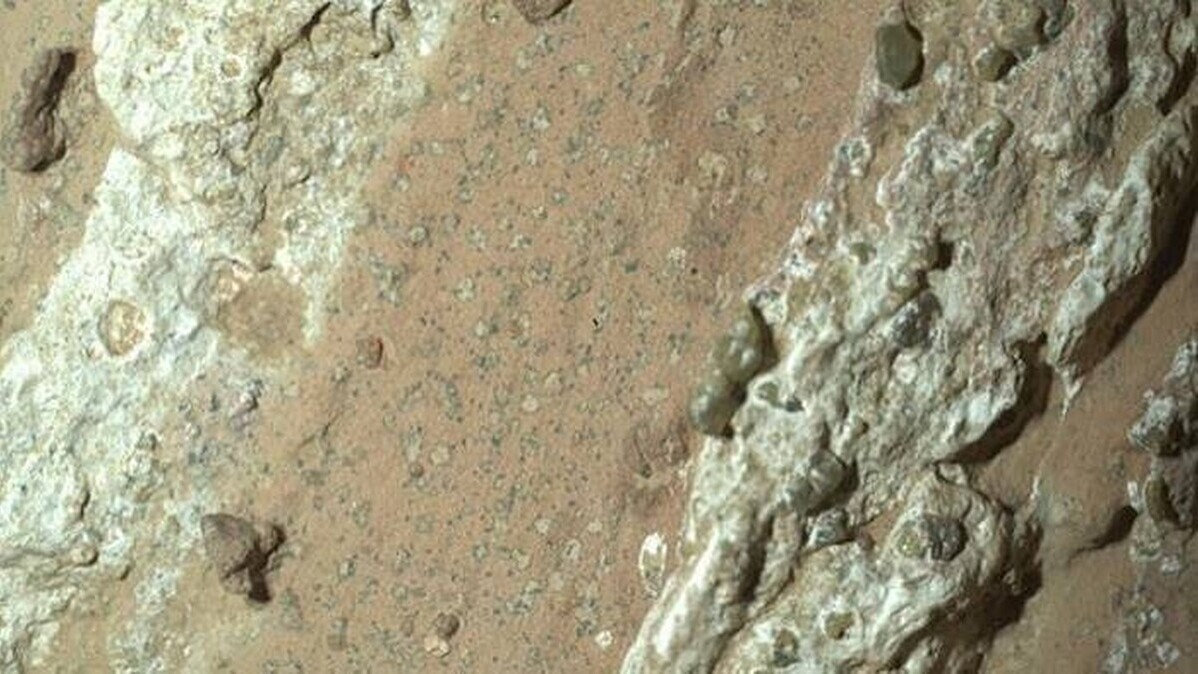
Mysterious rocks with shiny reflections are drawing scientists’ attention on Mars. Spotted during the exploration of the red planet, they could provide new clues about its geological past and the conditions that prevailed there billions of years ago. For NASA, their study is part of a major quest: to determine whether Mars once had the necessary conditions for the emergence and development of microscopic life.
The shiny appearance of certain rock formations can result from their mineral composition, the presence of crystals, or transformations caused by water and geological phenomena. These characteristics are of particular interest to researchers because minerals can preserve information about the environment in which they formed. Martian missions especially seek to identify traces of ancient interactions between water and rocks. The past presence of liquid water, already established in several regions of Mars, is a key element for understanding the planet’s ancient habitability.
Geological clues, but no evidence of extraterrestrial life
The study of these rocks could help better reconstruct the transformations undergone by the Martian surface. Scientists are particularly interested in mineral deposits that might preserve organic molecules or structures formed in environments once favorable to life. The Perseverance rover, exploring the Jezero crater, contributes to this research by analyzing rocks and collecting samples. However, a shiny rock alone does not constitute a biological clue: many purely chemical or physical processes can produce this appearance.
The search for traces of ancient life on Mars therefore requires cross-referencing multiple observations, including the chemical composition of rocks, their structure, and their geological context. Even the discovery of organic molecules would not be sufficient to prove the past existence of living organisms, since these compounds can also form without biological intervention. Analyses conducted directly on Mars allow selection of the most interesting formations, but thorough laboratory examinations may be necessary to distinguish between different hypotheses. These new observations thus remind us that the red planet still holds much information about its history, without any confirmed evidence of ancient Martian life having been established to date.










Respond to the article
Be the first to comment on this article.