

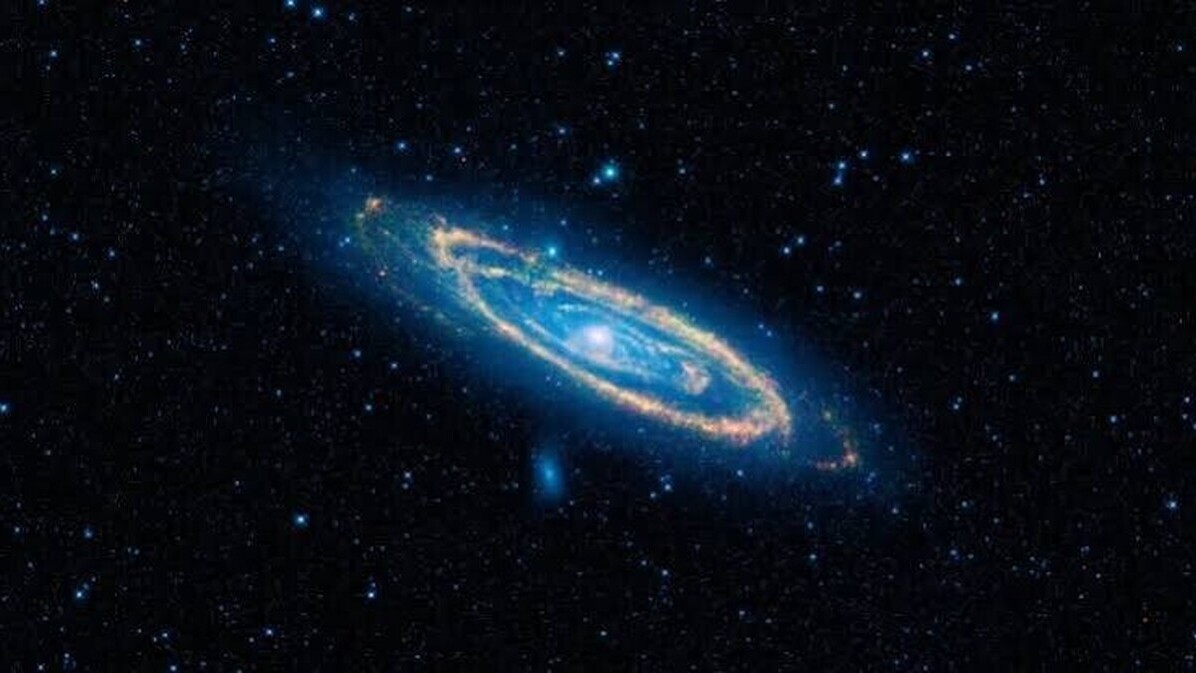
About 2.5 million light-years from Earth, in the Andromeda Galaxy, astronomers are studying a spectacular phenomenon: a giant star is believed to have engulfed its companion during a stellar merger. This event offers a valuable opportunity to better understand the final stages of life of certain star systems and the transformations that can occur when they dangerously approach each other.
The Andromeda Galaxy, neighbor to our Milky Way, continues to reveal fascinating phenomena. Astronomical observations suggest that a giant star has absorbed another star with which it formed a binary system. This type of event, called a stellar merger, occurs when two stars eventually join after a complex evolution of their orbits and gaseous envelopes.
Binary systems are common in the Universe. Unlike the Sun, which evolves alone, many stars have a companion around which they orbit. During their existence, gravitational interactions can profoundly alter their evolution. When a star expands into a giant, it can notably engulf its neighbor and trigger a series of spectacular transformations.
A cosmic encounter with significant consequences
The merger of two stars can release a large amount of energy and cause the expulsion of gas into space. Astronomers then look for brightness variations and spectral signatures to distinguish this phenomenon from other events, such as certain stellar explosions.
Studying these manifestations is particularly important because stellar mergers remain difficult to observe directly. Researchers have theoretical models describing interactions between stars, but each additional observation helps better understand the mechanisms involved. The mass of the stars, their initial distance, and their stage of evolution strongly influence the final outcome.
Andromeda, a natural laboratory for astronomers
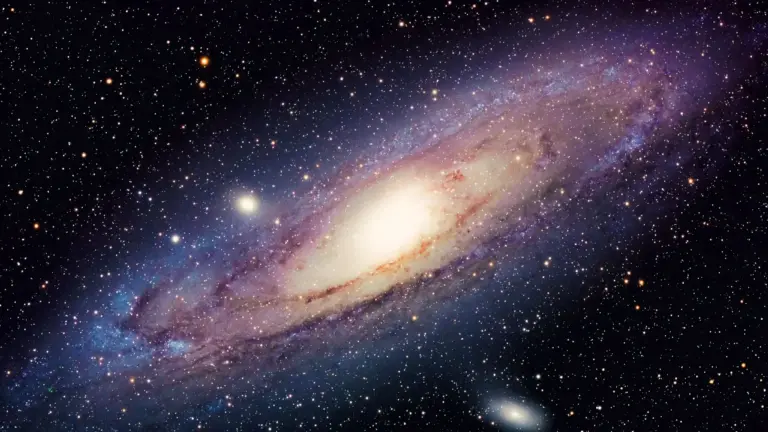
Located about 2.5 million light-years away, Andromeda is the closest large spiral galaxy to the Milky Way. It hosts hundreds of billions of stars and serves as a privileged observation ground to study their formation, evolution, and disappearance.
Modern astronomical instruments allow tracking brightness changes of certain stars in relatively nearby galaxies. By comparing observations made at different times, scientists can identify transient phenomena that would otherwise go unnoticed.
Understanding the end of stars’ lives
Stellar mergers contribute to the evolution of star populations. They can produce objects whose characteristics differ from ordinary stars and modify the distribution of matter in their environment. These phenomena particularly interest researchers studying the dynamics of binary systems.
The event reported in Andromeda will need to be characterized based on its observations and its evolution over time. It reminds us that galaxies are not static collections: stars are born, evolve, interact, and disappear within them. Each phenomenon of this type helps illuminate the mechanisms shaping the Universe.









Respond to the article
Be the first to comment on this article.