

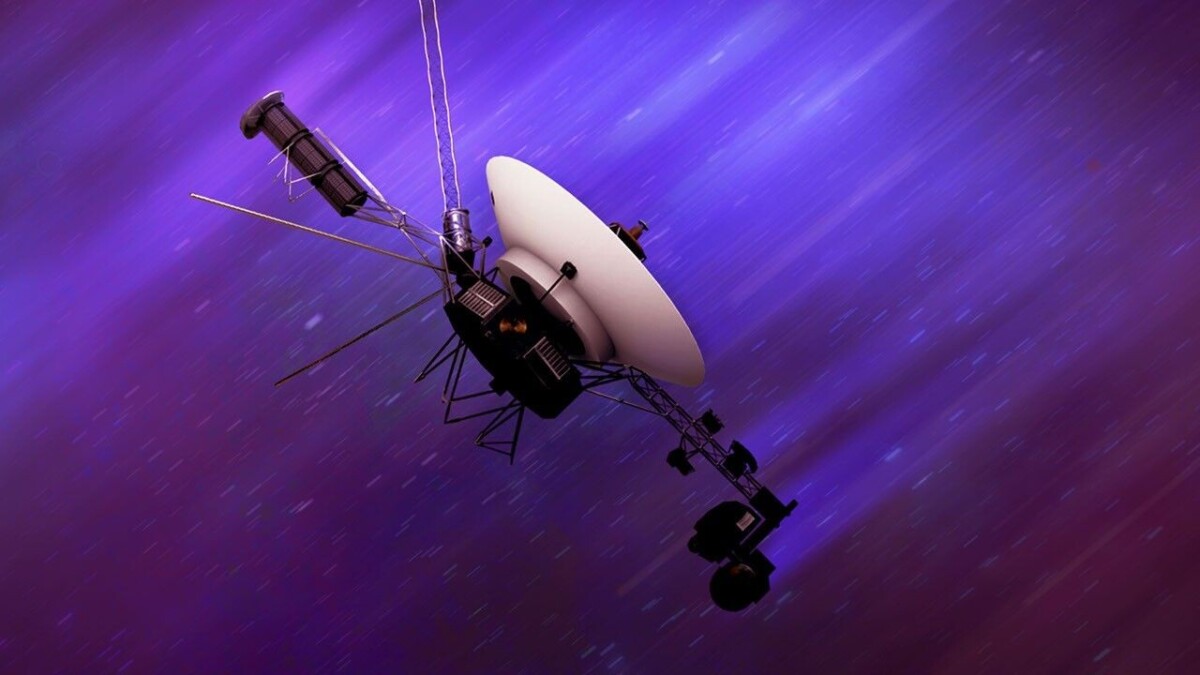
Nearly fifty years after its launch, Voyager 1 continues its extraordinary journey to the edge of space. Located about 26 billion kilometers from Earth, the American probe still transmits scientific information despite its age and the vast distance separating it from our planet. This historic NASA mission, launched in 1977, remains one of the greatest achievements in space exploration.
Launched on September 5, 1977, from Cape Canaveral, Florida, Voyager 1 initially aimed to study Jupiter and Saturn. The probe notably provided unprecedented images of these two gas giants and their moons, helping to transform scientific knowledge of the Solar System. After completing its primary mission, it continued its trajectory toward the most distant regions of our space environment. In August 2012, it became the first human-made object to cross the heliopause, the boundary beyond which the solar wind no longer dominates the surrounding medium. It now travels through interstellar space, while still far from the gravitational limits of the Solar System.
At a distance of about 26 billion kilometers, communicating with Voyager 1 is a true technical feat. A radio signal traveling at the speed of light takes nearly 24 hours to reach the probe from Earth, and the same amount of time for the return trip. Engineers must therefore wait nearly two days to receive a response to a command sent from ground facilities. Communications are handled by the Deep Space Network, an international network of large NASA antennas specially designed to maintain contact with the most distant space missions. Despite the weakness of the received signals, teams still manage to retrieve data from the functioning scientific instruments.
A Mission That Could Soon Fall Silent
The main challenge now concerns Voyager 1’s power supply. Unlike satellites equipped with solar panels, the probe uses radioisotope thermoelectric generators that produce electricity from the heat generated by the decay of plutonium-238. This energy source gradually decreases over time, forcing engineers to deactivate certain equipment to extend the mission. Several scientific instruments have already been shut down, while systems essential for communication and probe operation remain priorities. NASA hopes to maintain some observations as long as energy reserves allow, even though the end of scientific transmissions is inevitably approaching.
Voyager 1 also carries an iconic object: the Golden Record, a disc containing sounds and images intended to represent the diversity of life on Earth. It includes greetings in several languages, pieces of music, and recordings of natural phenomena. Designed as a symbolic message for potential extraterrestrial civilizations, this disc will continue its journey long after communications with Earth have permanently ceased. Even when it no longer has enough energy to transmit, Voyager 1 will continue its silent course through the galaxy. Nearly half a century after its departure, this small machine remains an exceptional testament to human curiosity and the will to explore the unknown.






Respond to the article
Be the first to comment on this article.