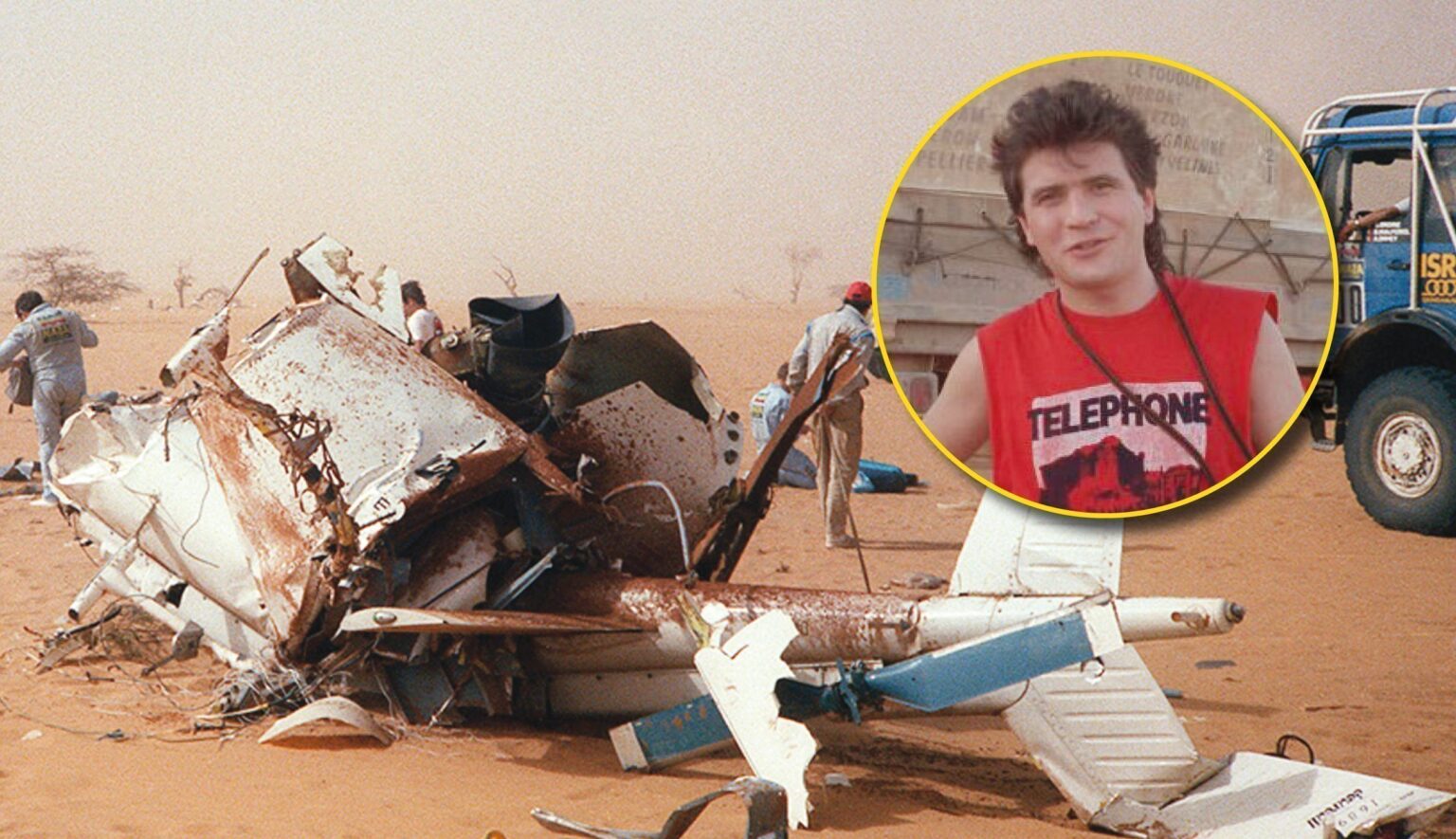
January 14, 1986, Mali. The date is etched in the history of the Paris-Dakar Rally as one of its most tragic episodes. On that day, Thierry Sabine , founder and director of the event, Daniel Balavoine , a singer committed to a humanitarian mission, helicopter pilot François-Xavier Bagnoud , journalist Nathalie Odent , and radio technician Jean-Paul Le Fur perished in a helicopter crash in the heart of the Sahel desert. Thirty years later, the meticulous circumstances of this tragedy continue to move and raise questions.
Morning of January 14, 1986: the beginning of a day that turned into tragedy
The day began early on the Niamey-Gourma-Rharous stage , the last major stage of the 8th edition of the Paris-Dakar Rally. Thierry Sabine gave the starting signal at dawn in a desert where a sandstorm was gradually picking up, progressively reducing visibility. Around 10:30 a.m. , Thierry Sabine and Daniel Balavoine met at Niamey airport , where they met with the governor of Mali to discuss the installation of water pumps as part of the Paris du Cœur humanitarian effort . These negotiations dragged on until early afternoon, while the operation's trucks were held up, slowing the progress of aid and supplies.
Shortly after 16:00 PM , the decision was made to return to Gao to follow the rest of the race from another strategic point. The organization's white helicopter, an Aérospatiale AS350 Écureuil registered F-GEAM , piloted that day by François-Xavier Bagnoud , was prepared for the flight; on board were to be Sabine, Balavoine, Odent, Le Fur, as well as the photographer Yann Arthus-Bertrand, who ultimately gave up his seat to Balavoine at Sabine's request, aware of the singer's media and symbolic importance in the humanitarian effort.
17:15 PM: Takeoff into the unknown
It is just after 17:15 p.m. when the helicopter leaves Gao bound for Gourma-Rharous , the village that will host the finish of the stage. There are still some 250 kilometers to cover , but the weather conditions are deteriorating rapidly. Daylight is fading, the sandstorms are intensifying, and the aircraft, although robust, is not equipped for night or instrument flight . Despite this, the flight continues, the pilot initially following the Niger River to maintain a more reliable visual reference in the shifting desert.
18:10 PM: First stop in Gossi: a harbinger
Around 18:10 PM , the pilot deemed it prudent to land in Gossi , about a hundred kilometers before the planned bivouac. The wind was blowing strongly, grains of sand were whipping across the desert, and night was approaching faster than expected. Sabine chatted briefly with some competitors already on the ground. The situation was already considered precarious, but the determination to reach the bivouac remained undiminished.
Around 19:00 PM: a second, uncertain attempt
Daylight was fading fast. Conditions were becoming decidedly hostile for air navigation, with visibility almost zero. Around 19:00 PM , the pilot decided to make a voluntary landing about 22 kilometers before Gourma-Rharous , as continuing the flight in those conditions was deemed too dangerous. Thierry Sabine, eager to rejoin the caravan, got out of the helicopter and, according to several accounts, intercepted a racing car —the one driven by Pierre Lartigue and Bernard Giroux —to ask them to report his position to the bivouac and send a rescue vehicle. The atmosphere was tense, even nervous, as darkness now enveloped the desert.
This moment is crucial. The aircraft is stationary. A safe plan to complete the leg seemed to be in place. Yet, for a reason that remains unknown (a desire not to waste time, tension between Sabine and her pilot, a bite or sting requiring emergency care), the helicopter takes off again even though it is not designed for night flight.
19:15 PM – 19:20 PM: The Illusion of Headlights and the Crash
As the passengers prepared to wait for the promised vehicle, the helicopter climbed back into the air, its only visual reference on the ground being the taillights of a Mitsubishi Pajero 4x4 driven by Charles Belvèze and Jacquie Giraud , the race vehicle making its way towards the bivouac. The pilot navigated at almost very low altitude , in total darkness, guided by this single point of light, hoping to gain a few minutes and reach the destination on foot.
Unfortunately, this strategy proved tragically perilous. Without any other reference instrument, the helicopter followed the 4x4's trajectory. But the vehicle, along the way, skirted a slight incline or subtly extended dune , invisible to the pilot under these conditions. The helicopter skimmed the ground, its skids grazing the crest of this overlooked rise three times—not large enough to be clearly visible, but enough to become a deadly obstacle. Disoriented, the helicopter finally crashed into a dune around 19:20 p.m. , just eight kilometers from the bivouac , after following the vehicle's lights without being able to adjust its trajectory accordingly.
The helicopter passengers were killed instantly
The helicopter crashed with extreme violence. It disintegrated over several dozen meters in the sand, leaving no survivors: Sabine, Balavoine, Bagnoud, Odent, and Le Fur died instantly. At the scene, rescuers and the competitors present were initially incredulous, then horrified, discovering a pile of debris and bodies that had to be identified by the light of their lamps.
In France, news of the crash only reached the following morning, sending shockwaves through the media and among the public. Reactions, tributes, and questions poured in. The already legendary race became an emblematic tragedy, forever marking the history of the Paris-Dakar Rally.
A memory that remains ever-present
Thirty years later, the exact circumstances of the final takeoff remain partly debated, fueling stories, documentaries, and analyses. But the sequence of decisions on January 14th, the attempted flight in the dark, the reliance on a fragile visual reference point, the invisible dune in a hostile desert, continues to be considered the determining factor in the crash. The victims, starting with Daniel Balavoine , an artist renowned for his social activism, and Thierry Sabine , a tireless adventurer, remain immortal figures of the Paris-Dakar Rally and of human adventure.