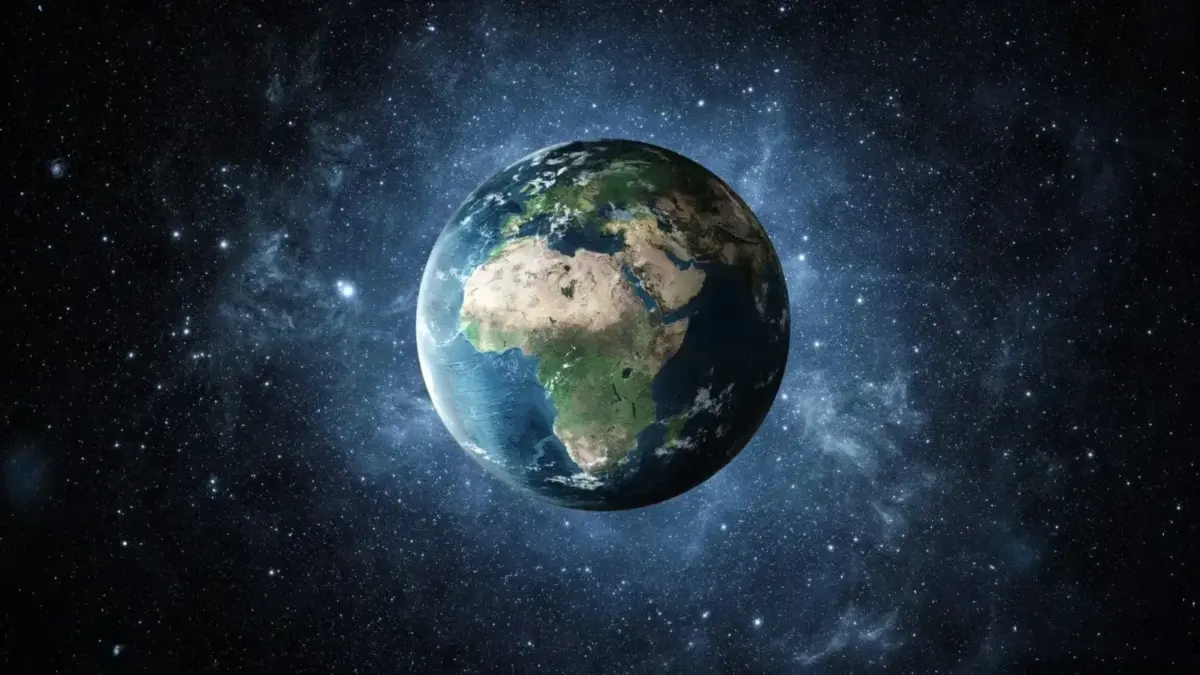
What if the Earth suddenly stopped rotating? Behind this hypothesis, worthy of a science fiction film, lies a scenario with devastating consequences. Our planet completes a full rotation in approximately 24 hours, carrying with it the oceans, the atmosphere, and all living beings. At the equator, its surface moves at nearly 1,670 kilometers per hour. If this movement were to stop instantaneously, the laws of physics would cause considerable upheaval: destructive winds, massive ocean shifts, and profound climate transformations. While such an event has no known natural cause for sudden occurrence, studying it allows us to better understand the balance of our planet.
The first consequence of a sudden halt in the Earth's rotation would be related to the principle of inertia. Today, continents, oceans, buildings, and human beings rotate with the Earth without directly experiencing this movement, since they generally share the same rotational speed. At the equator, this speed reaches approximately 1,670 kilometers per hour, then gradually decreases as one approaches the poles. If the ground were to stop instantaneously without an equivalent force simultaneously halting everything on its surface, objects not securely anchored would retain their initial velocity. The consequences would be particularly severe in equatorial regions, where relative displacements could reach several hundred meters per second. Buildings, infrastructure, and many landscape features would then be subjected to extreme mechanical stresses. Polar regions would be less affected by this direct effect, as their rotational speed around the Earth's axis is much lower.
The atmosphere and oceans would represent another major source of destruction. If the Earth's rotation were to stop while the air continued its initial motion, winds of extraordinary violence could sweep across a large part of the planet. These phenomena would be unlike any storm currently observed, although their actual intensity would depend on the exact conditions of this hypothetical halt. The oceans, also subject to inertia, would continue to move and could cause massive flooding on many coastlines. Immense quantities of water would be set in motion, resulting in destructive waves and rapid changes to coastal environments. Contrary to the simplified representations sometimes used in films, this would not be a single wave uniformly circling the globe: the phenomena would depend on the geography of the ocean basins, the topography, and the manner in which the rotation would have been interrupted.
Days lasting several months and a redistribution of the oceans
If the Earth were to remain stationary relative to its axis of rotation while continuing to revolve around the Sun, the alternation between day and night would be profoundly transformed. In this scenario, a large part of the planet would experience periods of sunlight and darkness lasting for several months. The complete solar cycle would last approximately one year, instead of the current 24 hours. Regions exposed to prolonged sunlight could experience particularly high temperatures, while those plunged into long nights would experience significant cooling. The magnitude of these variations would, however, depend on atmospheric circulation, the distribution of the oceans, and the tilt of the Earth's axis. Weather systems would also be transformed, as the disappearance of rotation would eliminate the Coriolis effect, which is currently responsible for part of the organization of winds and ocean currents. The seasons would still exist if the Earth's tilt and its orbit around the Sun remained unchanged, but their effects would combine with a radically different day-night cycle.
In the longer term, a halt in Earth's rotation would also alter the planet's shape and the distribution of its oceans. Earth is not perfectly spherical: it has a slight bulge at the equator, due in particular to the effects of its rotation. Without this rotation, the centrifugal force would disappear, and the planet would gradually tend toward a more spherical shape under the influence of gravity and the deformation of its materials. This transformation would not be instantaneous and could be accompanied by significant geological readjustments. The relative sea level would also change, with a tendency for water masses to shift toward higher latitudes, although the exact geography of the newly submerged areas would depend on numerous factors. Terrestrial and marine ecosystems would face profound transformations, to which many current species would struggle to adapt. Fortunately, this scenario remains purely theoretical. The Earth's rotation does slow down over very long periods, particularly due to gravitational interactions with the Moon, but this change is measured on minute scales and suggests no sudden halt. Our planet will therefore continue to rotate for considerable lengths of time, maintaining the natural cycles essential to life as we know it.